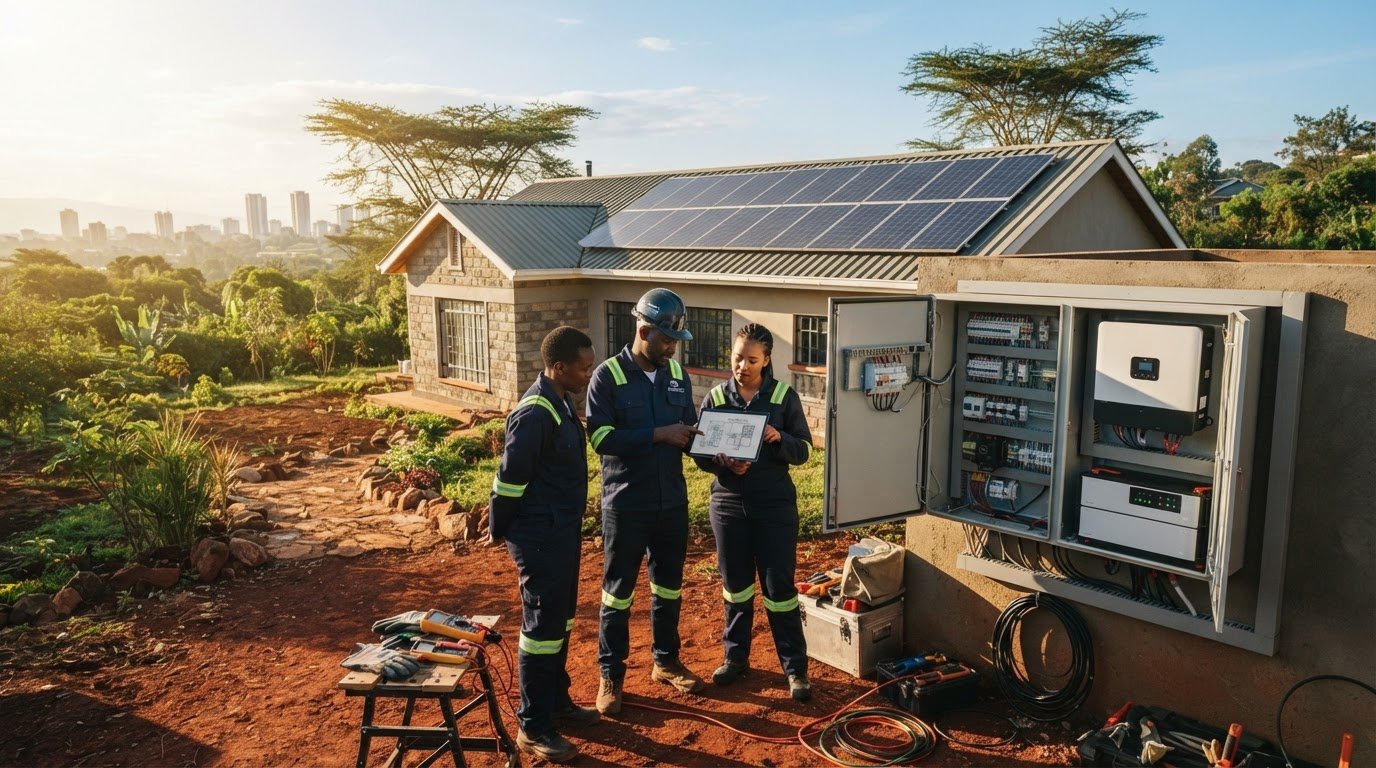
The right solar system is rarely the one with the most panels. For solar installation Kenya projects, measured energy use, site conditions and operating priorities should guide the design, not a headline capacity or equipment list. A system that overlooks peak loads, backup needs or existing electrical infrastructure may not support the way a home, business, farm or institution operates.
Choosing a system can feel complex because grid-tied, hybrid and off-grid configurations serve different needs. Storage, electrical integration and commissioning also affect how the system performs as a whole. Solar Man Power Solutions Ltd approaches solar PV and energy storage as an engineered installation, starting with energy audits and load profiles.
This guide explains what information supports a sound design, how to compare system configurations with your operational needs, and what to expect during specification, installation and commissioning. It also covers how monitoring, maintenance and upgrades support ongoing operation. Use it to assess a complete solar project, from measured demand and site assessment to lifecycle support.
Key Takeaways
- A complete solar project includes more than PV modules. Understand how the inverter, mounting, protection, cabling and optional storage work together.
- Use energy consumption in kWh and peak demand in kW to prepare a practical design brief for solar installation Kenya.
- Compare grid-tied, hybrid and off-grid configurations against your site infrastructure, load profile and continuity requirements.
- Plan for assessment, engineering, electrical integration, testing and handover as connected stages of project delivery.
- Energy audits, site conditions and operational priorities shape a tailored solar project for homes, businesses, farms and institutions.
Solar installation in Kenya: what a complete project includes
A solar installation is a coordinated project: assess energy demand and site conditions, engineer a suitable system, integrate it with the property’s electrical infrastructure, install the equipment and verify operation. Buying PV modules alone does not complete the job. The modules generate direct-current electricity, while other components manage, convert, protect, mount and distribute power for its intended use.
A successful solar installation is designed around verified loads, assessed site conditions and clear operating objectives, then installed and tested as an integrated power system. This is a practical standard for solar installation Kenya projects, whether the priority is daytime energy use, backup for essential loads or operation beyond the reach of the grid.
A complete system may include PV modules, a mounting structure, an inverter, cabling, electrical protection, switchgear and, where required, battery storage. Every component must suit the system architecture and the property’s electrical characteristics. For example, an inverter selected without regard to the loads may not support the required operating profile. Mounting must also suit the roof or ground location and allow safe installation and maintenance.
Priorities differ by application. A home may prioritise household loads and selected backup circuits. A commercial site may need a design that accounts for operating schedules, peak demand and continuity for critical equipment. Farms may have distributed loads or equipment with set operating periods, while institutions may need coordinated power for multiple buildings and essential services. These differences affect system design, equipment selection and whether storage is appropriate.
What is included in a solar PV installation?
A complete scope typically follows these connected stages:
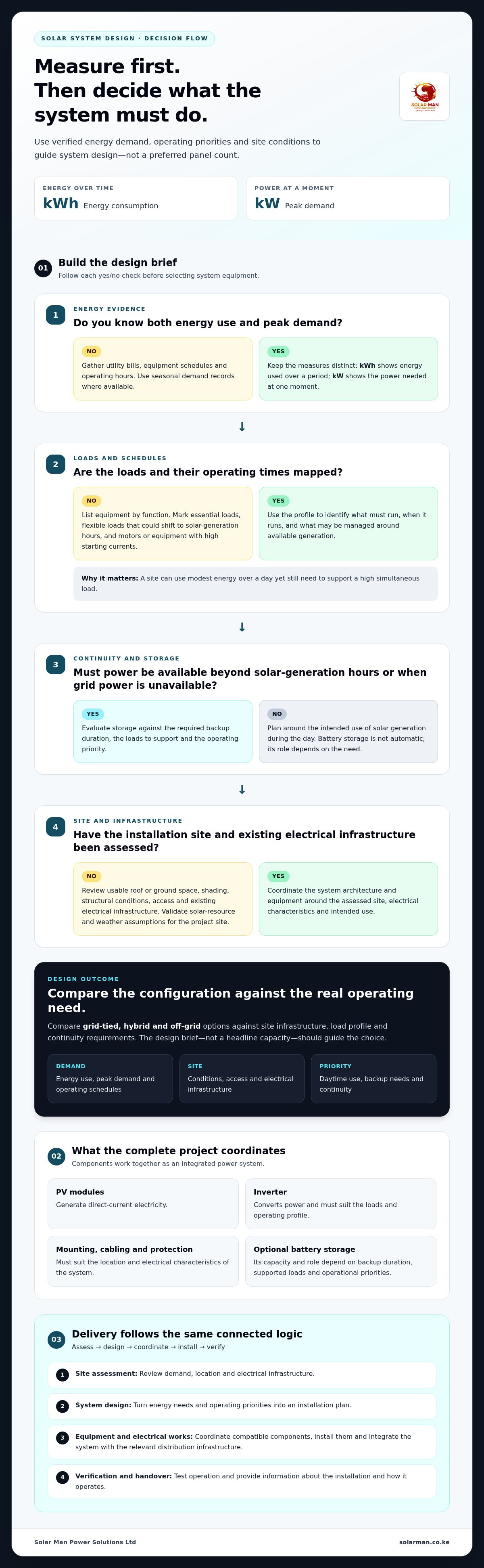
- Site assessment: Review usable roof or ground space, shading, structural conditions, access, electrical infrastructure and the system’s intended use.
- System design: Turn energy needs and operating priorities into a system architecture and installation plan.
- Equipment selection: Coordinate modules, inverter, mounting, protection, cabling and any storage as compatible system elements.
- Electrical works and installation: Mount equipment, complete electrical integration and connect the system to the relevant distribution infrastructure.
- Verification: Test system operation and provide handover information so the owner understands the installation and how it operates.
Battery storage is not automatic. Its capacity and role should reflect the required backup duration, the loads to be supported and operational priorities. A system focused on using solar generation during the day may need a different storage setup from one intended to support critical loads when grid power is unavailable. For more on matching storage to demand and backup priorities, see this guide to energy storage systems in Kenya.
Why Kenyan projects need site-specific planning
Usable roof or ground area, shading, structural suitability, installation access and the condition of existing electrical infrastructure all affect system design. Solar resource and weather assumptions also need validation for the project site rather than being treated as identical across the country. Solar power in Kenya provides broader context on the country’s solar development, but system decisions still depend on a site assessment.
Solar Man Power Solutions Ltd designs and installs systems for homes, businesses, farms and institutions across Kenya. Its project planning connects energy audits and load profiles with site conditions and budget, so equipment selection follows the application rather than dictating it.
How solar system design turns energy needs into an installation plan
A practical design starts with how electricity is used, not with a preferred panel count. Document the loads, review operating schedules, assess the site and electrical infrastructure, select the system architecture, then coordinate the equipment. Each stage helps define a system that can meet its actual duty.
Load profiles and peak demand shape system design because they show both how much energy is used over time and the maximum power required at once. Energy consumption, measured in kilowatt-hours (kWh), describes usage over a period. Peak demand, measured in kilowatts (kW), describes the power needed at a particular moment. A site can have modest daily consumption but still need a system capable of supporting a high simultaneous load.
Which energy data should a solar design use?
Gather utility bills, equipment schedules, operating hours and, where available, records of seasonal changes in demand. List equipment by function and identify essential loads, flexible loads that can shift to solar-generation hours, and motors or other equipment with high starting currents. This makes it easier to establish what must run, when it runs and what can be managed around available generation.
An energy audit can clarify consumption patterns and identify efficiency opportunities before system capacity is set. For example, a business that runs refrigeration throughout the day has a different load profile from one whose main demand occurs after working hours. A farm’s pumping schedule may also determine whether generation should align with daytime operation or storage should support a separate operating period.
Keep four design questions distinct: how much energy can be generated during the day, how much demand occurs in the evening, how long backup is required, and which loads need priority during an outage. These inputs affect PV capacity, inverter selection, battery requirements and the circuits included in backup. They also help avoid treating every appliance or process as equally critical.
How site conditions and electrical infrastructure affect design
A site assessment checks usable mounting area, orientation, shading, structural suitability and access for installation and maintenance. Cable routes matter too: their length and pathway affect where equipment can be positioned and how it can be integrated. Solar resource and weather assumptions should be validated for the specific project rather than applied uniformly across Kenya.
An electrical review examines the existing distribution arrangement, switchgear, earthing and connection points for solar systems on the AC and DC sides. This helps identify integration requirements and infrastructure considerations for the project scope. The design must coordinate generation, conversion, protection and distribution as one system.
Project planning can also be considered alongside broader national priorities. The International Energy Agency’s summary of Kenya’s National Energy Policy 2025-2034 highlights electricity access, renewable energy and energy efficiency. For an individual solar installation Kenya project, however, engineering decisions still need to follow measured loads and verified site conditions.
For a project-specific design assessment, discuss your load data, operating priorities and site requirements with Solar Man Power Solutions. The company tailors solar PV and storage designs to energy needs, site conditions and budget.
Grid-tied, hybrid, or off-grid solar installation: how to compare
System architecture determines how solar generation, the grid and energy storage work together. The right choice depends on the property’s electrical infrastructure, how it will interact with the grid, its load profile and the required continuity of supply. No configuration is right for every site: each serves different operating conditions.
| Configuration | Grid connection | Storage | Backup behaviour | Operating priorities and design implications |
|---|---|---|---|---|
| Grid-tied | Operates alongside an existing grid connection. | Not inherent to the configuration. | Outage support depends on the system architecture and equipment. A standard grid-tied arrangement should not be assumed to provide backup. | May suit sites prioritising solar use while retaining a grid connection. Design must account for load profile, electrical integration and applicable interconnection requirements. |
| Hybrid | Combines solar with a grid connection. | Can include storage. | Can support selected loads during an outage when designed and configured for that function. | May suit sites balancing grid interaction with backup priorities. Design coordinates generation, inverter, storage, circuits and required backup duration. |
| Off-grid | Designed to operate without reliance on a grid connection. | Storage is central to planning supply beyond generation periods. | Continuity depends on system capacity, stored energy, available generation and load management. | May suit sites without grid access or with a defined independent-supply objective. Generation and storage must be engineered around demand and autonomy needs. |
When a grid-tied solar system may fit
A grid-tied system may suit a property where an existing connection remains part of the operating plan and solar generation is intended to serve site loads. Its behaviour during an outage depends on the architecture and equipment configuration. Specify backup as a design requirement rather than assuming solar panels provide it. Grid interaction, export arrangements and interconnection procedures should follow current Kenya Power and Energy and Petroleum Regulatory Authority requirements.
When hybrid or off-grid design may fit
A hybrid system can coordinate solar, grid supply and storage when a site needs both grid interaction and support for selected loads during an outage. Battery capacity should reflect the loads to be supported and the required backup duration. Prioritising essential circuits, rather than backing up every load, can help align the design with operational needs.
An off-grid system needs a different planning basis because generation and storage must work together to serve loads when solar production is unavailable or reduced. The design should account for demand patterns, autonomy requirements and load management. Farms, remote facilities or other sites without a grid connection may have distinct operating profiles that affect the system specification.
For any solar installation Kenya project involving a grid connection, include current interconnection and compliance requirements in the design. Solar Man Power Solutions designs hybrid, grid-tied and off-grid systems around site infrastructure, load profiles and continuity priorities, aligning the architecture with the way the property needs to operate.
Solar installation in Kenya: project delivery, safety, and commissioning
A well-engineered design needs controlled site work, safe electrical integration and documented verification. A solar installation Kenya project typically moves from confirming the design and preparing the site to mounting equipment, completing electrical connections, testing system operation and handing over the installation.
Qualified installation and documented commissioning support safe, dependable operation by confirming that equipment is correctly integrated, functional checks are recorded and users understand the system. Each stage matters. Secure mounting supports the physical installation, while planned cable routes and electrical distribution connect PV generation, conversion equipment, storage where specified and the property’s loads.
What happens during solar installation and commissioning?
After the design is approved, site preparation establishes equipment locations, access and installation requirements. Technicians then install the mounting structure and PV modules, position the inverter and any specified storage, and complete the required DC and AC connections. Electrical integration coordinates cabling, switchgear, protection devices and earthing. Safe routing and separation of circuits help keep the installation organised and accessible for inspection and maintenance.
Solar Man Power Solutions uses qualified technicians and installs systems to industry standards. Commissioning follows installation and includes functional checks of system components and their interaction, verification of electrical connections, and a review of monitoring arrangements. The aim is to identify installation issues and confirm that the system operates as designed, rather than treating a simple switch-on as proof of completion.
A responsible handover gives the owner relevant system documentation and practical operating information. This can include the installed system configuration, equipment information, monitoring access or setup instructions, and guidance on normal operation and maintenance. For a business or institution, clear handover records also support facilities staff responsible for ongoing oversight.
What maintenance supports system performance over time?
Maintenance is an ongoing part of system ownership, not a one-time check. Its scope and timing depend on system design, equipment, site conditions and the operating environment. A maintenance plan may include periodic inspection of modules, mounting, cabling, electrical connections and protection components, alongside performance monitoring to help identify changes that need investigation.
When monitoring or operational checks indicate a fault, diagnosis should establish the cause before repairs begin. Issues may involve an individual component, an electrical connection or a change in site conditions, so corrective work should follow the system design and be verified after completion. Maintenance can also identify when an upgrade is appropriate, such as when load requirements or operating priorities change. Solar operations and maintenance, repairs and system upgrades help keep support aligned with the asset’s condition without assuming a fixed efficiency loss or guaranteed output.
For an installation that includes engineering, electrical integration and a defined handover, discuss your solar installation project with Solar Man Power Solutions.
Plan a solar installation with Solar Man Power Solutions
Solar Man Power Solutions Ltd designs and installs solar PV and energy storage systems for homes, businesses, farms and institutions across Kenya. Each project is scoped around the site’s energy requirements, operating priorities, physical conditions and budget. This engineering-led process connects the system architecture and equipment to how the property uses power, rather than treating an equipment list as a complete project plan.
The project scope can include solar PV, energy storage, hybrid, grid-tied or off-grid configurations, backup for critical loads and the electrical works needed to integrate the system. Monitoring and maintenance support operational oversight after installation. For solar installation Kenya projects, these elements are coordinated to suit the application, whether the priority is managing energy use, supporting selected loads during outages or operating without a grid connection.
What information helps scope a solar project?
Useful project information gives the design team a practical view of demand and site conditions. Prepare recent energy bills and an equipment list, including the main loads and their operating hours. Note which loads are essential, which can be scheduled flexibly, and whether any equipment has a high starting current. Describe any demand changes linked to seasons or production cycles.
- Operating requirements: Share daily schedules, periods of peak use and critical-load priorities, including the equipment that must continue operating during an interruption.
- Site and electrical details: Describe available roof or ground installation area, shading or access constraints, existing distribution infrastructure and current backup arrangements.
- Project objective: Explain whether the goal is energy management, backup for selected circuits, greater energy independence or a combination of priorities.
- Budget context: State the budget parameters so the proposed scope can reflect project priorities and practical constraints.
These details connect an energy audit and load profile to the site assessment and system specification. If complete records aren’t available, a clear description of equipment, schedules and operational priorities still provides a useful starting point.
How Solar Man supports a project beyond installation
Design, equipment coordination, installation and electrical integration are connected parts of project delivery. Solar Man’s work also includes energy storage, backup and critical power, as well as monitoring, maintenance, troubleshooting, repairs and upgrades. This lifecycle support is useful when operating needs change, monitoring indicates an issue for diagnosis, or an existing installation needs review and improvement.
Start by gathering the available energy and site information, then define the operational objective and critical loads. This gives project planning a clear technical basis and helps align the scope with the property’s requirements.
Discuss your solar installation requirements with Solar Man to start a project-specific conversation about your site, loads and priorities.
Move from solar planning to a defined project
Turn your energy assessment into a clear project brief. Record current operating priorities alongside anticipated changes, such as additional equipment, longer operating hours or new critical loads. Considering these possibilities early can keep the design discussion focused on the system’s intended role and potential future requirements.
For solar installation Kenya projects, the brief should connect energy needs, site conditions, load profiles and budget to a practical scope. Solar Man Power Solutions brings these considerations into project design, with qualified technicians installing systems to industry standards. Its capabilities span solar PV, energy storage, electrical works, monitoring, maintenance and upgrades, supporting project delivery and ongoing system management.
A clear starting brief does not need to resolve every technical detail. Identify the property, its main loads, the operating objective and any changes that could affect demand. From there, the project can move toward a tailored design and installation plan. Discuss your solar installation requirements with Solar Man Power Solutions and take the next step toward a system planned for your operational needs.
Frequently Asked Questions
How does solar installation work in Kenya?
Solar installation in Kenya begins by documenting energy use and operating priorities, then assessing the property and designing a suitable configuration. Once the equipment and installation plan are established, technicians complete the electrical integration and functional checks before handover. For a home, list loads such as refrigeration, lighting and water pumping, and note which need to operate together. A business should also record operating hours and critical processes so the system scope reflects actual use.
How do I determine the right solar system size for my home or business?
Base system size on measured electricity use, the equipment expected to run at the same time and the loads that need support during an outage. Review utility bills alongside an appliance or equipment inventory, including operating hours and anticipated additions. For example, if a pump starts while refrigeration is running, the design needs to account for simultaneous demand and the pump’s starting requirement. An energy audit can clarify consumption patterns before capacity is specified.
Can solar panels work during a power outage in Kenya?
Solar panels alone don’t necessarily keep a property powered during an outage. A standard grid-tied system generally stops supplying the property when the grid fails unless it has been specifically designed and configured for backup operation. A hybrid system with storage may support designated circuits, depending on its equipment and design. Identify the appliances or processes that must remain available, then define how those loads should be supplied when grid power is absent.
What is the difference between grid-tied, hybrid, and off-grid solar?
Grid-tied systems operate alongside an existing electricity connection, while hybrid systems combine solar with grid supply and may include batteries for backup. Off-grid systems are designed to operate without reliance on a grid connection. A property with a stable connection and daytime demand may consider grid-tied solar; one requiring selected outage support may consider hybrid; a site without grid access needs an off-grid design based on its energy and autonomy requirements.
Do I need batteries with a solar installation?
No, batteries aren’t required for every solar installation. They are useful when the system needs to store energy for later use, support selected loads during an outage or meet an operating requirement beyond solar-generation hours. A property that mainly uses solar power during the day while retaining grid supply may have different storage needs from a site requiring evening backup. Base the decision on intended use, critical loads and required backup duration.
How long does a solar installation take in Kenya?
There isn’t one reliable duration for every solar installation Kenya project. Timing depends on the system scope, site access, mounting requirements, equipment coordination and the amount of electrical integration involved. A straightforward installation and a project involving substantial infrastructure work have different schedules. Before work begins, plan the assessment, site preparation, equipment installation, electrical connection, testing and handover around the project’s requirements and any site constraints that could affect sequencing.
What should be checked after a solar system is installed?
Confirm that the installed equipment matches the agreed design, monitoring is set up and system status and expected functions have been reviewed. The handover should explain normal operation and provide relevant system documentation. Make sure the owner or facilities team understands which circuits receive backup, how to view system information and how to report a fault. These checks establish a clear operational baseline for future monitoring and maintenance.