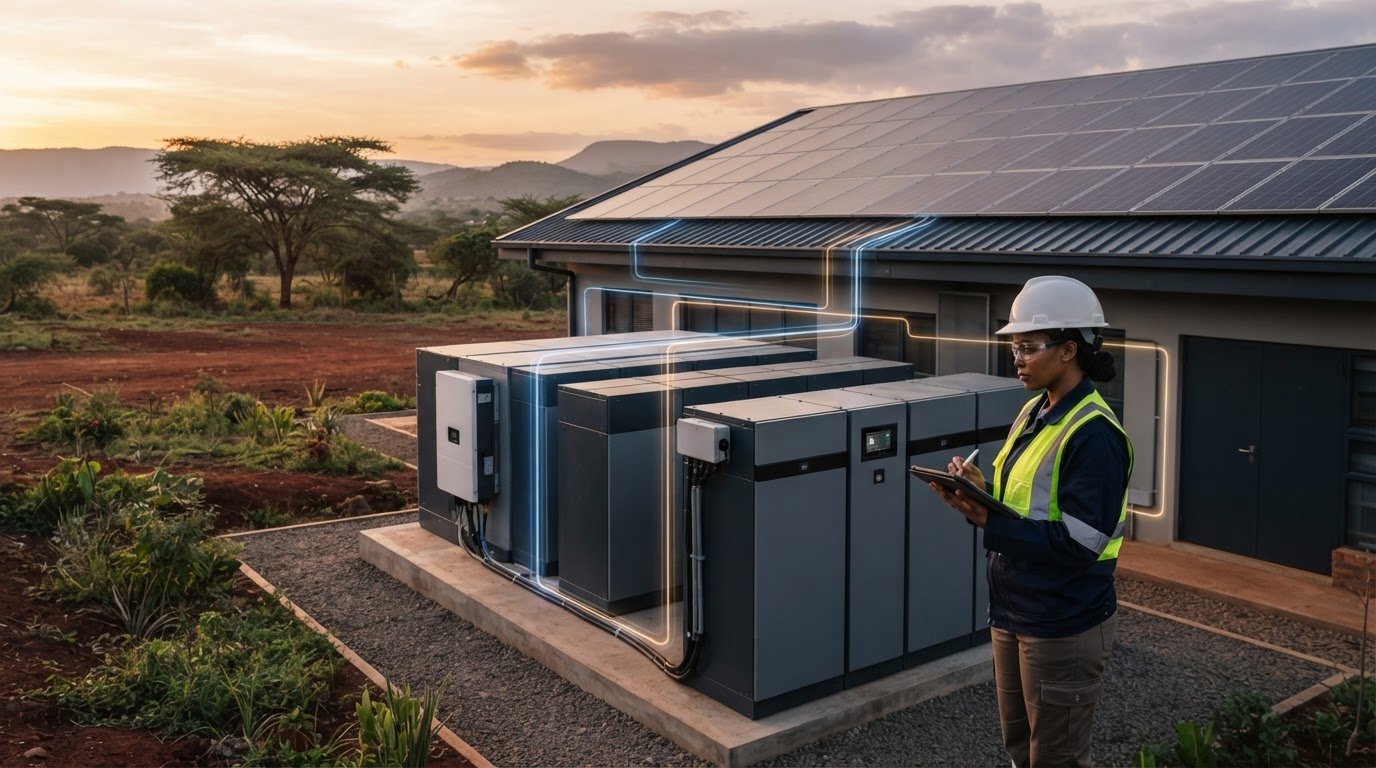
Battery capacity alone doesn’t determine whether a storage project will perform. The right energy storage systems Kenya sites need depend on the project’s purpose, the site’s actual load profile, and how storage will work with solar PV and existing electrical infrastructure.
It’s reasonable to focus on battery size when comparing options, but a system that doesn’t match demand may leave critical loads unsupported or provide capacity the site cannot use effectively. Storage can shift available energy to the periods when it’s needed. What it can do depends on the configuration, operating patterns, and power sources connected to it.
This guide explains how energy storage fits into a site power system and what information helps shape a suitable design, including load data, backup priorities, solar generation, and site conditions. It also shows how assessment, engineering, installation, monitoring, and maintenance fit together across a project. Whether you’re planning for a home, business, farm, or institution, you’ll find a practical basis for choosing an approach around operating requirements rather than battery capacity alone.
Key Takeaways
- Understand how energy storage systems Kenya projects use store electricity and support specific operating priorities.
- See how battery storage, solar PV, inverters, and existing electrical infrastructure work together in a site power system.
- Compare backup, load shifting, peak shaving, and solar self-consumption against your site’s loads and priorities.
- Use energy bills, interval data where available, load schedules, and outage priorities to prepare for a project assessment.
- Learn how Solar Man develops storage projects around energy needs, load profiles, site conditions, and budget, from engineering through installation and ongoing system support.
Energy Storage in Kenya: Functions and Value
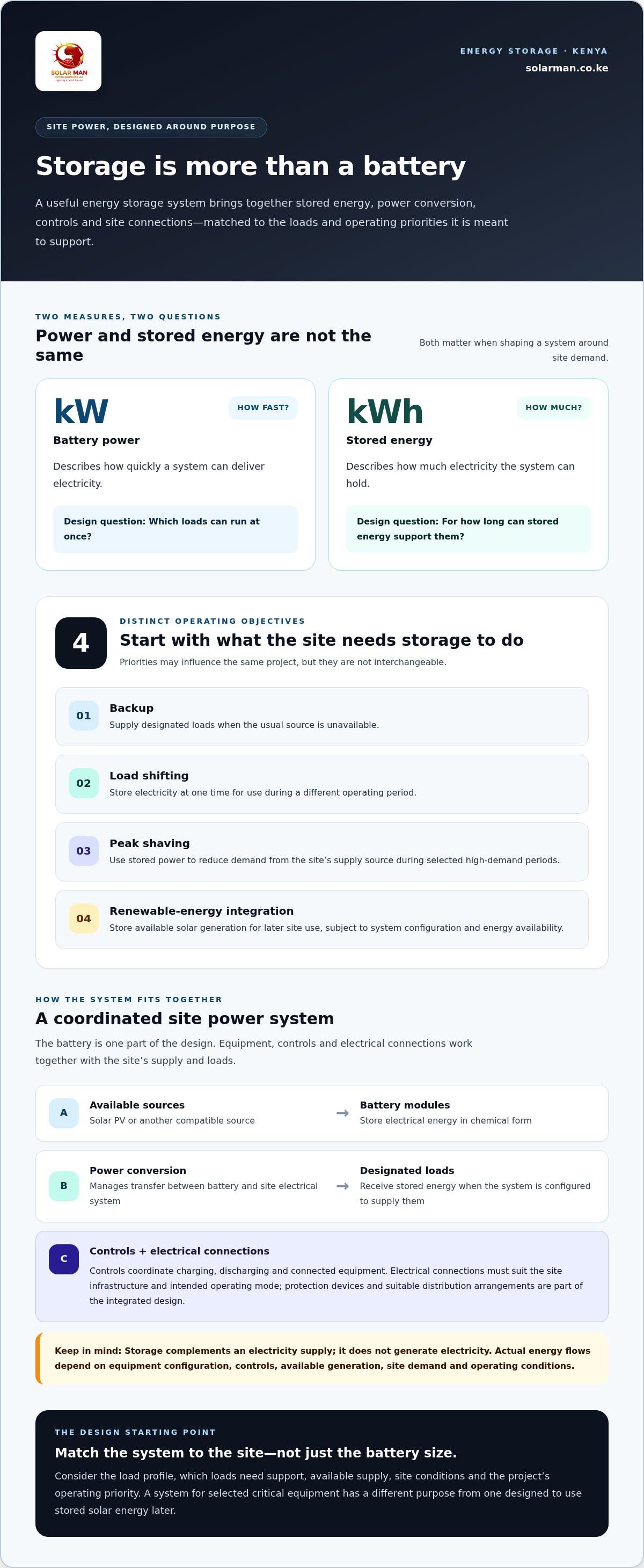
Energy storage systems Kenya projects use hold electricity for later, according to the site’s operating priorities. An energy storage system (ESS) combines storage equipment, power conversion, controls, and electrical connections. At a customer site, it operates within the home or facility’s power system. Grid-scale battery energy storage systems (BESS), by contrast, support electricity networks and manage energy at a much larger system level. The basic principle is similar, but the users and operating requirements differ.
Battery power describes how quickly a system can deliver electricity; stored energy describes how much electricity it can hold. Power is commonly expressed in kilowatts (kW), while energy is expressed in kilowatt-hours (kWh). Both matter, but they answer different design questions: which loads can run at once, and for how long can stored energy support them?
What an energy storage system does at a customer site
A battery stores electrical energy in chemical form. Power conversion equipment manages the transfer between the battery and the site’s electrical system. Controls coordinate charging, discharging, and interaction with connected sources and loads. Electrical connections must suit the site infrastructure and intended operating mode. Together, these components form a system, rather than a battery operating on its own.
Storage complements an electricity supply; it does not generate electricity. It can store energy from solar PV or another compatible source, then make that energy available for a defined use. Its design and operation depend on the load profile, the loads to be supported, available supply, and site priorities. A system intended to support selected critical equipment has a different purpose from one designed to use stored solar energy later in the day.
Customer-site storage is different from Grid energy storage, which stores electricity to support the wider power network. The distinction clarifies whether a system serves a household or facility’s operations, or the electricity grid.
Why Kenyan organisations assess storage
Homes, businesses, farms, and institutions assess storage for different operating reasons. A household may prioritise continuity for selected essential loads. A business may want to keep defined processes operating or manage when it draws energy. A farm may need to align stored supply with equipment schedules, while an institution may plan around critical services and varied building loads. These are planning objectives, not guaranteed outcomes. Performance depends on system design, available energy, and operating conditions.
Four objectives should be kept distinct:
- Backup: supplying designated loads when the usual source is unavailable.
- Load shifting: storing electricity at one time for use during a different operating period.
- Peak shaving: using stored power to reduce the site’s demand from its supply source during selected high-demand periods.
- Renewable-energy integration: storing available solar generation for later site use, subject to system configuration and energy availability.
These priorities can influence the same project, but they are not interchangeable. Identifying the main operating objective gives the assessment a clear starting point and helps determine how storage should fit the site’s wider power system.
How battery energy storage systems work with solar PV and site power
A battery energy storage system coordinates electricity from available sources with a site’s demand. In a solar installation, PV panels generate electricity, conversion equipment conditions it for use, and connected loads consume it. Depending on the design and control settings, available energy can also charge the battery. Later, the battery discharges through the conversion equipment to supply designated loads or support the wider site system.
The precise route depends on the equipment configuration and electrical layout. Solar generation may serve operating loads first, with available energy directed to storage according to system settings. If demand exceeds generation, the system may draw on stored energy or another configured supply source. When solar generation is unavailable, storage may supply loads within its operating limits. Design, controls, and the energy available at the time govern these flows.
The main components and their roles
Battery modules store energy. An inverter or other power-conversion equipment manages electrical transfer between the battery and the site, while controls govern operating modes and coordinate equipment. Protection devices are part of the design and address electrical fault and equipment protection requirements.
These components must connect correctly to the site’s distribution system. Electrical works, including suitable distribution arrangements and earthing, belong in the integrated design, not as details to consider only after equipment selection. A site assessment helps establish how storage can connect with existing infrastructure and which loads it is intended to serve.
How storage operates alongside solar and the grid
System configuration controls charging and discharging. Charging can draw on solar generation or another compatible source, depending on the design and settings. Discharging makes stored energy available to connected loads when configured to do so. Solar output, current site demand, and the battery’s available stored energy all affect how electricity flows at a given time.
Two ratings describe different capabilities. Discharge power, generally expressed in kilowatts (kW), indicates the rate at which the system can deliver electricity. Stored energy, expressed in kilowatt-hours (kWh), describes the amount available for use. Neither figure alone describes the whole operating outcome, because loads and control settings also matter.
A battery’s capacity alone cannot establish backup duration, because both the energy available to loads and the rate at which those loads draw power affect how long stored energy can support them. For example, a site supplying only selected essential equipment uses energy differently from one supplying a wider range of operating loads. The intended load group and operating priorities should therefore inform configuration.
For energy storage systems Kenya projects, effective integration depends on matching conversion equipment, controls, protection, and electrical connections to site requirements. Solar Man’s solar and storage system design brings these engineering considerations into the project plan.
Which energy storage application fits your Kenyan site?
The right application depends on what the site needs storage to do, how its loads operate, and which services are critical. A home prioritising essential circuits has a different objective from a farm scheduling equipment use or a commercial facility managing demand peaks. Energy storage systems Kenya projects should begin with the operating purpose, not a preferred battery size.
The comparison below connects each objective with site conditions that may make it relevant. Applications can overlap, but combining them may change operating priorities and system design.
| Application | Operating objective | Example site consideration |
|---|---|---|
| Backup | Support selected loads when the usual supply is unavailable | A home or institution identifies essential circuits and acceptable interruption periods |
| Load shifting | Store energy for use during a different operating period | A business has a predictable schedule for energy use |
| Peak shaving | Reduce demand drawn from the supply source during selected high-demand periods | A facility has concentrated periods of high electrical demand |
| Solar self-consumption | Use stored solar energy when generation and demand occur at different times | A farm or commercial site has solar output that does not coincide with all its loads |
Backup and critical-load support
Backup planning starts by listing essential loads, such as selected lighting, communications, refrigeration, or process equipment, and defining the interruption periods the site can accept. A system can be configured to support a limited group of priority loads rather than every circuit. The decision depends on the required discharge power and stored energy available for use.
Those limits affect which loads can operate together and for how long, but runtime cannot be assumed from battery capacity alone. A home may prioritise essential household circuits, while an institution may distinguish critical services from general building loads. Do not assume a fixed duration or uninterrupted supply without project-specific load and operating information.
Load shifting, peak shaving, and solar utilisation
Load shifting moves energy use across time: stored energy is charged during one period and used later, according to system settings. Peak shaving targets periods when demand drawn from the supply source is highest. It may suit a commercial facility with concentrated demand peaks, but its value depends on the site’s load pattern and applicable tariff structure. Neither application guarantees a particular bill reduction.
Solar self-consumption focuses on using solar energy on site when generation and demand do not coincide. For example, a farm or business may have solar generation available at one time and continuing loads later. Storage can help bridge that timing difference when the system is configured for it and sufficient energy is available.
These applications describe operating objectives, not equipment sizes. Suitability depends on load patterns, criticality, tariff arrangements, controls, and project economics. Assessing these conditions before equipment selection helps align the system with its intended operation rather than treating one setup as a universal solution.
How to assess an energy storage project before selecting equipment
A sound assessment begins with operating evidence, not a battery model. For energy storage systems Kenya projects, gather recent electricity bills, interval data where available, load schedules, and outage priorities. These inputs show when electricity is used, how demand changes during operations, and which activities must continue if the usual supply is interrupted.
Use these five steps to turn the information into a project brief before selecting equipment:
- Review energy use and supply history. Compare bills over time and examine interval data, if available, to identify daily and seasonal patterns. Add operating schedules and note the timing, frequency, and operational effect of outages. Separate recorded demand from assumptions so the design is based on site evidence.
- Define loads and resilience priorities. Classify equipment as essential, deferrable, or non-essential. Record each load’s schedule and demand characteristics, then agree with relevant stakeholders which functions need backup and what interruption periods are acceptable. A household, production facility, farm, and institution may each define critical service differently. Detailed battery capacity calculations belong in a dedicated capacity-support assessment, rather than this initial screening.
- Survey the site and electrical infrastructure. Record available installation space, environmental exposure, distribution equipment, and earthing arrangements. Document existing solar PV, inverter equipment, and other electrical infrastructure, including how these assets connect to site loads. The engineering review uses this information to assess integration requirements and define the installation scope.
- Set the intended operating objective. State whether the project prioritises backup, shifting energy use, reducing demand peaks, or using more solar generation on site. Review solar generation patterns alongside the load schedule to see when energy may be available and when the site needs it. If several objectives matter, identify which takes priority when operating needs compete.
- Check constraints and define project scope. Record the available budget and practical site limitations, then assess how they affect project options. Identify local safety, compliance, and grid-interconnection requirements relevant to the site, and verify them as part of project development rather than assuming one rule applies to every installation. The resulting brief should describe intended operation, integration needs, constraints, and required engineering work.
This sequence is an assessment framework, not a battery-sizing tutorial. Its purpose is to establish the conditions equipment selection must satisfy. Solar Man’s energy audits and system engineering connect load evidence, site conditions, budget, and existing infrastructure to a defined design and installation scope.
Arrange an energy storage project assessment to develop the site brief and integration plan.
How Solar Man delivers energy storage systems across Kenya
Energy storage projects require more than selecting a battery. Solar Man Power Solutions Ltd designs and installs systems for homes, businesses, farms, and institutions, aligning the engineering with energy needs, load profiles, site conditions, and budget. This approach connects the operating objective to the site’s solar generation, electrical infrastructure, and installation requirements.
For commercial and industrial projects, Solar Man offers the Golen Power 241kWh Outdoor Energy Storage Cabinet. It is a C&I energy storage offering, while the wider system design still needs to reflect the facility’s operating requirements and site conditions. Across energy storage systems Kenya projects, Solar Man develops the appropriate solution from the project brief, rather than assuming a product category alone determines the design.
From assessment to installation and system support
Project delivery begins with a review of requirements and available energy-use information, followed by a site assessment. Solar Man’s energy audits inform the engineering review, which considers load profiles, existing solar assets, electrical distribution, and practical installation conditions. The design then establishes the system architecture and installation scope around the agreed operating priorities.
Qualified technicians carry out installation to industry standards, integrating storage with relevant electrical infrastructure. Solar Man also provides monitoring, maintenance, troubleshooting, repairs, and upgrades to support system safety, reliability, and efficiency as site requirements and energy assets change.
This connected approach matters because equipment, controls, and electrical connections must work as part of the site power system. A well-defined scope gives the installation team a basis for coordinating components and assessing how storage interacts with solar PV and existing infrastructure.
Prepare a project brief for Solar Man
A concise project brief helps focus the technical assessment. Include the site type, how it operates, the loads that matter most, and the periods when those loads must be supported. Add energy bills or load data where available, outage priorities, and the intended purpose of storage, such as backup, solar utilisation, or shifting energy use.
Also record existing solar PV and inverter equipment, electrical infrastructure, available installation space, and known site constraints. Share the project’s budget parameters so the design can account for practical trade-offs alongside operating requirements. Solar Man tailors system design and installation to this information, connecting assessment, engineering, electrical works, and ongoing system support.
Discuss your project requirements with Solar Man to begin planning an energy storage solution for your site. Request an energy storage assessment.
Put Your Energy Storage Plan into Operation
The next step for energy storage systems Kenya projects is to turn operating priorities into a practical project brief. Set out what storage needs to achieve, which loads matter most, and how the solution must fit existing energy assets. This gives the engineering process a clear basis for evaluating requirements and trade-offs.
Solar Man works with homes, businesses, farms, and institutions across Kenya, tailoring system designs to energy needs, load profiles, site conditions, and budget. Qualified technicians install systems to industry standards, with planning that connects design decisions to site implementation.
Bring your site information and operating objectives into the planning conversation. Discuss an engineered energy storage solution with Solar Man and take a considered step toward a system suited to your operation.
Frequently Asked Questions
What is an energy storage system, and how does it work?
An energy storage system stores electricity so it can be used at a different time. For example, a facility can charge its battery from an available source, then use the stored energy to operate selected equipment later. Conversion equipment and controls coordinate the transfer with the site’s electrical system. Operating settings determine when the system charges, which loads it can supply, and how it responds to changing site demand.
Can an energy storage system work without solar panels?
Yes. Energy storage systems Kenya projects can operate without solar panels if the system is designed to charge from another compatible electricity source, such as the grid. A site might use this arrangement to store electricity for planned later use or backup. The charging source, inverter configuration, controls, and electrical connections must suit the intended operation. Without solar PV or another generation source, storage shifts available electricity; it does not generate new energy.
How long can a battery energy storage system provide backup power?
Backup duration depends on the usable energy available and the power drawn by connected loads. A battery may support selected equipment longer when non-essential loads are disconnected, while high-demand appliances or machinery can use available energy more quickly. Planning should account for which equipment may run simultaneously, operating schedules, and any reserve the system is configured to retain. A project-specific assessment is needed to estimate runtime for a defined set of loads.
What happens to an energy storage system during a power outage?
During an outage, a system configured for backup may supply its assigned loads, subject to available energy and power limits. Transfer and isolation arrangements depend on the system design. Some installations support only designated circuits, while others are configured for a broader set of loads. Equipment outside the backup arrangement may stop operating. The installation design should establish which loads are supported and how the system behaves when supply returns.
Can a battery storage system be added to an existing solar installation?
Yes, storage can be added to some existing solar installations, but integration depends on the installed inverter, system configuration, electrical distribution, and protection arrangements. Review the solar equipment and how it connects to site loads before deciding how a battery can work with it. For example, an installation may need changes to conversion equipment or controls. Compatibility and the intended operating mode should guide the integration design, not battery selection alone.
How should a business choose between backup power and peak shaving?
Choose according to the operational risk the business needs to address. Backup is a priority when interruptions threaten essential processes, safety, or service delivery. Peak shaving is relevant when the site has identifiable periods of high demand and its tariff structure makes managing those peaks an objective. Review load records and the consequences of interruptions, then compare them with demand patterns and project economics. A business can prioritise one objective or assess both.
Do energy storage systems require regular maintenance?
Yes. Maintenance helps assess system condition and identify issues that may affect operation. The maintenance plan should follow the installed equipment’s requirements and include appropriate inspection of electrical connections, protection equipment, and the installation area. Monitoring records and operational changes can also inform troubleshooting or upgrade decisions. Maintenance needs vary by system design and site conditions, so establish a schedule for the specific installation rather than assuming it is the same for every project.