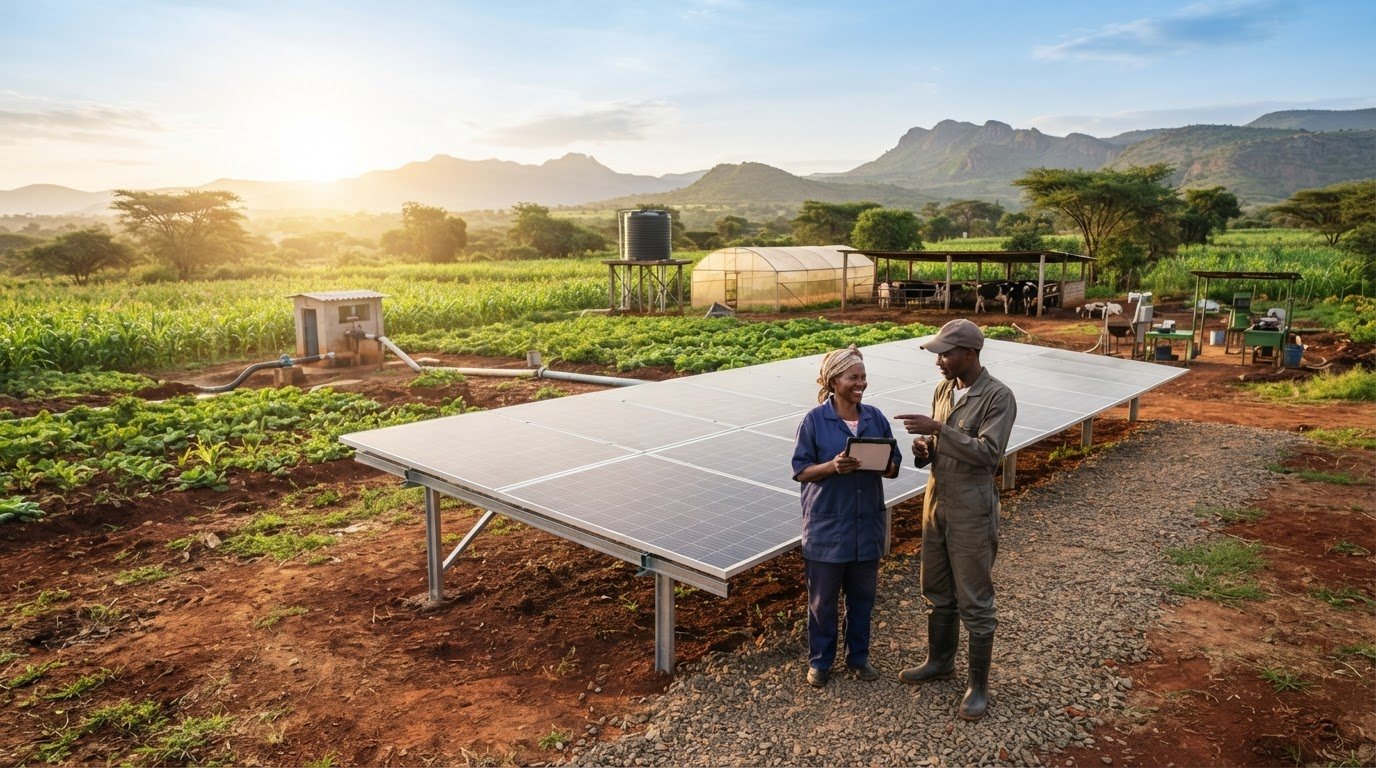
A farm solar system sized from panel capacity alone can leave essential equipment without dependable power. Effective solar installation for farms starts with the work the system must support, from irrigation and water pumping to cooling, livestock operations and processing. Each load has its own energy profile, operating schedule and tolerance for interruptions, so the design should reflect the farm’s actual requirements.
It’s reasonable to be cautious about system sizing and technology choices. An undersized system can disrupt critical tasks, while storage or excess capacity may add cost without serving a defined need. The right design depends on energy demand, site conditions, available grid supply and the level of backup required.
This guide explains how to assess farm energy needs in Kenya, identify operations suited to solar support and compare rooftop, ground-mounted, grid-tied and battery-backed configurations. It also covers installation and electrical integration decisions that affect reliability, plus the operating and site information to prepare before a project begins. Solar Man Power Solutions Ltd designs and installs PV and energy storage systems around farm workflows, load profiles, site conditions and budget.
Key Takeaways
- Map each farm operation’s power demand and schedule before selecting system capacity, storage or backup.
- Compare roof-mounted and ground-mounted layouts based on available space, access and potential effects on farm operations.
- Choose grid-tied, hybrid or off-grid solar installation for farms according to grid access and the level of operational continuity required.
- Prepare electricity bills, equipment ratings, operating schedules and planned load changes to support a more informed system design.
- Account for site conditions, electrical integration, monitoring and maintenance as part of the project plan.
Solar Installation for Farms in Kenya: Which Farm Operations Can It Support?
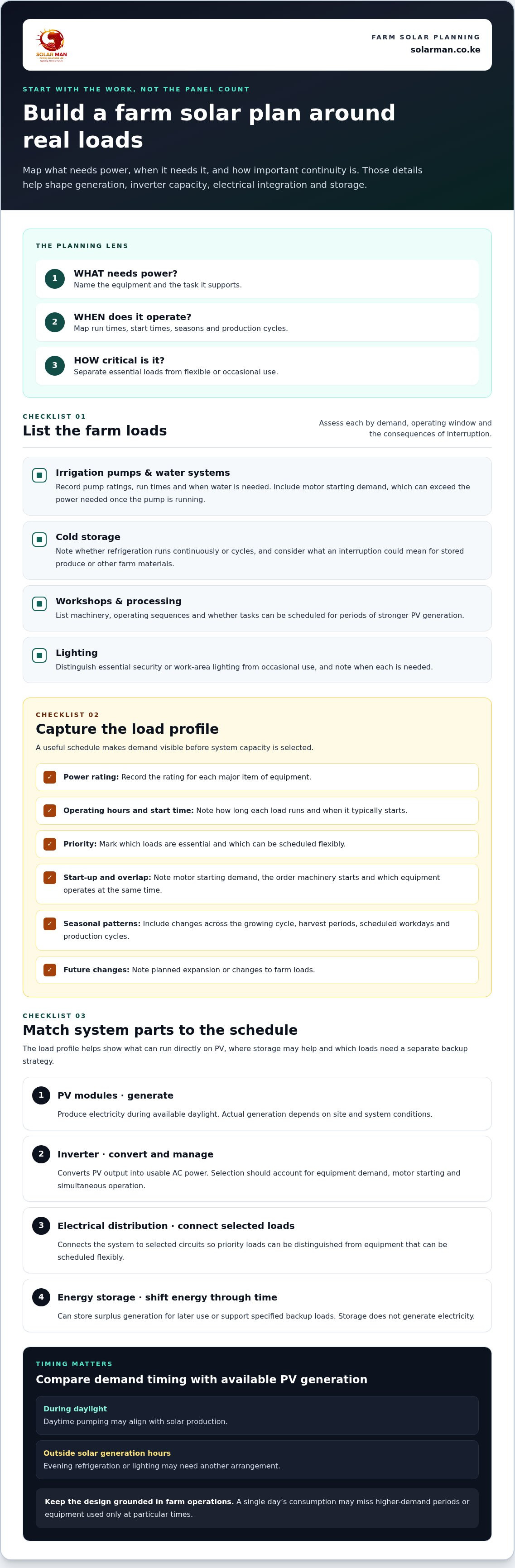
Irrigation pumps, water systems, cold storage, lighting and processing equipment can all be included in a farm solar plan. The key questions are which tasks need power, when they operate and how critical they are to production. Solar PV can be configured to supply selected farm loads, with the design based on measured demand and conditions at the installation site.
Farm solar installation is a PV system engineered around measured operational demand, site conditions and the farm’s priority electrical loads. This keeps system design tied to real tasks rather than a generic package.
Solar can reduce reliance on grid electricity by supplying some or all of a farm’s assessed loads. It does not, by itself, guarantee uninterrupted power. Continuity depends on the configuration, available generation, storage where required, electrical integration and the loads the system is designed to support. The broad overview of renewable energy in Africa and solar power applications includes water pumping, a relevant example for agricultural planning.
Which farm loads are suitable for solar power?
Assess equipment by its electrical demand, operating window and the consequences of interruption. Separate essential loads, whose interruption could affect production or product quality, from flexible or occasional loads that can be scheduled around available power. This priority list helps determine what the PV system should serve directly and where storage or backup may be useful.
- Irrigation pumps and water systems: Record pump ratings, run times and when water is needed. Motor starting demand can exceed the power required once a pump is running, so account for both when selecting system equipment.
- Cold storage: Establish whether refrigeration runs continuously or cycles, and consider the consequences of a power interruption for stored produce or other farm materials.
- Workshops and processing: List the machinery used, its operating sequence and whether tasks can be scheduled for periods of stronger PV generation.
- Lighting: Distinguish essential security or work-area lighting from occasional use, and note when each is needed.
What makes farm energy demand different?
Farm demand can change with seasons, daily work patterns and production cycles. Irrigation requirements may vary during the growing cycle, while processing equipment may run only during harvest or on scheduled workdays. Livestock facilities, storage and workshops also create distinct load profiles. A design based on one day’s consumption may miss higher-demand periods or equipment used only at particular times.
Continuous loads, such as equipment that must remain in operation, place different demands on a system from intermittent loads used for short tasks. Map both across a normal operating day, and note seasonal changes, planned expansion and the order in which machinery starts. These details help an engineer assess generation, inverter capacity and storage requirements without assuming every farm has the same crop, livestock or processing needs.
How Farm Solar Systems Match PV Generation, Storage, and Electrical Loads
A farm solar system must coordinate PV electricity generation with the demand of connected equipment. PV modules produce direct-current electricity. An inverter converts it into usable alternating-current power and manages how energy reaches the farm’s electrical distribution system, which then supplies selected circuits and equipment. Energy storage can hold surplus generation for later use, depending on system design and operating conditions.
A farm load profile translates equipment demand, operating schedules and priorities into the capacity and configuration of a solar system. It helps establish what PV generation can serve directly, where storage may be useful and which loads need a separate backup strategy.
- PV modules produce electricity during available daylight, with actual generation affected by site and system conditions.
- Inverters convert PV output and are selected to suit the required electrical supply and equipment demand, including motor starting and simultaneous operation.
- Electrical distribution connects the system to selected circuits, allowing the design to distinguish priority loads from equipment that can be scheduled flexibly.
- Energy storage stores electricity for later use. It can shift energy across time or support specified backup loads, but it does not generate electricity.
How do farm load profiles shape system design?
Record each major load’s power rating, operating hours, priority and typical start time. Compare the timing of demand with expected PV generation. Daytime pumping may align with solar production, while evening refrigeration or lighting may need another arrangement. Starting currents and equipment running at the same time also affect inverter and distribution design. A load schedule makes these needs visible before system capacity is selected.
When should a farm assess battery storage?
Assess storage when priority loads operate outside solar generation hours, the farm has defined backup needs, or shifting energy to a later operating period is useful. Specify which equipment needs support and for how long in the design brief. Battery capacity and inverter performance must suit those requirements. Storage can support selected loads, but it cannot guarantee uninterrupted supply under every condition.
Grid-tied systems use the grid alongside solar generation, while hybrid configurations combine solar, grid supply and storage according to the design. Off-grid systems must meet farm loads using available generation without relying on a grid connection. Site conditions and operating priorities determine which arrangement fits; batteries are not automatically required for every project.
Solar Man Power Solutions Ltd designs farm PV and energy storage systems around load profiles, site conditions and project budgets, and integrates electrical works as part of the project. Explore farm solar PV and energy storage design.
Choosing Farm Solar Installation Options by Site and Operating Use
Choose the mounting location and electrical configuration together. A roof can keep equipment away from working land, but its condition, orientation, shading and access affect whether it is suitable. A ground-mounted array allows a different layout, but its position must work around irrigation routes, livestock movement, buildings and future expansion. For solar installation for farms, the most practical site supports generation without obstructing essential operations.
Rooftop or ground-mounted solar: what changes for a farm?
Compare potential locations against the farm layout and maintenance needs. For a roof, assess structural condition, usable area, orientation, shading and safe access for installation and ongoing work. For a ground-mounted system, consider available space, equipment access, farm traffic and competing land uses. A site inspection helps establish which locations are practical for the project.
| Consideration | Roof-mounted system | Ground-mounted system |
|---|---|---|
| Site suitability | Requires a suitable roof with sufficient usable area, favourable orientation and manageable shading. | Requires an accessible area that can accommodate the array without conflicting with planned farm use. |
| Access and maintenance | Access depends on the building layout and safe routes to the installation area. | Access depends on ground conditions, farm roads and clearance for maintenance activities. |
| Operational impact | Can use existing building space, but roof works must account for building use and future repairs. | Placement must avoid disrupting irrigation lines, livestock movement, equipment routes or planned expansion. |
Map a proposed location against daily activities, not just the site boundary. An area beside a workshop may appear available but interfere with vehicle access or a planned building extension. A roof with clear space may still be unsuitable if shading or access constraints make it impractical. These are design inputs that need to be assessed on site.
Grid-tied, hybrid, or off-grid: which use case fits?
Configuration depends on the farm’s grid connection and operating priorities. Grid-tied solar can suit a site that uses the grid alongside PV generation and does not require storage as part of the design. A hybrid system combines grid supply, PV and energy storage when specific loads need backup or energy shifting. Off-grid design is relevant where the operation must function without a grid connection, making the balance between available generation and farm demand central.
Each option has different trade-offs. A grid connection can remain part of the supply arrangement, while storage adds capacity for defined operating needs. Off-grid operation requires careful alignment between system resources and loads. No option suits every farm. Solar Man Power Solutions Ltd assesses site conditions and operating requirements as part of its farm PV and energy storage design and installation work. Explore farm solar system design and installation to see how an engineered project can account for these factors.
Planning a Farm Solar Installation: Information to Prepare Before Design
A sound design starts with records of how the farm uses electricity and where equipment could be installed. For solar installation for farms, useful inputs help align the system scope with operating priorities, site conditions and project budget. Gather information from representative periods, including busy production seasons when demand may differ from routine operations.
For an initial assessment, prepare electricity bills, equipment ratings, operating schedules, priority and future loads, candidate installation areas, access constraints and details of the existing electrical infrastructure.
What farm energy and site information should be gathered?
Collect available bills and consumption records, then pair them with equipment schedules to show when and how loads operate. Identify essential, flexible, seasonal and planned future loads separately. For potential roof or ground locations, record shading, access and visible constraints, including roof condition and existing electrical infrastructure. This information gives the design team a practical basis for assessing site and demand.
- Compile energy records. Gather electricity bills and available consumption data covering representative operating periods. Note seasonal differences and peak activity.
- Inventory equipment. Record ratings for pumps, refrigeration, processing equipment, workshop tools, lighting and other significant loads. Include operating hours and whether equipment runs continuously, intermittently or at the same time as other loads.
- Set load priorities. Mark equipment as essential, flexible, seasonal or occasional. Record planned changes, such as new machinery, expanded storage or increased pumping requirements, so the design can account for expected demand.
- Document site conditions. Identify possible roof and ground locations, shading, roof condition, access routes and areas used by farm operations. Note irrigation lines, livestock movement, buildings and space reserved for future expansion.
- Record electrical infrastructure and project priorities. Describe the existing supply and distribution equipment, the loads requiring support and the farm’s budget parameters. This helps define a realistic project scope for further assessment.
How do design, installation, and handover fit together?
Preparation leads into a staged project process. Assessment reviews the records and site conditions. Engineering then develops the system design around agreed loads and priorities. Electrical integration and installation planning account for existing infrastructure and farm workflows. Qualified technicians carry out installation, followed by system testing and handover so the farm team can understand the installed arrangement and its intended operation.
Plan access and work areas around active farm tasks. Installation near a pump house or workshop, for example, may need to be coordinated with equipment use and vehicle movement. The design should also identify how monitoring will provide visibility into system performance and how maintenance will be planned, without assuming a fixed service interval or guaranteed operating outcome. Solar Man Power Solutions Ltd tailors project scope and budget to farm energy needs and site conditions, integrating PV, storage and electrical works where required.
Prepare your project inputs and request a farm solar installation assessment to begin planning around your loads, site and operational priorities.
Solar Man Farm Solar Solutions Across Kenya: From Engineering to Ongoing Performance
Solar Man Power Solutions Ltd designs and installs solar PV and energy storage systems for farms across Kenya. Each project is based on the farm’s energy needs, site conditions, load profile and budget, rather than a generic system package. This approach helps define which loads to serve, where equipment can be installed and whether storage or additional electrical works belong in the project scope.
Farm solar installation involves more than placing PV modules. The system must connect appropriately with the farm’s electrical infrastructure and suit its operating priorities. Irrigation, refrigeration, processing and other equipment may have different schedules and levels of importance. Accounting for these differences provides a clearer basis for system capacity, configuration and installation planning.
How does Solar Man approach farm solar project delivery?
Solar Man starts with the farm’s requirements and site conditions, using available load information to develop a tailored system design. PV, energy storage and hybrid, grid-tied or off-grid configurations can be included according to the project’s needs. Storage is considered where backup or load-shifting requirements call for it, rather than treated as a standard feature of every farm system.
Electrical works and power infrastructure can be included to integrate the solar system with relevant farm circuits. Qualified technicians carry out installation to industry standards, with planning informed by site access and farm activities. This coordinated approach aligns the engineering scope with practical installation conditions and the farm’s budget.
What happens after a farm solar system is installed?
System handover is part of a longer operating lifecycle. Monitoring can provide visibility into system performance, while maintenance and upgrades support ongoing management as farm requirements change. If production expands, equipment is replaced or operating schedules shift, review the system against the updated load profile.
Ongoing performance management also means treating safety and electrical integration as continuing considerations. Monitoring, maintenance and upgrades help identify where system operation or farm demand may need attention, without implying a guaranteed level of output or uninterrupted supply. Solar Man’s services include monitoring, maintenance, energy management and electrical works, supporting farms beyond initial design and installation.
For a farm project, useful starting information includes electricity bills, equipment ratings, operating schedules, priority loads, site details and planned changes. These inputs help the project scope reflect actual operations and conditions. Solar Man Power Solutions Ltd works with farms nationally across Kenya, tailoring system design to each project’s requirements.
Discuss a farm solar project with Solar Man Power Solutions Ltd.
Turn Farm Priorities into a Practical Project Brief
Turn operational priorities into a clear project brief. Identify which activities need support first, how their schedules may change and which future plans could affect electricity demand. This gives the design process a practical reference and helps align system scope with current requirements and planned development.
Solar Man Power Solutions Ltd designs and installs solar PV and energy storage systems for farms across Kenya. Each solar installation for farms can account for load profiles, site conditions and budget, with qualified technicians carrying out installation to industry standards. Monitoring, maintenance, troubleshooting and system upgrades also support farms as operating needs evolve.
Bring your farm’s energy records and priorities to the first project discussion. Discuss a farm solar project with Solar Man and take the next step toward a system designed around your operation.
Frequently Asked Questions
Can solar panels power irrigation pumps on a farm?
Yes. Solar can supply an irrigation pump when the system is designed for the pump’s electrical requirements and operating pattern. Account for the motor’s rated power and starting demand, not only its running consumption. A farm may, for example, schedule pumping during periods of solar generation and store water for later use if its water system allows. Assess a solar installation for farms against the actual pump and irrigation requirements.
Do farms in Kenya need batteries with solar panels?
No. Batteries are not necessary for every farm solar system. A farm using solar mainly during daylight, with grid supply available when needed, may have different requirements from one that needs selected equipment supported after sunset or during outages. Storage can provide backup or shift energy to another operating period, but its usefulness depends on the loads, required support duration and system design. Review these needs before deciding whether battery storage belongs in the project scope.
How does cloudy or rainy weather affect farm solar generation?
Cloud cover and rain can reduce solar generation compared with clear conditions, and output can vary as weather changes. Panels can still generate electricity in diffuse daylight, but available power may not match the farm’s full demand at every moment. Farms with weather-sensitive operations should consider how essential equipment will be supplied during lower-generation periods, including the role of grid supply, storage or operational scheduling.
Can solar panels be installed on existing farm buildings?
Yes. Existing farm buildings can be considered for PV installation if the roof and site are suitable. Assessment should account for the roof’s condition, available area, shading, access for installation and maintenance, and how the building is used. A roof due for significant repair may affect project planning, while structures with limited access or unsuitable conditions may not be practical locations. A site inspection helps establish whether a building can accommodate the proposed system.
What happens to a farm solar system during a grid outage?
During a grid outage, a standard grid-tied system generally stops supplying power to the farm unless it is configured to provide backup. A hybrid system with energy storage may keep designated circuits operating, depending on its configuration, battery charge and connected demand. This does not mean every farm load will remain powered. The design should identify which equipment requires backup and account for its energy needs during an outage.
How long does solar installation for a farm take?
There is no single installation duration for every farm project. Timing depends on factors such as system size, site readiness, roof or ground work, electrical integration and coordination with farm operations. Design and installation planning also affect the project schedule. A site requiring substantial electrical work or changes to installation access may need a different programme from a straightforward site. Set the project schedule after assessing its scope and site conditions.
How should a farm maintain its solar installation?
Follow the system’s maintenance guidance and arrange qualified support for inspections, electrical checks and troubleshooting. Keep PV modules free of material that could obstruct sunlight, using safe access and suitable cleaning methods. Monitor system performance for changes from its normal operating pattern, and report visible damage or unusual behaviour for assessment. Maintenance planning should reflect the farm environment and equipment condition. Avoid opening electrical enclosures or attempting repairs without appropriate technical expertise.