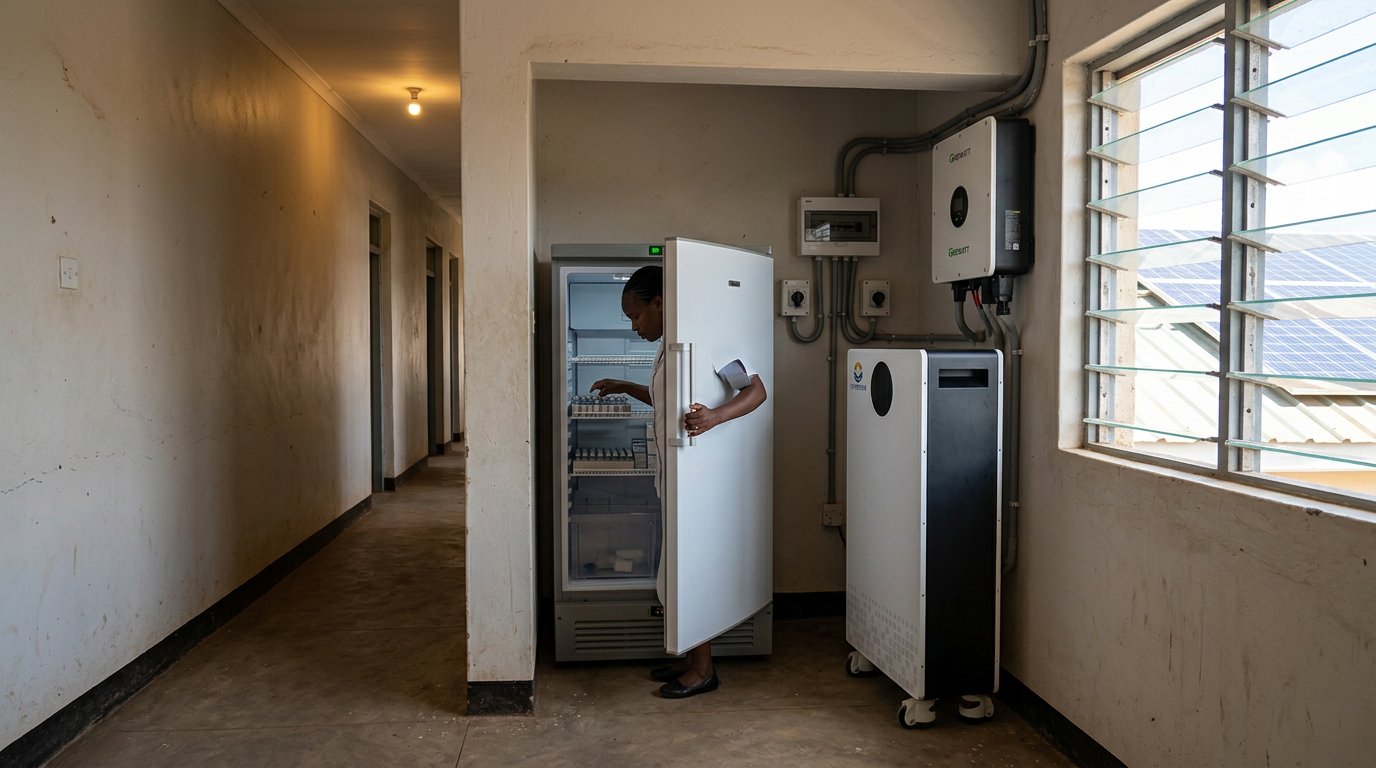
Solar backup power systems can be added to a grid-tied installation later if the system is designed for expansion and its inverter is compatible with battery storage. Without batteries, a standard grid-tied system switches off during an outage. A suitable hybrid setup can isolate the property and use solar panels to recharge batteries.
Planning for storage from the start helps align the inverter, battery capacity and backup loads with how you expect to use electricity, rather than treating the battery as a standalone addition.
This guide explains how to upgrade a grid-tied system, recharge batteries with solar during an outage, and compare grid-tied, hybrid and off-grid configurations. Use it to assess which setup suits your home or facility in Kenya.
Key Takeaways
- Plan for future battery storage when selecting a grid-tie system, since inverter compatibility affects how easily backup can be added later.
- Understand why standard grid-tie solar switches off during an outage and what system configuration allows solar panels to recharge batteries.
- Compare inverter setups by their ability to coordinate solar generation, battery storage and backup loads.
- Size panels and battery capacity around the appliances you need to run, how long you need backup, and the system’s operating conditions.
Can I start with grid-tie solar and add battery backup later?
Yes. A grid-tied installation can support battery backup later if its design allows compatible storage and inverter controls. Planning for expansion helps establish a practical upgrade path for solar backup power systems.
Installed Home Batteries
A home battery connects to the solar system and can supply designated household circuits during an outage. Unlike a portable power station, it is planned as part of the home’s electrical configuration. Its usable capacity and the circuits it serves depend on the system design. Battery lifespan and warranty terms vary, so compare the specific manufacturer’s cycle-life information and conditions.
Adding Backup to Grid-Tie Solar
Upgrading an existing grid-tied installation for solar backup power systems starts with assessing the inverter, wiring, panels and intended backup loads. If the inverter cannot manage batteries or isolate backup circuits, system changes may be needed. A professional checks compatibility and defines the upgrade configuration, because connecting a battery alone will not provide backup during an outage.
Lithium-Ion and Lead-Acid Batteries
Lithium-ion and lead-acid batteries differ in maintenance needs, operating characteristics and cycle-life specifications. Choose based on more than chemistry: compare usable capacity, inverter compatibility and expected charging and discharging patterns. Battery efficiency and the required backup duration also affect how much stored energy is available to the selected loads.
Recommended Systems and Installation Requirements
A hybrid inverter paired with a compatible battery can coordinate solar generation, storage and backup loads. In Kenya, applicable permits and standards depend on the installation scope and grid connection. System design must account for relevant electrical safety and utility interconnection requirements, which vary with the project configuration.
| Option | Integration | Typical role |
|---|---|---|
| Portable power station | Standalone | Selected devices |
| Installed home battery | Part of home system | Designed backup circuits |
| Grid-tie upgrade | Inverter-dependent | Existing solar array |
Choose a setup based on backup loads, inverter compatibility and the integration required.
Can Solar Panels Recharge a Battery Backup During an Outage?
Yes. Solar panels can recharge a battery during an outage if the system can operate independently of the grid. The inverter and battery controls determine whether solar generation remains available.
Solar Recharging During Outages
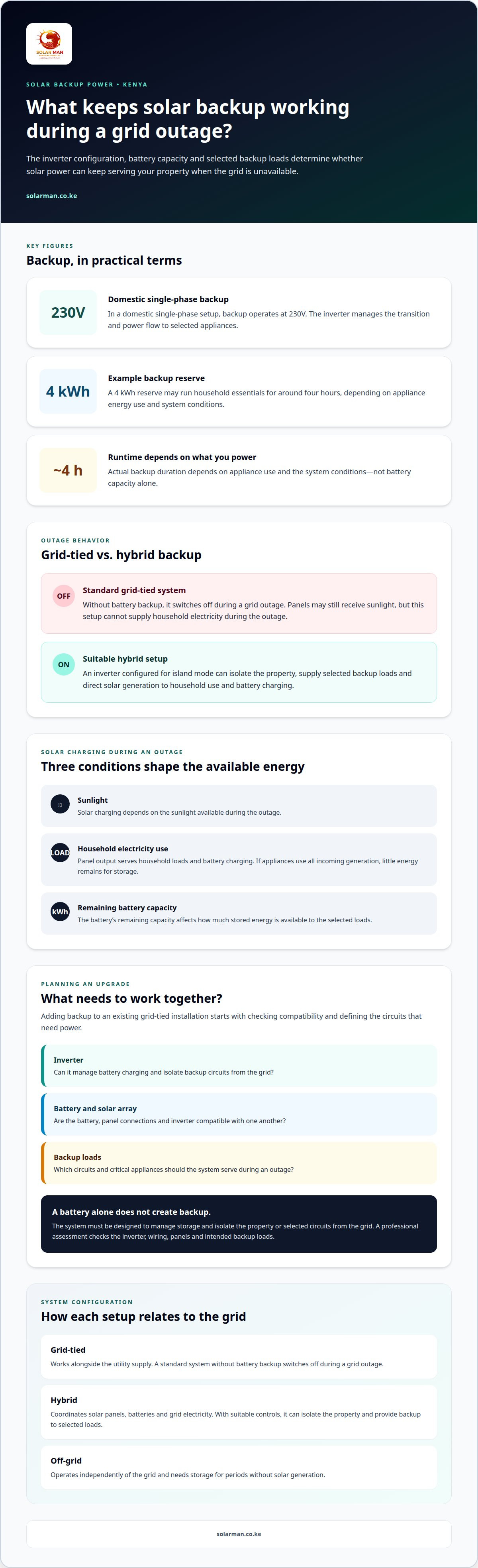
A solar-and-battery system can direct panel output to household loads and battery charging while disconnected from the grid. This requires an inverter configured for island mode, rather than one that shuts down with the utility supply. During an outage, charging depends on sunlight, household electricity use and the battery’s remaining capacity. If appliances use all incoming generation, little energy will remain for storage.
Backup Power During Outages
A grid-connected battery backup system can disconnect from the grid during an outage and draw on stored battery energy. Its backup supply serves only the circuits included in the system design, so critical appliances may take priority over non-essential loads. In a domestic single-phase setup, backup operates at 230V. The inverter controls the transition and manages power flow between the battery and selected appliances.
Grid-Tie System Outages
A standard grid-tied system without battery backup switches off during a grid outage. This prevents it from feeding electricity into the grid while utility workers make repairs. Although the panels may still receive sunlight, this configuration cannot supply household electricity. Restoring solar power during an outage requires equipment designed to isolate the property and manage generation independently of the grid.
How do professionals determine the panel count and battery capacity needed for common household appliances?
Professionals assess each appliance’s power demand, expected operating hours and priority during an outage. They then match those loads against battery capacity and the solar generation available for recharging. For example, a 4 kWh backup reserve may run household essentials for around four hours, depending on appliance energy use and system conditions. The required panel count depends on energy use, sunlight conditions and the charging target, not appliance count alone.
Hybrid inverters and system compatibility
Before recommending off-grid, hybrid or grid-tied solar, a professional assesses your energy use, grid access, outage needs and expansion plans. Grid-tied systems work alongside the utility supply; hybrid systems coordinate solar panels, batteries and grid electricity; off-grid systems operate independently and need storage for periods without solar generation.
Hybrid inverters manage power flow between panels, batteries, household loads and the grid. Compatibility with the battery, existing solar array and backup circuits determines how the system operates. A professional assesses inverter specifications, battery requirements, panel configuration and the loads you want powered during an outage.
For example, a property connected to Kenya’s grid that needs selected appliances during outages may suit a hybrid configuration. A site without a practical grid connection may need an off-grid design, while a property focused on grid-connected solar generation may use a grid-tied setup. The key differences are each system’s relationship with the grid and its ability to provide backup.
For an existing installation, a professional checks the inverter model and whether it can control battery charging and backup operation. The assessment also covers panel connections, the circuits requiring backup and the inverter’s ability to isolate those circuits from the grid. An incompatible inverter may need to be replaced or the system modified before storage can operate as intended.
Choose off-grid for independent operation, hybrid for coordinated grid and battery use, or grid-tied solar when backup is not a priority. A professional bases the recommendation on your load profile, existing equipment and required outage coverage.
How many solar panels and what battery capacity are needed for common household appliances?
Start by listing the appliances you need during an outage, such as lights, a refrigerator, a router and a water pump. Record each appliance’s rated power and expected operating time, then estimate its energy use. Separating essential loads from equipment that can stay off gives the backup design a clear purpose.
Next, assess which appliances may run at the same time. A refrigerator and lights create a different peak demand from a pump starting alongside other equipment. The inverter must handle the combined load, while battery capacity must cover the expected operating period. These are related, but distinct, design requirements.
Battery capacity is based on the total energy required by selected appliances, adjusted for battery efficiency and system operating limits. A professional also considers whether solar panels should recharge the battery during an outage. This connects overnight or low-sunlight needs with daytime consumption and charging priorities.
Panel quantity depends on required energy production, local sunlight, panel output, shading and roof orientation. The installer assesses the mounting location and estimates how much generation can serve household loads while recharging stored energy. The appliance list alone does not determine a fixed panel quantity: backup duration and operating patterns matter too.
- Record essential appliances and their rated power.
- Estimate operating hours and identify simultaneous loads.
- Set the required backup period and battery capacity.
- Match panel output to consumption, charging needs and site conditions.
For example, a household prioritising a refrigerator, selected lights and communications equipment needs a different design from one that also uses a pump. Assessing loads gives you a practical basis for choosing system capacity.
Solar Man Power Solutions: Power Backup & Critical Systems
Solar Man Power Solutions designs solar and storage systems for homes, businesses and institutions requiring planned backup or critical power. Its Power Backup & Critical Systems service supports projects where selected equipment or operations must remain powered during grid interruptions. The right configuration depends on your loads, existing equipment and backup requirements.
For an existing solar installation, Solar PV System Design & Installation can address system planning and installation needs. The assessment considers the panels, inverter, battery compatibility and circuits you want backed up. For a new project, the design can account for backup needs from the outset, rather than treating storage as an isolated addition.
Solar Man Power Solutions also provides Energy Storage Systems (ESS) and Hybrid, Grid-Tied & Off-Grid Solar Solutions. These options address different operating needs: a hybrid system coordinates solar, storage and grid supply, while an off-grid design operates without a grid connection. Energy use and site conditions guide the choice.
For a productive assessment, prepare information about:
- Appliances, equipment or operational loads that need backup.
- Which circuits are essential and when they operate.
- Existing solar panels, inverter and battery equipment.
- Your preferred backup arrangement, including grid-connected or off-grid operation.
These details help define the system scope and identify compatibility requirements. Solar Man Power Solutions can support you with system design, installation and storage selection for residential, commercial and institutional needs. Contact Solar Man Power Solutions to discuss your power backup requirements.
Frequently Asked Questions
How long do solar batteries hold charge?
A battery’s usable runtime depends on its stored energy and the appliances drawing power. A 5.12kWh battery, for example, supplies different runtimes for a small router than for several high-demand appliances. If a battery is reserved for emergencies, periodic charging helps maintain its charge. The system’s monitoring and battery settings also affect how much stored energy remains available.
How many batteries does it take to power a house with solar?
There is no fixed battery quantity for every home because household loads and backup periods differ. A useful calculation divides the required stored energy by the usable capacity of each compatible battery, then accounts for system limits. A home backing up only lighting and communications, for example, needs a different storage arrangement from one that also includes refrigeration or water pumping.
How can a professional determine the battery size you need to back up your home?
A professional can use your appliance schedule and electricity use to estimate the energy required during an outage. They also distinguish continuous loads from equipment with high starting demand, such as a pump. Battery selection then accounts for usable capacity, inverter compatibility and the backup duration you want. This helps prevent choosing storage based only on the number of rooms.
How can a professional recommend the right solar kit for your needs?
A professional matches the kit to your intended loads, daily electricity use, site conditions and whether you need grid-connected or independent operation. For a small, selected-device setup, a portable station may be suitable; the Vestwoods 1kWh model has a rated output of 500W. A larger household system needs equipment selected around its appliances, solar generation and backup requirements.
Which type of battery is best for storage?
No single battery chemistry is best for every installation. Lithium-ion options, including lithium iron phosphate, are used in solar storage; lead-acid batteries remain another category to assess. Compare usable capacity, cycle-life data, warranty terms, maintenance needs and inverter compatibility for the intended duty. For example, the Vestwoods 5.12kWh 48V 100Ah Lithium Battery is a listed lithium storage option.
What is a solar backup power system and how does it work?
A solar backup power system defines which household operations should continue during a supply interruption and how much reserve is available. For example, a plan may prioritise refrigeration while excluding discretionary appliances. Recording these priorities and expected use gives you a clear operating scope to review during commissioning and performance monitoring. Backup power is not an unlimited supply for every household load.
Disclaimer
**Disclaimer**
The information published on this website is provided by Solar Man Power Solutions Ltd for general informational and educational purposes relating to solar energy, renewable energy systems, power backup, energy storage and related technologies.
While we make every effort to ensure that the information is accurate, reliable and up to date, product specifications, technical details, prices, availability and system configurations may change without prior notice. Information provided in our articles, guides and product descriptions should not be considered a substitute for a professional site assessment, technical evaluation or customized quotation.
**Solar System Performance:** Actual solar system performance, energy generation, battery backup duration and savings depend on several factors, including geographical location, weather conditions, equipment specifications, installation quality, energy consumption patterns and system maintenance. Any performance figures or estimated savings are indicative and are not guaranteed results.
**Product Information:** Product images, descriptions, specifications and technical information are provided for reference. Manufacturers may update product designs, specifications and features from time to time.
**Pricing and Quotations:** Prices, promotions and product availability displayed on this website are subject to change. Final project costs and system recommendations are determined following an assessment of the customer's requirements and site conditions.
**Professional Installation:** Solar installations and electrical systems should be designed, installed and commissioned by appropriately qualified professionals in accordance with applicable Kenyan laws, regulations and technical standards.
**External Links:** This website may contain links to third-party websites for additional information. Solar Man Power Solutions Ltd is not responsible for the content, accuracy or privacy practices of external websites.
By using this website, you acknowledge that the information provided is for general guidance and that any purchasing, installation or investment decision should be based on appropriate professional advice and an assessment of your specific requirements.
For technical assistance, product enquiries, quotations or professional solar energy solutions, please contact Solar Man Power Solutions Ltd through our official communication channels.
**Solar Man Power Solutions Ltd**
Reliable Solar & Energy Storage Solutions for East Africa.
Website: https://solarman.co.ke