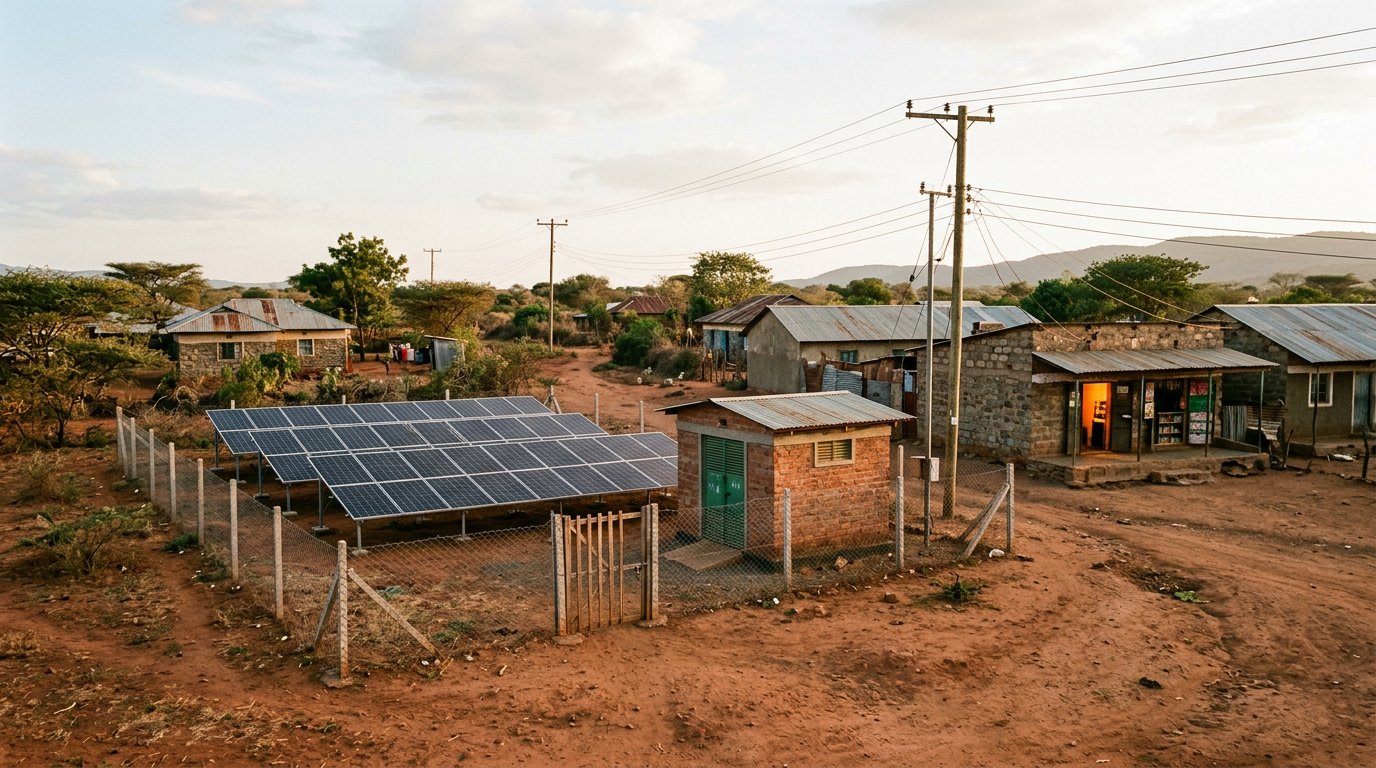
National electricity access in Kenya stands at 84%, while the electrical power infrastructure in Kenya combines grid-connected generation and networks with off-grid options for remote communities. Independent power producers own and operate around a third of installed electricity capacity, and the Kenya Off-Grid Solar Access Project aims to electrify 14 remote counties representing 20% of the population, according to the Ministry of Energy and Petroleum. This overview explains how electricity access and rural distribution fit into the system, who owns generation capacity, and where off-grid solar and mini-grids serve communities beyond the reach of the grid, giving you a practical view of how Kenya’s power supply is structured.
Key Takeaways
- Understand how national access targets relate to the practical work of extending electricity to rural communities.
- Learn how transmission and distribution networks connect generation to homes and businesses, and why network reach matters.
- See how public utilities and independent power producers contribute to Kenya’s electricity generation mix.
- Identify where off-grid solar and mini-grids can serve communities beyond the reach of the main grid.
Electricity access and electrification targets
Kenya’s electricity access agenda combines national connection targets with rural network expansion. These priorities shape where grid investment and alternative power options are most relevant.
Electrification Targets
Electrification targets set the intended reach and timing of electricity connections across Kenya. National access increased from 32% to 73% of households in five years, while universal access remains a goal for 2030. For you, the distinction between a national target and a local connection is practical: service depends on network reach and the infrastructure serving your location. The figures describe progress and ambition, not a guarantee of supply at every site.
Rural Electrification
Rural electrification extends electricity service beyond established urban networks. Kenya’s rural electrification programme aimed to provide electricity to 40% of the rural population by 2020. Rural electricity connectivity reached 32%, up from 4% when the Rural Electrification Authority was established. These figures show why access planning must account for settlement distance and distribution infrastructure. For households and organizations outside existing networks, the supply route may differ from a standard grid connection.
Network access also affects how electricity reaches customers after generation. Kenya’s electrical power infrastructure includes transmission and distribution systems, while open-access rules create a route for private distributors to use those networks. The Energy (Electricity Market, Bulk Supply and Open Access) regulations 2024 provide for private distributors to access transmission and distribution systems under specified access arrangements. This provision can support market participation, while actual delivery still depends on network capacity and access arrangements. It does not mean every site has a direct connection or identical supply conditions.
Current household, business, and large-user electricity tariffs are not one universal rate. The applicable tariff depends on the customer category and consumption profile, so the same unit rate should not be assumed across these users. For a commercial site combining grid supply with onsite storage, a commercial hybrid solar and storage system is one example of how supply sources can be integrated.
Electricity distribution and rural electrification
Kenya’s grid depends on transmission lines, distribution networks, and transformers working together. Their reach and losses affect how electricity moves from generation areas to homes and enterprises.
Infrastructure investment needs depend on route length, network capacity and the equipment required to connect users. Kenya’s open-access regulations allow private distributors to use transmission and distribution systems, providing a defined route for participation. Opportunities include network expansion and last-mile connections, while project financing depends on asset ownership and access arrangements.
Transmission and Distribution Infrastructure
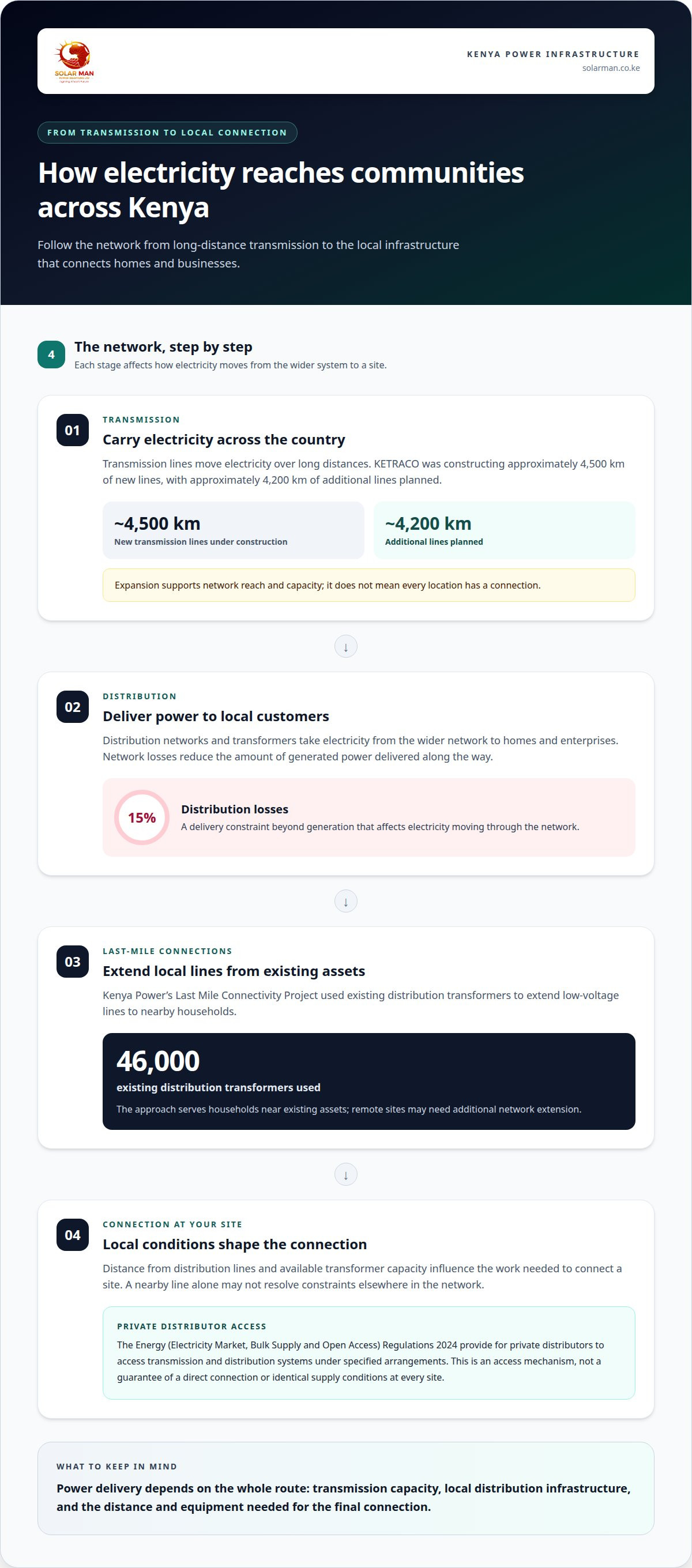
Transmission infrastructure carries electricity across the country, while distribution networks deliver it to local customers. This distinction matters because a nearby distribution line cannot compensate for constraints further upstream. KETRACO was constructing approximately 4,500 km of new transmission lines, with approximately 4,200 km of additional lines planned. These projects address network reach and capacity, but do not establish that every location has a connection.
Network losses also affect delivery. Network losses reduce the amount of generated power delivered through transmission and distribution systems. These figures describe separate measures and should not be added as if they were identical totals.
Infrastructure and Financing
Electrical power infrastructure requirements depend on the work and assets needed to move electricity through a specific network. Route length, capacity requirements and connection equipment shape each project. Kenya’s open-access framework allows private distributors to access transmission and distribution systems. This sets out an access mechanism, while financing depends on project ownership and the assets being developed. For owners and developers delivering complex commercial and infrastructure projects, engaging professional advisory teams such as hodgecmc.com can provide crucial owner’s representative support throughout construction planning and execution.
For users, the practical benefit is improved network access when expansion reaches their area. Nearby lines and available transformer capacity influence the work required to make a connection.
Infrastructure Risks and Challenges
Infrastructure risks include network losses, voltage instability, and the challenge of extending supply across areas with different settlement patterns. Distribution losses of 15% indicate that electricity delivery faces constraints beyond generation, leading many industrial facilities to rely on surge protection and power quality specialists like Energy Control Systems to safeguard their equipment. Transmission expansion also requires coordinated construction across long routes, while local connections depend on available distribution infrastructure.
Kenya Power’s Last Mile Connectivity Project used 46,000 existing distribution transformers to extend low-voltage lines to nearby households. This approach connects users close to existing assets, but remote sites may require additional network extension. For your site, distance from distribution lines and transformer capacity shape how a connection can be delivered.
Electricity generation capacity and ownership
Kenya’s electricity supply comes from generating assets using different technologies and ownership models. Their combined capacity and operating mix affect the power available across the system.
Installed Generation Capacity
Installed generation capacity is the combined rated output of power plants connected to the electricity system. It indicates the scale of domestic supply, but not how much electricity is available at a particular time.
Kenya had 3,321 MW of installed electricity capacity in 2023. Ownership is shared: independent power producers own and operate around a third of installed capacity, while KenGen is 70% government owned. This structure means generation assets are operated by both public and private entities. For commercial and institutional users, the mix matters because power supply depends on operating plants as well as the transmission network.
Geothermal is a major domestic resource. Kenya’s estimated geothermal potential is 10,000 MW, while installed geothermal capacity is less than 985 MW. These figures distinguish the resource estimate from capacity already installed. Geothermal power accounted for 28.6% of effective electricity capacity in April 2017, showing its established role in the generation mix at that time.
Wind, Solar, and Imports
Wind and solar contribute renewable generation, while hydropower and geothermal provide other domestic sources. Imports can supplement domestic electricity when supply is available through connected markets. Contributions vary with generation and system conditions, so installed capacity is not a constant measure of available supply.
The Lake Turkana Wind Power Plant supplies 310 MW to Kenya’s grid. The Kipeto wind power plant has a capacity of 100 MW and was commissioned in late 2021. Solar development also features in public plans: Kenya’s Rural Electrification Authority was constructing a 50 MW solar plant scheduled for completion in 2018. These examples show distinct roles for utility-scale renewable generation alongside broader electrification efforts.
For your site, national generation capacity provides context, not an assessment of site-specific supply. Local network access and demand determine how grid electricity serves a facility. Onsite generation and storage can form part of a separate power arrangement.
Off-grid solar and mini-grids
Off-grid solar supplies electricity without a connection to Kenya’s national grid. Mini-grids distribute locally generated power to multiple users, while standalone solar systems serve an individual home, facility or piece of equipment.
The Kenya Off-Grid Solar Access Project aims to electrify 14 remote counties, representing 20% of the population, according to the Ministry of Energy and Petroleum. The project illustrates how off-grid approaches can address access where extending the main grid is challenging. Its stated reach describes the programme’s target, not a guarantee that every household or business in those counties receives a connection.
A mini-grid combines local generation with a distribution network serving a defined group of users. Solar generation can be paired with energy storage so electricity produced at one time can support demand later. By contrast, a standalone solar system supplies one site rather than distributing power among several customers. In both cases, design depends on local energy demand and the role electricity needs to perform.
For a rural institution, such as a health facility or school, start by identifying which loads need power and when. Lighting, communications equipment, refrigeration and other electrical loads create different operating profiles. A mini-grid must account for users’ combined demand, while an individual system is sized for one site. These factors shape generation and storage requirements, with no single configuration suited to every community.
Off-grid systems can also complement grid supply when users need a separate source for selected loads. A hybrid arrangement may combine grid electricity, solar generation and storage, with its design reflecting site demand and supply conditions. In remote locations, the choice between a mini-grid and standalone solar depends on whether electricity serves multiple users or one facility. Kenya’s electrification programmes show how these approaches contribute to wider access.
Solar Man Power Solutions: Electrical Works & Power Infrastructure
Solar Man Power Solutions Ltd provides Electrical Works & Power Infrastructure for projects assessing how electricity reaches and serves a site. Where grid supply needs to work alongside onsite generation or storage, the company’s Solar PV System Design & Installation and Energy Storage Systems (ESS) can address those connected requirements.
For a commercial facility, an integrated design considers electricity demand, existing supply arrangements and the role of storage. Solar Man Power Solutions Ltd also provides Hybrid, Grid-Tied & Off-Grid Solar Solutions, matching the system approach to the project’s connection context. This service is relevant when planning electrical infrastructure or assessing how solar and storage could fit into an existing power setup.
Contact Solar Man Power Solutions Ltd to discuss your electrical works and power infrastructure requirements.
Plan the next stage of your power system
Planning Kenya’s electrical power infrastructure starts with a clear site-level operating brief. Identify essential loads, daily demand patterns and the role your system should play during grid interruptions or remote operation. This gives design decisions a practical basis, whether you’re upgrading a facility or planning a new installation. Include operating schedules and critical equipment so the proposed system reflects how the site works.
Solar Man Power Solutions Ltd’s technical team supports this planning with Solar PV System Design & Installation, Energy Storage Systems (ESS), and Hybrid, Grid-Tied & Off-Grid Solar Solutions. The right configuration depends on site conditions, energy requirements and the system’s intended role.
To discuss your project requirements, contact Solar Man Power Solutions Ltd. A clear brief is a practical first step toward a power system designed around your operations.
Frequently Asked Questions
How does electricity move from generation through Kenya’s grid to a customer?
Electricity moves from generating plants through high-voltage transmission lines, then through distribution networks to customer connections. Each stage has a distinct function, so a constraint at one stage can affect a site’s supply even when generation is available. When planning solar integration, the connection point and the loads to be supplied help determine how onsite equipment fits into the facility’s electrical system.
What do Kenya’s installed capacity and energy mix indicate for 2025?
The dated capacity figures discussed in this article do not establish a 2025 installed-capacity total. Kenya’s electricity mix includes geothermal, hydropower, wind, solar, and imports, but their contributions vary with operating conditions and available supply. For a site assessment, distinguish installed capacity from effective output and electricity delivered to the customer. Those measures describe different stages of the supply picture.
Which organizations should you identify for different power infrastructure interfaces?
KenGen and independent power producers are associated with generation, KETRACO with transmission infrastructure, and Kenya Power with distribution connections. Understanding this division helps identify the relevant system interface for a project. A question about a generating asset differs from one about a transmission route or local connection. Identify the interface first to make technical discussions more focused.
How should you assess the status of a major power project?
Before treating a project as part of available supply, distinguish whether it is planned, under construction or commissioned. A planned transmission route does not provide an operational connection, and a generating plant affects supply only after commissioning and integration. For a site decision, the project’s stage and relevance to the connection matter more than a headline capacity or announcement.
How should you interpret Kenya’s electricity access rate and rural access?
A national access rate is an overall indicator, while rural connectivity describes a different setting and may use a different measure. Neither figure establishes whether a specific property can connect to the grid. For a rural home or institution, consider the nearby distribution network, connection route, and whether an individual off-grid system or community mini-grid better fits its needs.
What legal provisions affect network access and qualifying power-project imports?
Kenya’s framework includes provisions for private distributors’ access to transmission and distribution systems, as well as exemptions for specified power-project activities and imported equipment. These provisions address different project aspects; they are not blanket approvals or universal tax exemptions. The relevant activity, asset and project category determine which provision applies. This distinction helps project teams focus legal and technical reviews on the actual infrastructure proposal.
Disclaimer
**Disclaimer**
The information published on this website is provided by Solar Man Power Solutions Ltd for general informational and educational purposes relating to solar energy, renewable energy systems, power backup, energy storage and related technologies.
While we make every effort to ensure that the information is accurate, reliable and up to date, product specifications, technical details, prices, availability and system configurations may change without prior notice. Information provided in our articles, guides and product descriptions should not be considered a substitute for a professional site assessment, technical evaluation or customized quotation.
**Solar System Performance:** Actual solar system performance, energy generation, battery backup duration and savings depend on several factors, including geographical location, weather conditions, equipment specifications, installation quality, energy consumption patterns and system maintenance. Any performance figures or estimated savings are indicative and are not guaranteed results.
**Product Information:** Product images, descriptions, specifications and technical information are provided for reference. Manufacturers may update product designs, specifications and features from time to time.
**Pricing and Quotations:** Prices, promotions and product availability displayed on this website are subject to change. Final project costs and system recommendations are determined following an assessment of the customer's requirements and site conditions.
**Professional Installation:** Solar installations and electrical systems should be designed, installed and commissioned by appropriately qualified professionals in accordance with applicable Kenyan laws, regulations and technical standards.
**External Links:** This website may contain links to third-party websites for additional information. Solar Man Power Solutions Ltd is not responsible for the content, accuracy or privacy practices of external websites.
By using this website, you acknowledge that the information provided is for general guidance and that any purchasing, installation or investment decision should be based on appropriate professional advice and an assessment of your specific requirements.
For technical assistance, product enquiries, quotations or professional solar energy solutions, please contact Solar Man Power Solutions Ltd through our official communication channels.
**Solar Man Power Solutions Ltd**
Reliable Solar & Energy Storage Solutions for East Africa.
Website: https://solarman.co.ke