Solar panel upkeep and Kenya’s road maintenance levy are separate matters. Solar system maintenance in Kenya does not itself attract the levy offences discussed here. An unpaid road maintenance levy incurs a penalty of three per cent of the unpaid amount per month or part thereof; a person who fails without reasonable cause to comply with a levy order or refuses to pay may face a fine of up to KSh 3 million, imprisonment for up to three years, or both.
Keeping a solar installation operating well means monitoring its condition and performance. Levy compliance, by contrast, applies to people and businesses with legal remittance duties. Understanding the difference helps ensure each obligation is handled appropriately.
This article explains registration and remittance duties, offences that can attract penalties, and the consequences of unpaid levies. It also explains how professional solar operations and maintenance fits in, so equipment care is not confused with levy obligations.
Key Takeaways
- Learn what influences professional panel-cleaning schedules and service costs across different Kenyan site conditions.
- Understand which system details affect inverter servicing costs and what a maintenance assessment can cover.
- Recognise common performance faults and how a technician can diagnose their likely source across system components.
- See how dust, rainfall and changing site conditions inform maintenance planning, and when professional system maintenance or upgrades may help.
How often should solar panels be cleaned in Kenya, and how much does cleaning cost?
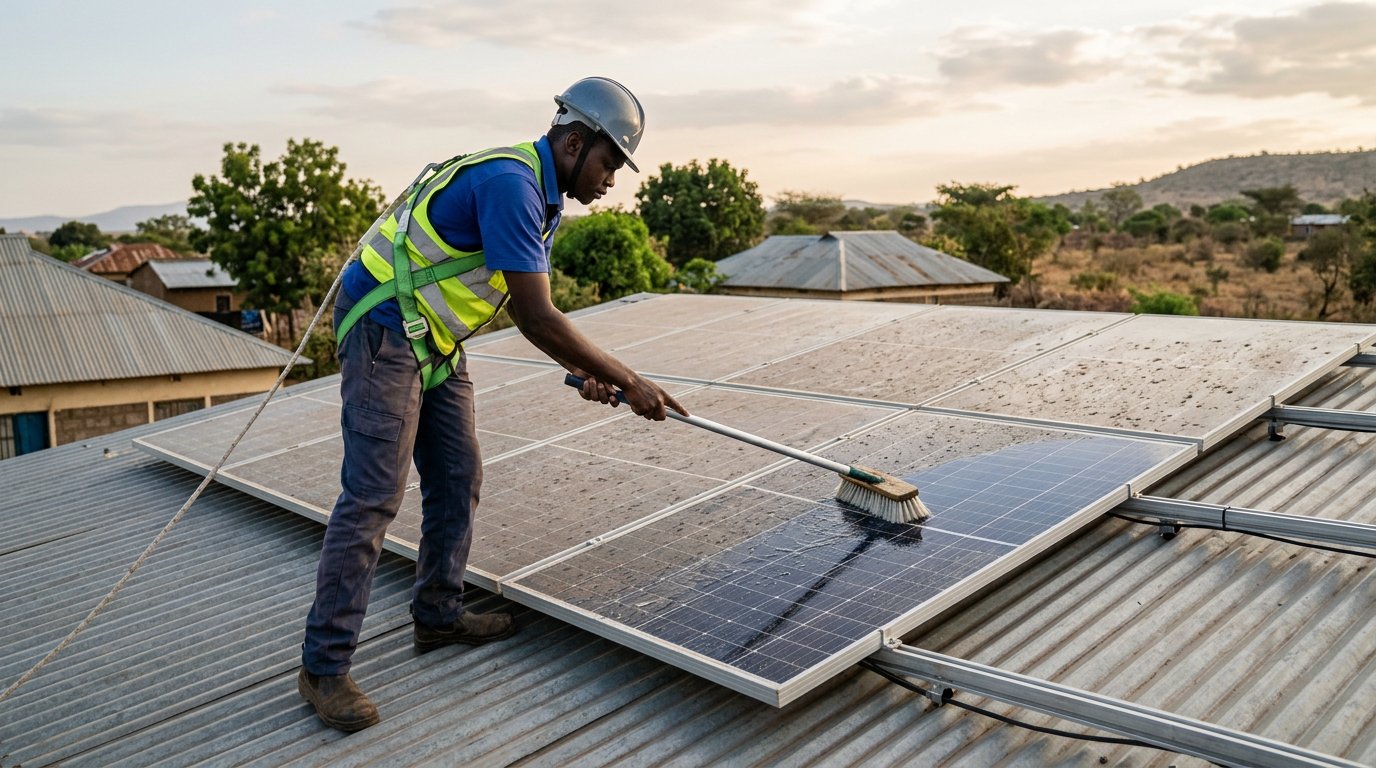
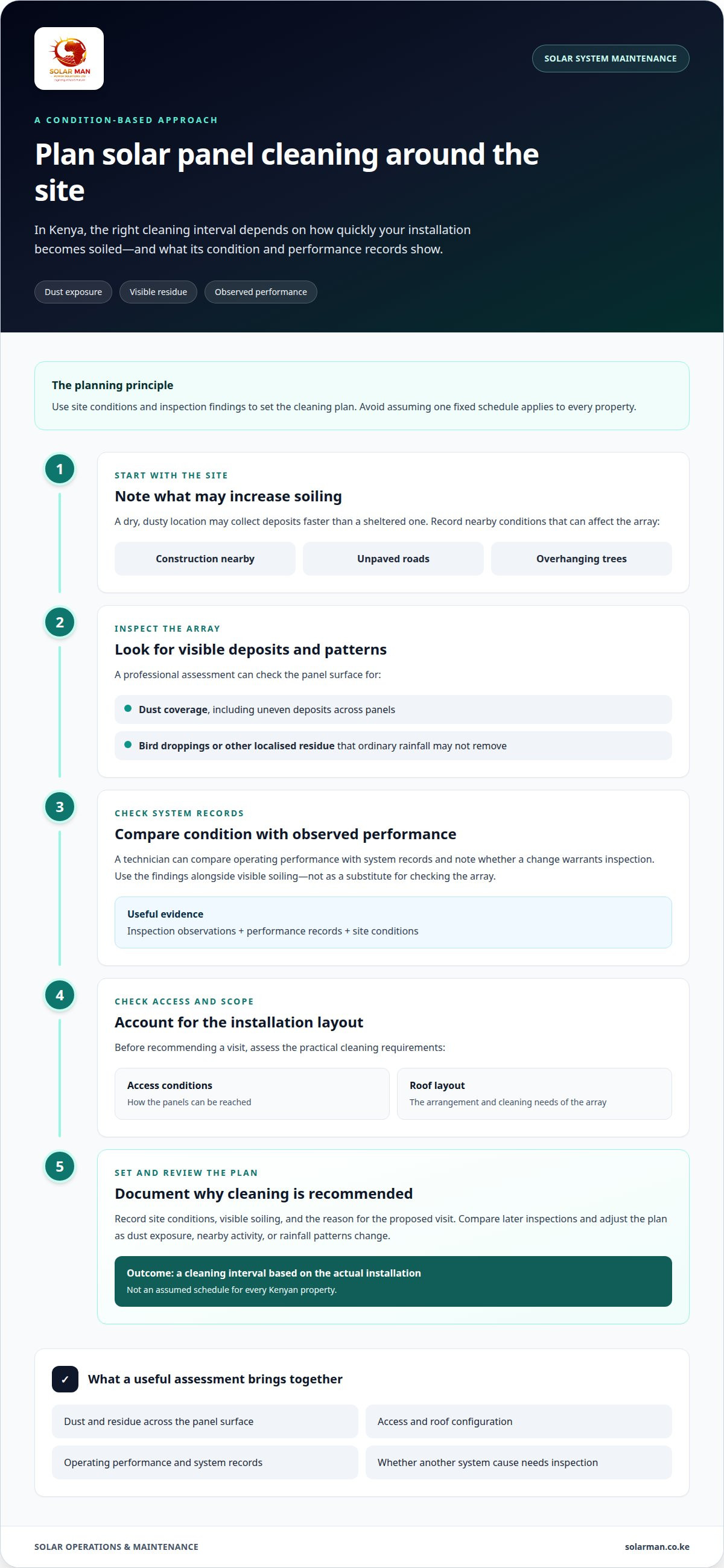
Panel soiling is the layer of dust, bird droppings, or other residue that reduces the light reaching photovoltaic cells. A dry, dusty site in Kenya may accumulate visible deposits faster than a sheltered one. Nearby construction, unpaved roads, and overhanging trees can also affect how quickly panels become dirty. A professional assessment considers these site conditions and the array’s observed performance before recommending cleaning.
A cleaning interval is the planned time between professional panel-cleaning visits. It should reflect how quickly the specific installation becomes soiled, rather than follow an assumed schedule for every Kenyan property. A technician can inspect the array, note residue patterns, and compare operating performance with system records. If panels near a dusty access road collect residue while sheltered panels remain clear, the exposed array may need attention sooner.
Cleaning is most useful when deposits are visible or performance records show a change that warrants inspection. During a professional visit, the technician can assess:
- Dust coverage across the panel surface, including uneven deposits.
- Bird droppings or other localised residue that ordinary rainfall may not remove.
- Access conditions, roof layout, and the cleaning requirements of the installation.
- Whether the observed performance change may have another system cause.
Cleaning cost is the amount charged for a professional visit to remove panel soiling. The price depends on the job and is provided after a quote request. Factors include array size, site access, roof configuration, residue type, and the work required. A ground-mounted array with clear access may involve different labour and access needs from rooftop panels above a commercial facility. The scope should distinguish panel cleaning from inspection or other maintenance tasks.
For a practical schedule, ask the maintenance professional to document site conditions, visible soiling, and the reason for the recommended visit. This record helps compare later inspections and adjust the cleaning plan as dust exposure, nearby activity, or rainfall patterns change. A condition-based approach in Kenya ties cleaning frequency and cost to the actual installation, rather than an unsupported fixed interval or general market price.
What does solar inverter servicing cost in Kenya?
Inverter servicing is a professional assessment of an inverter’s condition, operation, and connections. The cost depends on the system and work required, not just the inverter model. The price is provided after a quote request. Factors include inverter type, system configuration, site access, diagnostic time, and any required repair or replacement. Diagnosing a fault differs from a routine inspection and may require additional testing.
A service scope is the defined set of inspection and maintenance tasks included in a visit. The technician reviews the reported symptoms, inverter display or fault codes, and relevant system records. The assessment may include checking visible connections, ventilation, operating status, and integration with batteries or other components. A grid-tied installation and a hybrid system may need different checks because their configurations differ.
For example, an inverter showing an alarm may need solar inverter repair diagnosis before repair costs can be determined. The fault code helps guide the assessment, but does not by itself establish the cause or work required. A professional can distinguish a configuration issue from a component fault, then explain the proposed scope before proceeding.
A repair estimate is a cost proposal for corrective work identified during diagnosis. It should separate the inspection from any repair or replacement and specify which work is included. The final KSh amount in Kenya depends on the inverter’s condition and model, the parts required, and the labour involved. Replacing a component is a different scope from resolving a setting or connection issue.
- Provide the inverter make and model, such as a TBB Riiosun II or Sunsynk LYNKS unit.
- Describe the displayed alarm, operating change, or service concern.
- Share relevant system details, including whether batteries form part of the installation.
These details help define the assessment and avoid treating every inverter fault as the same repair. For a system-specific evaluation, arrange professional inverter maintenance based on the equipment and symptoms.
What are common solar system faults in Kenya and how are they diagnosed?
A solar system fault is a condition that disrupts expected power generation, storage, or delivery. Common categories include low energy output, inverter alarms, battery charging problems, and electrical connection faults. A symptom shows that something has changed, but not necessarily why. For example, reduced output may relate to panel soiling, shading, wiring, or another component.
Low output means the system produces less energy than its operating records or expected conditions indicate. A technician compares performance data with the system configuration and inspection findings. The assessment considers panel condition, changes in shading, inverter readings, and connection integrity. This helps distinguish a generation issue from a monitoring or system-operation issue.
An inverter alarm is a displayed warning or fault code reporting an operating condition. The technician records the exact code, checks the inverter’s operating status, and assesses connected system components. An alarm alone does not prove that the inverter needs replacement. Its meaning depends on the equipment model, installation configuration, and diagnostic results.
A battery charging fault occurs when an energy storage system does not charge or discharge as expected. Diagnosis includes reviewing battery status, inverter settings, system records, and relevant connections. For a hybrid installation, the technician also considers how solar generation and backup power interact. This helps determine whether the issue lies in storage, control settings, or another component. For more detail on tracing these causes, see this guide to solar battery troubleshooting.
An electrical connection fault is a loose, damaged, or interrupted connection affecting system operation. A qualified technician inspects the relevant electrical path and tests components using appropriate procedures. The assessment may include cables, protective devices, and connection points. This is professional electrical work, not a repair for the reader to attempt.
For accurate fault diagnosis, the technician connects the reported symptom with system records and inspection evidence. Useful details include the alarm text, when the issue began, and whether it affects generation, battery charging, or backup supply. A maintenance report should identify the diagnosed cause, corrective work, and any remaining performance concerns. This makes fault investigation a traceable maintenance decision.
How do Kenya’s climate, dust, and rainy seasons affect solar panel maintenance
Environmental exposure means the site conditions that affect a solar array’s surfaces and components. Dust from unpaved roads, construction activity, or dry ground can settle on panels in Kenya. Nearby trees may add leaves or bird droppings. Conditions vary by site, so maintenance planning should reflect the array’s actual surroundings.
Dust loading is the accumulation of airborne particles on panel surfaces. A rooftop beside a busy, unpaved access road may collect more residue than a sheltered installation. Dust can obstruct sunlight, and uneven deposits may affect different parts of an array differently. A technician assesses visible soiling alongside system performance rather than treating every site alike.
Rainy-season exposure describes the effects of rainfall and damp conditions on a solar installation. Rain may wash away loose dust, but it does not reliably remove stubborn deposits, bird droppings, or residue at panel edges. A professional inspection can also identify signs of water exposure around mounting points, cable routes, and electrical enclosures.
- At a roadside site, record visible dust patterns and how quickly they return after cleaning.
- Near trees, include leaf accumulation and bird droppings in panel inspections.
- After heavy rainfall, have a professional assess drainage, mounting points, and visible cable condition.
- For a commercial roof, account for nearby construction and access changes when planning maintenance.
Condition-based maintenance means adjusting the schedule to observed site conditions and system behaviour. The technician can document soiling, rainfall effects, access constraints, and performance at each visit. Comparing records helps show whether a site needs more frequent panel attention or a broader system inspection. It also helps distinguish seasonal changes from faults that need diagnosis.
Kenya’s local conditions make a site-specific maintenance assessment more useful than a single schedule for every installation. Arrange a solar maintenance assessment to address dust exposure, rainy-season effects, and the condition of system components.
Solar Man Power Solutions: Solar Operations, Maintenance & System Upgrades
Solar Man Power Solutions provides solar operations, maintenance, and system upgrades for installations that need professional assessment or ongoing technical care. Use this service when panel soiling, inverter alarms, changing site conditions, or reduced performance call for a structured inspection rather than cleaning alone.
Maintenance can address system condition and operating performance, while upgrade work can respond to changed energy needs or an existing system configuration. If an installation needs a broader redesign or additional capacity, Solar PV System Design & Installation is also available. Energy Storage Systems (ESS) and hybrid, grid-tied, or off-grid solutions serve different power requirements.
For an assessment, provide the system configuration, observed performance issue, and any inverter alarm or maintenance records. This helps define the relevant checks and work scope. Contact Solar Man Power Solutions to discuss professional maintenance or upgrade requirements for your solar installation.
Make maintenance part of your system plan
Reliable solar performance depends on treating maintenance as part of ongoing asset management, not just a response to visible problems. Clear service records help track recurring faults, changing energy requirements, and decisions about future upgrades. For solar system maintenance in Kenya, connect operating observations with the installation’s wider power needs and site conditions.
Solar Man Power Solutions Ltd supports this work through Solar Operations, Maintenance & System Upgrades and Solar PV System Design & Installation. Its Energy Storage Systems (ESS) and Hybrid, Grid-Tied & Off-Grid Solar Solutions serve different system configurations and power requirements. The right scope depends on the installation and objective, whether maintaining existing equipment or planning a system change.
Set a practical next step by discussing your system’s configuration, observed concerns, and operational priorities. Contact Solar Man Power Solutions Ltd to discuss maintenance, design, or system upgrade requirements, and move forward with a plan suited to your installation.
Frequently Asked Questions
What routine maintenance does a home solar system need in Kenya?
A home system needs periodic professional checks of its panels, mounting, inverter, wiring, and any battery storage. Maintenance records can reveal gradual changes that a single visit may not show. For example, a technician can compare a new performance concern with earlier service notes and system readings. Arrange an assessment after a reported fault or a change to the installation, such as adding equipment.
What are typical solar system maintenance costs in Kenya per year?
Annual maintenance cost depends on the system’s condition and the work included, so there is no single figure that applies to every installation. The price is provided after a quote request. The total may reflect inspection scope, site access, required repairs, replacement parts, and service frequency. A quote should distinguish routine maintenance from corrective work identified during the assessment.
How often should solar batteries be inspected or replaced in Kenya?
Battery inspection and replacement timing depend on the battery type, manufacturer guidance, operating conditions, and observed performance. A technician can review charging behaviour, system records, alarms, connections, and the battery’s physical condition. Replacement should follow an assessment of the battery’s condition and ability to meet system requirements, rather than an assumed lifespan for every installation. The technician can also use solar battery troubleshooting guidance to investigate charging or shutdown issues before recommending replacement.
How can a licensed technician maintain a solar system in Kenya, and what should clients expect?
Arrange a maintenance assessment with a qualified solar technician and provide the system model, reported symptoms, and relevant service records. The technician can review the installation, assess inverter and battery operation, inspect relevant electrical components, and explain the findings and proposed work. The scope should reflect the actual system and fault. Solar Man Power Solutions Ltd offers inspections, troubleshooting, repairs, performance monitoring, and upgrades.