
Conduct a solar system energy audit before choosing solar equipment, and repeat it when your loads, operating hours, backup priorities, or site conditions change. By recording appliance ratings, run times, peak demand, daytime use, and critical loads, the audit shows how much energy your home, business, or institution needs and when it needs it. These findings inform solar panel, battery, and inverter selection instead of relying on broad estimates. In Kenya, an assessment is useful before a new installation, when electricity consumption changes, or when backup power no longer meets essential needs. Load scheduling and efficiency improvements can also affect the system required.
This guide explains when to conduct an audit, what professionals assess about appliances and usage patterns, and how the results shape equipment choices, including how storage can support priority loads during power interruptions.
Key Takeaways
- Account for appliance ratings, quantities, and operating hours to build a more reliable picture of daily energy demand.
- Identify which loads are essential during outages so battery storage and inverter capacity align with your backup priorities.
- Review when and how energy is used to spot avoidable demand, peak periods, and opportunities to shift operations to daylight hours.
- Use audit findings alongside site conditions to guide solar panel placement and system sizing before installation decisions are made.
How a professional auditor assesses appliance lists, power ratings and daily operating hours
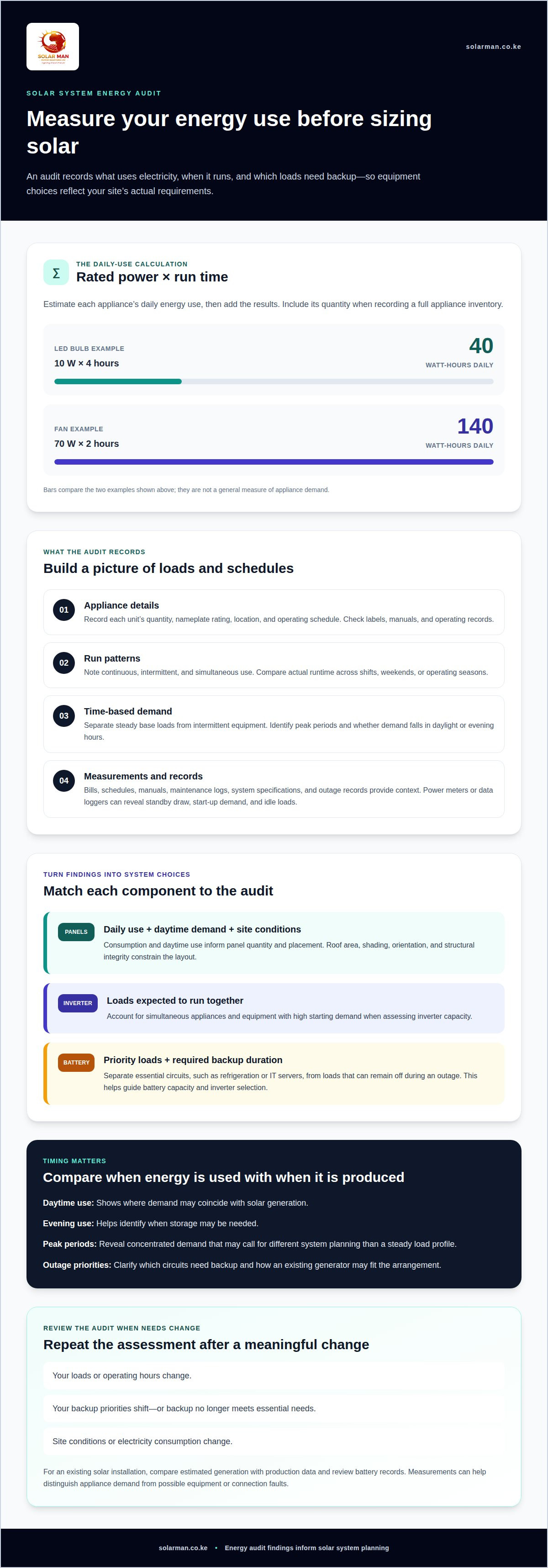
A professional begins by inventorying appliances and recording each unit’s quantity, nameplate rating, operating schedule, and location. For a solar system energy audit, these details establish which loads run continuously, intermittently, or together. The auditor verifies ratings against equipment labels, manuals, and operating records, noting differences between similar appliances. A 10-watt LED bulb used for four hours consumes 40 watt-hours daily; a 70-watt fan used for two hours consumes 140 watt-hours.
Estimate daily appliance energy use by multiplying each device’s quantity by its rated power and daily operating hours, then adding the results. This provides a working estimate, not a substitute for measured demand. The auditor checks schedules with occupants or facility staff and notes differences between shifts, weekends, and operating seasons. This reveals which loads run simultaneously and helps distinguish actual runtime from assumed runtime.
Useful records include recent electricity bills, appliance schedules, equipment manuals, and maintenance logs. You can also provide previous solar installation documents, inverter or battery specifications, and records of outages or backup operation. These materials help the auditor compare billed consumption with equipment-level estimates and understand the site’s operating requirements.
To measure energy use, the auditor may use suitable power meters, current-measuring instruments, or data loggers at appliance or circuit level. Measurements across operating periods can reveal standby draw, start-up demand, and loads that remain active when equipment appears idle. The auditor compares readings with nameplate values and checks operating conditions before interpreting differences.
Inefficient appliances and processes may become apparent when measured consumption is high relative to the service delivered, or equipment runs unnecessarily. The auditor can identify avoidable lighting, poorly scheduled equipment, and persistent standby loads. For existing solar installations, readings and system records can also point to battery, inverter, or wiring problems. Unexpected consumption, irregular charging, abnormal voltage readings, or circuit losses help narrow down the cause. The findings distinguish appliance demand from possible equipment or connection faults.
Using audit results to choose solar panels, batteries and inverters
Audit findings connect recorded demand to equipment capacity. Daily consumption and daytime use help determine solar panel quantity and placement, while roof area, shading, orientation, and structural integrity constrain the array layout. A solar system energy audit assesses usable generation potential against the load profile, rather than relying on panel ratings alone.
The inverter must support the appliances expected to operate simultaneously, including equipment with high starting demand. Battery capacity depends on which loads need backup and how long they must run. The auditor separates essential circuits, such as refrigeration or IT servers, from loads that can remain off during an outage. This analysis guides battery and inverter selection.
A general home energy audit examines energy use and may assess insulation, windows, doors, and heating or cooling equipment. A solar-focused audit also evaluates electrical infrastructure, solar potential, generation requirements, and backup needs. The assessments can overlap, but they answer different planning questions.
Solar panel output is estimated using panel ratings and site conditions, including orientation and shading. For an existing installation, the auditor compares estimated generation with actual production data, then considers losses through conversion and storage. System efficiency is assessed by examining how much generated electricity reaches the loads or battery under operating conditions.
Backup analysis considers outage priorities, operating schedules, and the role of any existing generator. The generator may support selected loads or complement battery storage, depending on the required backup arrangement. Solar output monitoring and battery records help show when electricity is produced, stored, and used. That tracking can reveal mismatches between generation and demand. For equipment planning, solar panel systems must be considered alongside the site’s measured loads and installation conditions.
An audit informs panel, inverter, and battery quantities and helps establish backup needs. For businesses, it identifies critical and noncritical loads, supports storage planning, and helps size a system around demand. Addressing these factors can improve efficiency and inform installation and maintenance decisions.
Assessing equipment loads and energy consumption patterns
A professional assessment maps electricity demand throughout the day, not just total consumption. The auditor compares utility bills with operating schedules, then separates continuous base loads from equipment that runs intermittently. At home, refrigeration may operate overnight while laundry equipment runs during daylight. This distinction shows whether solar generation coincides with demand or storage is needed to cover evening use.
Time-based measurements reveal peak periods and changes in energy consumption across weekdays, weekends, and operating seasons. At a business, the auditor may compare opening hours, production schedules, and equipment start-up periods. A concentrated morning peak can create different system requirements from a steady demand profile. Seasonal records also help explain changes in electricity use when occupancy or operating conditions shift.
For a home solar power system, the professional reviews bills, load schedules, equipment records, and system data, then inspects the array, inverter, battery, and electrical connections. The auditor measures relevant circuits, records generation and consumption patterns, and compares actual operation with intended backup priorities. The assessment helps distinguish changes in demand from possible system performance issues.
Measurements can identify loads that continue drawing electricity when occupants expect them to be off. Examples include standby equipment, exterior lighting left on during daylight, or pumps running outside required schedules. The auditor compares readings with the facility’s routine and identifies whether operational changes or equipment upgrades could reduce unnecessary demand.
At larger sites, the auditor separates critical loads from processes that can be delayed or temporarily switched off. Security systems and refrigeration may require continuous supply, while some nonessential operations can shift to solar production hours. This load profile supports decisions about backup priorities and energy scheduling, and can show when changes in demand warrant a fresh assessment.
Benefits of an energy audit for solar system design
An accurate audit links renewable energy design to measured demand, site conditions, and operating priorities. It helps prevent panel capacity from being based only on roof area or electricity bills. For example, a shaded roof and heavy evening demand require different planning from an unshaded roof with daytime operations. The audit turns these conditions into design inputs.
An audit can identify practical ways to reduce demand before installation. The auditor may find lighting left on during daylight, equipment running outside operating hours, or energy-intensive work that could shift into solar production periods. Reducing avoidable demand can change the required system size and backup scope. Electricity bill savings depend on actual consumption, tariffs, operating schedules, and system performance.
Kenya’s Energy Management Regulations 2012 require designated facilities to conduct a certified energy audit every three years and submit findings to EPRA. This requirement concerns designated facilities and energy audits; it should not be treated as a general solar inspection rule for every property. Solar inspection requirements depend on the applicable project and installation context.
During a solar assessment, the professional examines accessible electrical connections, cable condition, protective devices, mounting security, and signs of heat damage or water entry. These checks can identify risks such as loose connections, damaged insulation, exposed conductors, or unstable panel supports. Electrical isolation and safe access are essential during inspection, particularly around live equipment and rooftop arrays; for complex elevated installations, industrial height safety providers such as Dangle® demonstrate how specialist rope access techniques enable secure inspection work at height.
The key design benefit is a system matched to real operating conditions, rather than an assumed load. Audit findings also establish a baseline for later performance monitoring, helping distinguish changes in consumption from changes in solar output. For a professional assessment that connects energy use with system planning, arrange a solar energy audit.
Solar Man Power Solutions Ltd: Energy Audits, Monitoring & Energy Management
Solar Man Power Solutions Ltd provides Energy Audits, Monitoring & Energy Management to help you assess electricity use and turn findings into practical system decisions. Use this service before a new installation, when operating loads change, or when an existing system no longer meets your backup priorities.
Audit findings can inform Solar PV System Design & Installation, Energy Storage Systems (ESS), and Hybrid, Grid-Tied & Off-Grid Solar Solutions. The assessment connects your consumption profile, site conditions, and essential loads with the system configuration being considered. For an existing installation, monitoring can track output and operation over time, supporting decisions about performance and future requirements.
Contact Solar Man Power Solutions Ltd to discuss an energy assessment for your home, business, or institution.
Turn audit findings into a practical next step
Treat the audit as an operating reference, not a one-time purchasing document. If occupancy, production schedules, or backup priorities change, compare the new conditions with the original planning assumptions before expanding or replacing equipment. Record the reasons for each change so future decisions reflect how your site operates, rather than outdated expectations.
A solar system energy audit can also help you define the performance measures that matter for your property, such as energy supplied to priority circuits or solar contribution during operating hours. Solar Man Power Solutions Ltd’s engineering team can connect those objectives to system planning and installation, with the technical scope aligned to your requirements.
Before proceeding, identify the operational priorities your system must support and the decisions the audit should inform. This gives the technical discussion a clear purpose. When you are ready to discuss your requirements, contact Solar Man Power Solutions Ltd and take a considered next step toward your solar plans.
Frequently Asked Questions
When Should You Conduct an Audit?
Conduct an audit before committing to a new installation, after major changes to occupancy or equipment, or when electricity bills rise without an obvious operational cause. Adding refrigeration or extending business hours, for example, can change demand and affect equipment selection. In Kenya, designated facilities must conduct a certified energy audit every three years and submit findings to EPRA under the Energy Management Regulations 2012.
What is a solar system energy audit and what does it assess?
A solar system energy audit assesses a property’s electricity use alongside its solar installation, providing information for system planning and operational decisions. For an existing system, the assessment can compare utility bills with inverter and battery records, then identify differences between expected and observed operation. This can be useful after equipment is added or when usage changes and the system’s contribution needs review.
How often should a solar power system be audited or serviced?
Inspection timing depends on the equipment manufacturer’s maintenance guidance and the installation’s operating conditions. Arrange an inspection if a warning appears, visible damage occurs, or the system behaves differently than expected. Dust exposure, weather, and equipment condition can influence maintenance needs. An auditor can assess whether observed changes call for servicing, further testing, or a separate review of energy use.
How much can an energy audit save on electricity bills?
There is no fixed savings amount. Results depend on actual consumption, tariffs, operating schedules, and system performance. An audit can identify avoidable demand and opportunities to shift energy use to daylight hours.
Disclaimer
**Disclaimer**
The information published on this website is provided by Solar Man Power Solutions Ltd for general informational and educational purposes relating to solar energy, renewable energy systems, power backup, energy storage and related technologies.
While we make every effort to ensure that the information is accurate, reliable and up to date, product specifications, technical details, prices, availability and system configurations may change without prior notice. Information provided in our articles, guides and product descriptions should not be considered a substitute for a professional site assessment, technical evaluation or customized quotation.
**Solar System Performance:** Actual solar system performance, energy generation, battery backup duration and savings depend on several factors, including geographical location, weather conditions, equipment specifications, installation quality, energy consumption patterns and system maintenance. Any performance figures or estimated savings are indicative and are not guaranteed results.
**Product Information:** Product images, descriptions, specifications and technical information are provided for reference. Manufacturers may update product designs, specifications and features from time to time.
**Pricing and Quotations:** Prices, promotions and product availability displayed on this website are subject to change. Final project costs and system recommendations are determined following an assessment of the customer's requirements and site conditions.
**Professional Installation:** Solar installations and electrical systems should be designed, installed and commissioned by appropriately qualified professionals in accordance with applicable Kenyan laws, regulations and technical standards.
**External Links:** This website may contain links to third-party websites for additional information. Solar Man Power Solutions Ltd is not responsible for the content, accuracy or privacy practices of external websites.
By using this website, you acknowledge that the information provided is for general guidance and that any purchasing, installation or investment decision should be based on appropriate professional advice and an assessment of your specific requirements.
For technical assistance, product enquiries, quotations or professional solar energy solutions, please contact Solar Man Power Solutions Ltd through our official communication channels.
**Solar Man Power Solutions Ltd**
Reliable Solar & Energy Storage Solutions for East Africa.
Website: https://solarman.co.ke