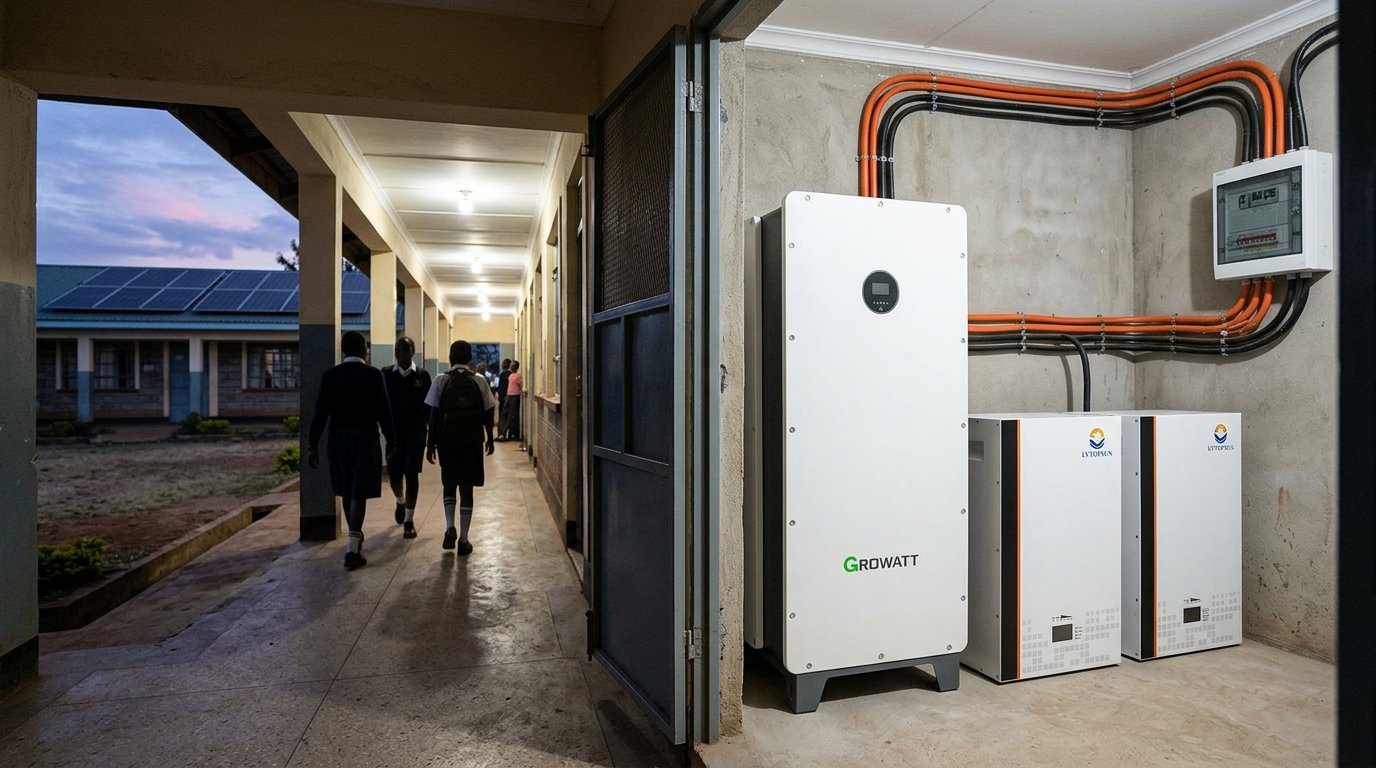
A school’s solar system should be designed around the loads it needs to serve, not simply the size of its roof. Solar can support classroom and dormitory lighting, administration, ICT equipment, water pumps, and other essential loads. Battery storage can supply selected circuits when solar generation is unavailable.
For solar power for institutions in Kenya, the right configuration depends on electricity use, operating schedules, site conditions, and backup needs. A day school with mainly daytime demand has different requirements from a boarding school running kitchens, dormitories, and essential equipment after daylight hours.
This guide explains which school loads solar can serve, how system design and storage needs vary by school type, and how energy audits, installation planning, and performance monitoring support sound decisions. It also covers practical operating considerations to help you assess options against your school’s actual demand and continuity needs.
Key Takeaways
- Map the school’s essential loads, operating hours, and backup priorities to identify which circuits solar should serve.
- System size and battery storage vary by school type; use actual electricity consumption and an energy audit to guide design.
- Plan installation, maintenance, and performance monitoring together so system operation can be assessed over time.
- Compare grid-tied, hybrid, and off-grid configurations against the school’s power needs and continuity requirements.
What Can be Powered by Solar in a School?
Solar can supply lighting, classroom equipment, ICT systems, water pumps, and selected kitchen loads. Planning solar power for institutions in Kenya starts by identifying which circuits need daytime generation and which require backup.
School Energy Needs
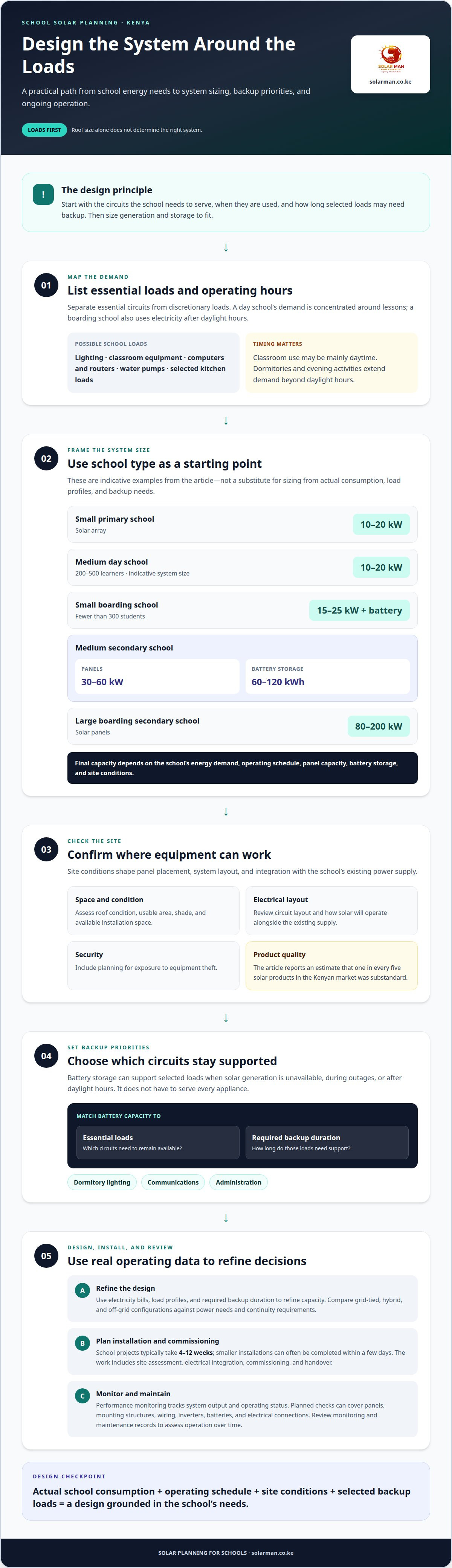
A school’s energy needs include the electrical loads required for teaching, administration, accommodation, and daily operations. Timing matters: a day school concentrates demand during lessons, while a boarding school also needs power for dormitories and evening activities. Solar can support lighting, computers, routers, water pumping, and selected food-preparation equipment. Separating essential circuits from discretionary loads helps set backup priorities and avoids treating every appliance as equally critical.
Solar System Location and Sizing
System location and sizing determine how much electricity a school can generate and which loads it can serve. A small primary school is described with a 10kW to 20kW solar array, while a medium secondary school may use 30kW to 60kW of panels and 60kWh to 120kWh of battery storage. Large boarding secondary schools may use 80kW to 200kW of panels. Roof suitability, available installation space, shade, and circuit layout affect placement; battery storage supports selected loads beyond solar generation hours.
Kenya’s Finance Act No. 8 of 2021 amended the VAT Act to exempt specialized solar and wind energy equipment from VAT. Leases spread equipment payments over an agreed term, power purchase agreements link payment to supplied electricity, and concessional loans finance equipment through borrowing.
There is no single system size for every institution. The scope depends on energy demand, panel capacity, battery storage, and site conditions.
Roof condition and usable area affect equipment placement; security planning addresses theft exposure. Equipment quality also matters: an estimated one in every five solar products in the Kenyan market was substandard. Grid interconnection design must account for how the solar system operates alongside the school’s existing supply.
Installation, maintenance and performance monitoring
School solar projects combine site assessment, electrical integration, commissioning, and planned upkeep. In Kenya, installations typically take 4-12 weeks, while smaller installations can often be completed within a few days.
Professional System Design and Installation
Professional design translates a school’s load profile and site conditions into an installation plan. It matters because panel placement, electrical integration, and system testing affect safe operation and how well the investment meets priority loads. EPRA’s Solar Photovoltaic System Regulations were gazetted in 2012 and provide for licensing solar industry practitioners. For an institutional project, practitioner licensing is therefore a relevant qualification when selecting an installer. Design also needs to account for existing power sources and planned backup circuits.
Maintenance and System Repairs
Solar system maintenance involves the inspections and care needed to keep equipment operating safely and efficiently. Planned checks can cover panels, mounting structures, wiring, inverters, batteries, and electrical connections. They can help identify physical damage, loose connections, or changes in system output before priority school loads are affected. Repairs should address the identified fault and be followed by system testing. Comparing maintenance records with operating data helps schools track recurring issues and assess whether the system still supports its intended loads.
Installation Timelines and Remote Monitoring
Installation timelines cover site work, electrical integration, commissioning, and handover. School projects typically take 4-12 weeks, while smaller installations can often be completed within a few days. Remote performance monitoring tracks system output and operating status, helping identify changes that may need inspection. Monitoring records can also distinguish reduced solar generation from increased school demand or grid power outages. Reviewing these data alongside maintenance records gives school managers a clearer basis for scheduling service and assessing energy savings over time.
Solar system sizes and battery storage by school type
System capacity and storage should reflect each school’s consumption patterns and backup priorities. School type helps frame the design, but load profiles determine the final configuration.
System Sizing by School Type
System sizing matches solar generation capacity to a school’s electricity use and operating schedule. It matters because day and boarding schools have different demand profiles. A medium day school with 200-500 learners has an indicative system size of 10-20 kW. A small boarding school with fewer than 300 students is listed at 15-25 kW plus battery. Installers use electricity bills, load profiles, and required backup duration to refine capacity.
Battery Backup and Reliability
Battery backup stores generated electricity for use when solar panels are not producing enough. It can support selected circuits during outages or after daylight hours. Battery capacity is matched to essential loads and the length of time they need support. Storage might prioritize dormitory lighting, communications, or administration rather than every appliance. The required capacity therefore depends on consumption and which loads must remain available.
Solar Panels, Inverters, and Batteries
Panels, a solar inverter, and batteries each play a distinct role. Panels generate direct-current electricity, the inverter converts it into alternating-current electricity for compatible school loads, and batteries store energy for later use. Their combined ratings must suit the school’s demand profile. A system designed for daytime classroom use, for example, differs from one serving evening lighting and overnight loads.
Hybrid Systems and Backup Capabilities
A hybrid system combines solar generation, battery storage, and grid supply to serve selected loads. It can suit a school seeking solar energy for daytime consumption and backup during grid interruptions. The system manages how generation, stored electricity, and grid power serve connected circuits. Defining priority loads and backup needs during design helps the school understand which equipment can operate during an outage and how storage supports continuity.
Professional solar audits and system design
A professional solar audit reviews an institution’s electrical infrastructure and operating constraints before design decisions are finalized. Planning solar power for institutions in Kenya starts with documenting existing circuits, equipment condition, operating schedules, and planned facility changes. This gives decision-makers a clearer technical basis for setting project scope.
An audit can review distribution boards, available electrical drawings, existing backup equipment, and recurring operational issues. It can also record anticipated changes, such as new classroom blocks, laboratory equipment, or expanded clinical services. These details help distinguish immediate requirements from future needs and reduce the risk of designing around an incomplete picture of facility operations.
System design coordinates solar equipment with the institution’s electrical infrastructure. It should identify connection points, circuit arrangements, equipment locations, and the boundaries between solar supply and existing sources. For solar power for institutions in Kenya, this coordination clarifies how the installation fits the facilities and what electrical work the project involves.
Design documentation supports procurement, installation planning, and future technical decisions. It can record the selected equipment, system configuration, connection arrangements, and provisions for changes. For example, a school planning an additional block can consider how it may affect the electrical layout before construction begins. Clear documentation gives facilities and technical teams a shared reference for project delivery and later modifications, without assuming every future requirement belongs in the initial installation.
Solar Man Power Solutions
Solar Man Power Solutions Ltd helps schools translate electricity priorities into a system configuration suited to their operating patterns. Its Solar PV System Design & Installation service aligns required loads with site conditions and the intended supply arrangement. It is a practical next step when you have identified priority circuits and need an engineered plan for generation and continuity.
Design connects school consumption, daily schedules, and backup priorities with panel, inverter, and circuit requirements. A day school may prioritize classroom lighting and ICT during teaching hours; a boarding school may also need evening power for dormitories. Defining these priorities helps align the system with institutional use instead of treating every appliance as equally critical.
Energy Storage Systems (ESS) can be included when selected circuits need stored electricity beyond solar generation hours. The arrangement depends on which loads the school prioritizes and how they operate. This distinguishes essential backup needs from broader energy use without assuming every circuit requires battery support.
Solar Man Power Solutions Ltd also provides Hybrid, Grid-Tied & Off-Grid Solar Solutions. A grid-tied system works alongside the existing supply, while a hybrid configuration combines grid supply, solar generation, and storage. An off-grid design serves sites without grid supply. The right configuration depends on the school’s supply conditions and continuity requirements.
Power Backup & Critical Systems support planning for equipment that must remain available during interruptions. Integrating these priorities with the solar design clarifies which circuits receive backup and how storage fits the overall system. Qualified technicians install systems to industry standards, supporting safe integration with the school’s electrical infrastructure.
Contact Solar Man Power Solutions Ltd to discuss your school’s solar requirements.
Frequently Asked Questions
How Long Does Installation Take?
Institutional solar installation typically takes 4-12 weeks, while smaller school projects can often be completed within a few days. The programme includes site assessment, electrical integration, mounting, commissioning, and handover. Scheduling also depends on access to roofs and switchboards, coordination with school operations, and equipment delivery. Planning work around lessons, examinations, and term breaks can help limit disruption to school activities.
What solar power systems are suitable for schools, hospitals, universities, and other institutions in Kenya?
Grid-tied systems suit facilities seeking to use solar generation alongside an existing grid connection. Hybrid systems add battery storage for selected loads during interruptions or after daylight hours. Off-grid systems serve sites without grid supply. A school may prioritize classroom and dormitory circuits, while a hospital may prioritize critical equipment. The right arrangement depends on the institution’s supply conditions, operating schedule, and continuity requirements.
How does solar power compare with grid electricity and diesel generators in Kenya?
The comparison depends on the institution’s Kenya Power tariff, diesel consumption and maintenance, solar production profile, and battery use. Compare equivalent delivered electricity over the same operating period, including whether storage serves evening or outage loads. Daytime solar generation can offset some grid consumption, while diesel generation depends on fuel use and generator operation. A site-specific energy analysis can help assess the options for your institution.
Which Kenyan solar companies provide institutional design, installation, and maintenance services?
Solar Man Power Solutions Ltd provides solar PV system design and installation, energy storage systems, hybrid, grid-tied and off-grid solutions, and power backup for critical systems. Its services also include maintenance, troubleshooting, performance monitoring, and system upgrades. For a school, hospital, or university, these capabilities connect project design with installation and ongoing technical support, allowing institutional requirements to shape the system configuration and service scope.
What are the steps and timelines for planning and installing solar power at a Kenyan institution?
Planning begins with reviewing electricity use, operating schedules, site conditions, and backup priorities. The design then defines equipment, system integration, and installation scope before site work and commissioning. Institutional installations typically take 4-12 weeks; smaller projects can often be completed within a few days. Coordinating access, procurement, electrical works, and commissioning with the institution’s academic or operating calendar helps organize the project sequence.
What maintenance, warranties, and system lifespan should institutions expect from solar installations in Kenya?
Maintenance can include inspection, troubleshooting, repairs, performance monitoring, and system upgrades. Warranty coverage and duration depend on the equipment and its applicable terms, so distinguish component warranty conditions from maintenance arrangements. Quality solar panels can continue producing electricity for 25 years or more. An institution should also account for the condition of inverters, batteries, wiring, and mounting structures when planning inspections and future system upkeep.
Disclaimer
**Disclaimer**
The information published on this website is provided by Solar Man Power Solutions Ltd for general informational and educational purposes relating to solar energy, renewable energy systems, power backup, energy storage and related technologies.
While we make every effort to ensure that the information is accurate, reliable and up to date, product specifications, technical details, prices, availability and system configurations may change without prior notice. Information provided in our articles, guides and product descriptions should not be considered a substitute for a professional site assessment, technical evaluation or customized quotation.
**Solar System Performance:** Actual solar system performance, energy generation, battery backup duration and savings depend on several factors, including geographical location, weather conditions, equipment specifications, installation quality, energy consumption patterns and system maintenance. Any performance figures or estimated savings are indicative and are not guaranteed results.
**Product Information:** Product images, descriptions, specifications and technical information are provided for reference. Manufacturers may update product designs, specifications and features from time to time.
**Pricing and Quotations:** Prices, promotions and product availability displayed on this website are subject to change. Final project costs and system recommendations are determined following an assessment of the customer's requirements and site conditions.
**Professional Installation:** Solar installations and electrical systems should be designed, installed and commissioned by appropriately qualified professionals in accordance with applicable Kenyan laws, regulations and technical standards.
**External Links:** This website may contain links to third-party websites for additional information. Solar Man Power Solutions Ltd is not responsible for the content, accuracy or privacy practices of external websites.
By using this website, you acknowledge that the information provided is for general guidance and that any purchasing, installation or investment decision should be based on appropriate professional advice and an assessment of your specific requirements.
For technical assistance, product enquiries, quotations or professional solar energy solutions, please contact Solar Man Power Solutions Ltd through our official communication channels.
**Solar Man Power Solutions Ltd**
Reliable Solar & Energy Storage Solutions for East Africa.
Website: https://solarman.co.ke