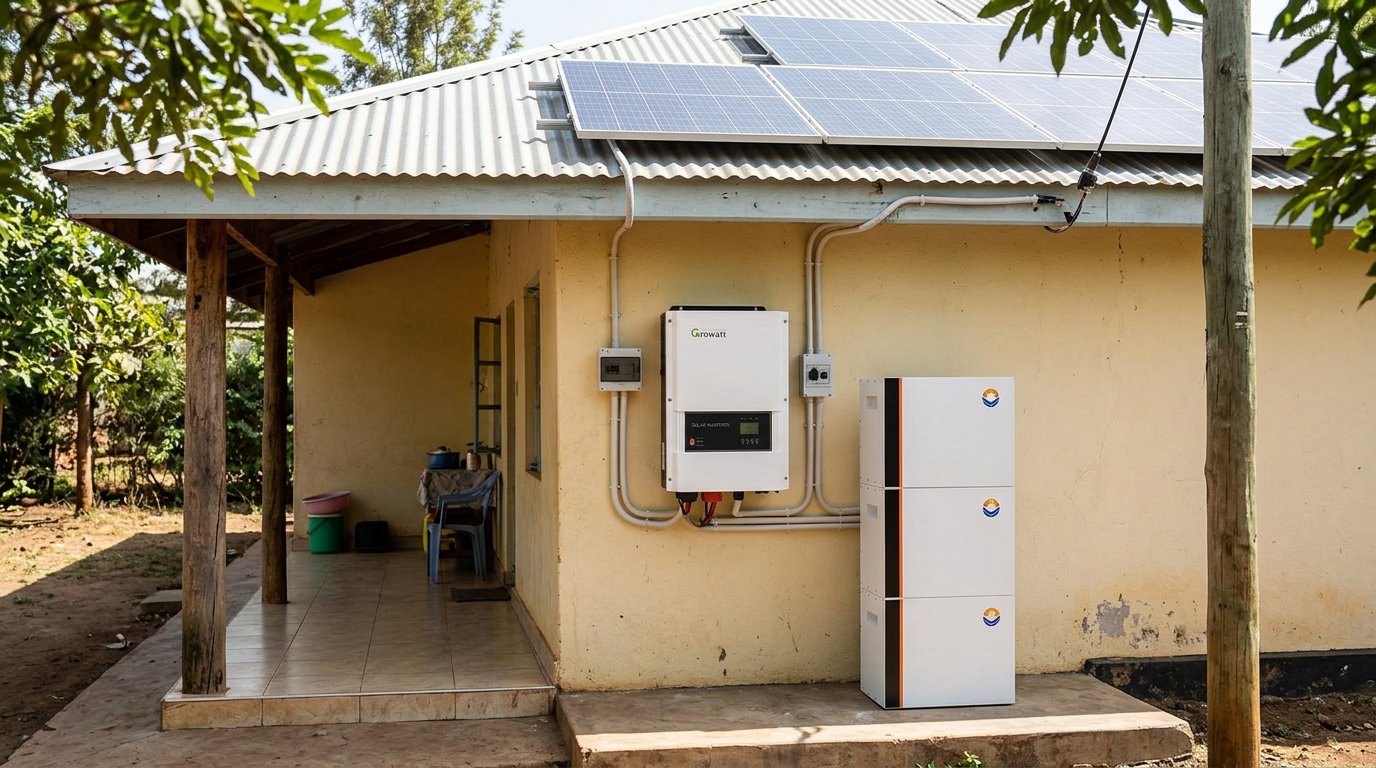
Choosing between off grid vs hybrid solar depends mainly on your grid access and how much independence your site needs. An off-grid system operates without utility power, using solar panels and batteries to supply electricity. A hybrid system combines solar and battery storage with a grid connection that can supplement supply when needed.
Off-grid systems can suit remote sites or locations with limited grid access, but they need careful planning for periods of low solar production and may require a generator for backup. Hybrid systems retain the grid as another power source. Battery backup during an outage depends on the system’s configuration.
This comparison explains how each system uses solar, batteries, the grid and generators, then outlines the energy-use and site factors that guide system sizing in Kenya. You’ll be able to assess which setup better matches your daily consumption, critical loads, desired backup duration and reliance on grid power.
Key Takeaways
- Match your system type to grid access: off-grid designs suit sites without dependable grid supply, while hybrid systems retain the grid as an additional power source.
- Account for how solar panels, batteries, the grid and a generator work together before deciding what will power critical loads.
- Size the system around energy use, peak demand, backup duration and seasonal solar conditions, not just total daily consumption.
- Assess whether a hybrid inverter can support your intended off-grid configuration, including the required storage and backup arrangements.
What is an Off-Grid Solar Inverter?
An off-grid solar inverter converts direct-current electricity from solar panels into alternating-current electricity for equipment without relying on a utility connection. It works with batteries, which store solar energy for use after sunset or during low production. Off-grid systems do not draw power from the grid or export surplus electricity to it. Available inverter ratings range from 1 kW for basic setups to more than 10 kW for whole-house systems.
The off grid vs hybrid solar decision often starts with grid access. Off-grid systems can suit remote sites or places with unreliable grid connections, offering greater independence from utility power. However, the system must meet demand through its own generation and storage. Extended cloudy weather or higher-than-expected consumption can deplete batteries, so a generator may be needed to support critical loads.
For day-to-day energy management, identify essential loads first, such as refrigeration, lighting or communications equipment. Schedule flexible loads, such as water pumping, during periods of stronger solar production. A household that uses high-power appliances after sunset needs enough stored energy for those loads, not just enough solar panels for daytime use. This distinction makes an off grid vs hybrid solar comparison relevant to your daily routine.
| Option | Grid connection | Energy supply | Suitable priority |
|---|---|---|---|
| Off-grid | Not connected | Solar, batteries, optional generator | Grid independence or remote access |
| Hybrid | Connected | Solar, batteries and grid | Storage with grid support |
| Grid-tied | Connected | Solar and grid | Solar use without battery storage |
Choose off-grid when grid access is unavailable or independence is a priority. Consider a hybrid inverter when keeping grid support matters.
When comparing installer quotes in Kenya, use the same load schedule, battery capacity, backup duration, equipment scope and commissioning work. This makes the technical differences easier to assess.
Maintenance needs depend on the equipment and operating conditions. Equipment lifespan also varies with battery chemistry, usage and care, so no single figure applies to every off-grid or hybrid system.
Solar, battery, grid, and generator system components
A hybrid system connects solar panels and batteries to the utility grid; an off-grid system operates without that connection. In Kenya, permits and utility approvals for grid-connected hybrid systems depend on the project and its connection arrangement.
Hybrid Grid Connection and Battery Storage
Solar panels produce direct-current electricity, and a hybrid inverter directs it to loads or battery storage. The grid can supply electricity when solar production is low, while stored energy can support loads during an outage if the system is configured for backup. Unlike a grid-tied system without batteries, a hybrid system stores surplus solar energy. Unlike an off-grid system, it retains a utility connection and can draw grid power when needed.
Off-Grid Battery Storage
An off-grid system stores solar energy in batteries because there is no grid connection to supply loads at night or during low production. Battery capacity must cover demand between charging periods, including essential equipment such as refrigeration, lighting or communications. A generator can supplement supply during prolonged low solar production or unusually high demand. Unlike a hybrid system, an off-grid system cannot draw utility electricity when stored energy runs low.
Battery Capacity and Cloudy-Weather Reliability
Battery capacity describes how much energy can be stored, while backup duration depends on the loads using it. During cloudy weather, solar panels may replenish batteries more slowly, reducing the reserve through repeated low-production periods. A hybrid system may draw grid electricity when solar and stored energy are insufficient. An off-grid system has no grid support, so its batteries and any generator must match the critical-load plan. For example, a site that prioritizes refrigeration can reserve stored energy for that equipment and schedule flexible loads during stronger solar production.
System planning should define which loads need backup, how long they must operate, and how the grid or generator contributes. A solar system design can account for those operating requirements and the site’s connection arrangement.
Sizing systems for electricity use and solar resources
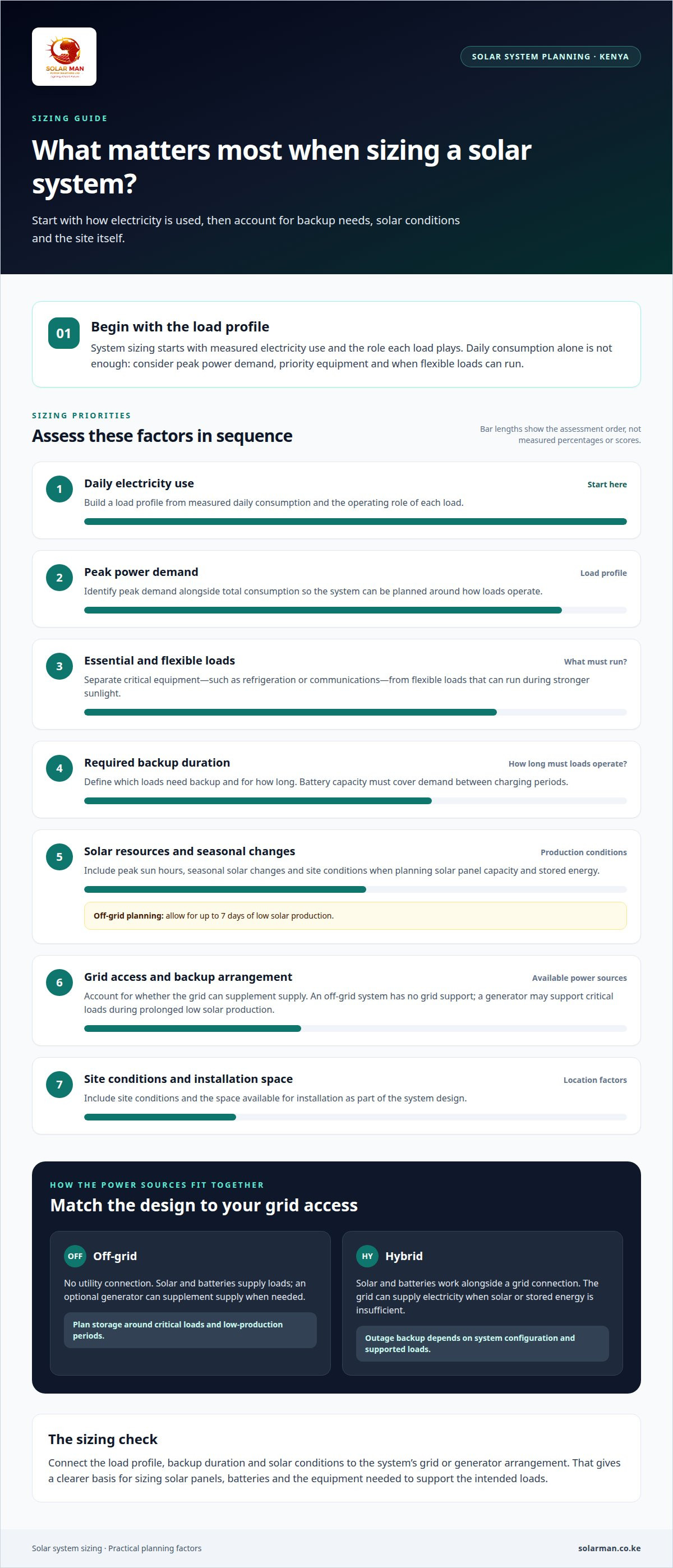
System sizing starts with measured electricity use and the operating role of each load. In Kenya, solar resources, grid access, backup needs and available installation space all shape the design.
Build a load profile from daily consumption, peak power demand and priority equipment. Separate essential loads, such as refrigeration or communications, from flexible loads that can run during stronger sunlight. Include peak sun hours, seasonal solar changes, site conditions and required backup duration. For off-grid planning, allow for up to 7 days of low solar production. This helps determine solar panel capacity and the stored energy needed to support loads through lower-production periods.
Hybrid Systems for Outages and Limited Net Metering
A hybrid system can use stored solar energy during outages, with grid electricity available when solar generation or battery supply is insufficient. Backup capability depends on the system configuration and the loads it supports. Where export credit is limited or unavailable, storing surplus solar energy makes it available for later use rather than relying on export to the utility grid. The battery and inverter add equipment requirements and need suitable installation space.
Choosing Between Off-Grid and Hybrid Systems
Choose off-grid when a site is remote, lacks a usable grid connection or prioritizes independence. The design must cover critical loads through periods of low solar production without utility support. A hybrid system suits sites that need battery backup but can retain grid access as another supply source. Before choosing, compare daily use, maximum demand, grid reliability, future expansion plans and the required backup duration.
A grid-tied system generally requires less equipment because it has no battery storage. It can send surplus solar electricity to the grid where applicable arrangements allow, but solar backup power systems need backup equipment to maintain supply during an outage. This option suits sites that prioritize solar generation while remaining dependent on the grid.
For homes and businesses, the final design should match panel capacity, battery storage and inverter capability to actual load priorities and available space.
Using hybrid inverters for off-grid operation
A hybrid inverter can be part of an off-grid system, but its label alone does not confirm that it can operate independently. The specific inverter must support operation without a utility grid, and its configuration must match the solar panels, battery storage and connected loads. For homeowners comparing off grid vs hybrid solar, the key question is whether the chosen equipment can operate as intended without grid input.
Start by reviewing the inverter’s operating modes and system diagram. Confirm that the planned design can supply loads without the grid, manage battery charging from solar energy and meet the site’s peak demand. A hybrid inverter designed for grid-connected use may need different settings or compatible equipment for standalone operation. Do not assume that every hybrid model supports both configurations.
Next, size battery capacity for consumption during periods without useful solar production. List essential evening loads separately from equipment that can run during daylight. The battery must provide the required energy, while the inverter must handle simultaneous demand. Solar panel capacity must replenish expected use, including after cloudy periods. A generator can provide another source if the design requires backup during prolonged low production.
Decide how to manage excess solar energy. In an off-grid configuration, surplus generation can charge batteries or serve available loads, but it cannot be exported without a grid connection. If grid access is added later, the design may need adjustment. Some hybrid systems can begin as grid-tied installations and add energy storage later. Expansion depends on equipment compatibility and system design.
The practical takeaway from the off grid vs hybrid solar comparison is to specify standalone operation before selecting an inverter. Align its supported configuration with loads, battery capacity, solar input and backup needs. A system design can account for those requirements before installation. Plan your off-grid solar system around its actual operating conditions.
Solar Man Power Solutions Ltd: Hybrid, Grid-Tied & Off-Grid Solar Solutions
Solar Man Power Solutions Ltd helps you choose a system configuration based on grid access, electricity use, backup priorities and site conditions. Its Hybrid, Grid-Tied & Off-Grid Solar Solutions address different operating needs, from retaining a utility connection to designing for standalone power.
For a home or facility with variable demand, Solar PV System Design & Installation aligns panel generation and inverter capacity with the load profile. When stored energy is needed for evening use or backup, Energy Storage Systems (ESS) can form part of the design. Power Backup & Critical Systems can also help plan for designated essential loads.
Bring your typical electricity use, priority equipment and backup needs to the design discussion. These details help shape a system around how your site operates, rather than selecting equipment by capacity alone. Contact Solar Man Power Solutions Ltd to discuss the solar configuration that fits your power requirements.
Move from system choice to site planning
Choosing off grid vs hybrid solar is the starting point for a site-specific design. Before selecting equipment, gather your operating schedule, essential loads, available installation space and backup requirements. These details turn a general preference into a practical design brief.
Solar Man Power Solutions Ltd provides Solar PV System Design & Installation, Energy Storage Systems (ESS), and Hybrid, Grid-Tied & Off-Grid Solar Solutions. Its technical team applies these services to your project requirements. A design discussion can help when you are planning a new installation or assessing how storage fits your power needs.
Set out your priorities, then contact Solar Man Power Solutions Ltd to discuss your solar requirements. A clear brief gives your project a practical starting point.
Frequently Asked Questions
What Is a Hybrid Solar System?
A hybrid solar system combines solar generation and battery storage with a utility connection. During the day, solar electricity can supply active loads and charge the battery; stored energy can then serve selected loads later. For a small business, this can help coordinate daytime equipment use with evening security lighting, while the grid remains an additional supply source.
Off-grid – what is it, and what does it mean for homeowners?
Off-grid means your home operates without a utility connection, relying on its solar installation and stored energy for electricity. Plan appliance use around available generation and storage. For example, running a water pump during productive daylight hours can preserve battery energy for evening needs. A generator may provide another source if low solar production lasts longer than expected.
What Is a Hybrid Inverter?
A hybrid inverter manages electricity between solar panels, batteries, household loads and, where connected, the grid. It converts direct current from solar panels into alternating current for compatible loads and can convert incoming alternating current to charge batteries. Its functions depend on system design and settings. Check that the planned operating mode suits the equipment and loads the installation must support.
Which System Best Fits Your Needs?
The better fit depends on grid access, battery requirements and how you use electricity. A grid-tied setup avoids battery storage, while off-grid and hybrid designs include storage when backup or independence matters. Compare the equipment needed for priority loads and your operating schedule, along with how much grid supply the site can retain.
What is the difference between off-grid and hybrid solar systems?
The key difference is the grid connection: off-grid systems operate independently, while hybrid systems retain a utility connection alongside solar and batteries. This affects how each site handles extended periods of low solar production and future changes in grid access. For a remote property, standalone operation may be central to the design; a connected home can keep grid electricity as another supply option.
How do off-grid and hybrid solar systems work during a power outage?
An off-grid system continues supplying loads from solar generation and stored energy as long as those sources can meet demand. A hybrid system can supply selected loads from its battery if configured for backup; the supported circuits depend on the system design. A grid-tied system without backup equipment cannot maintain power during an outage. A generator can provide another source when included.