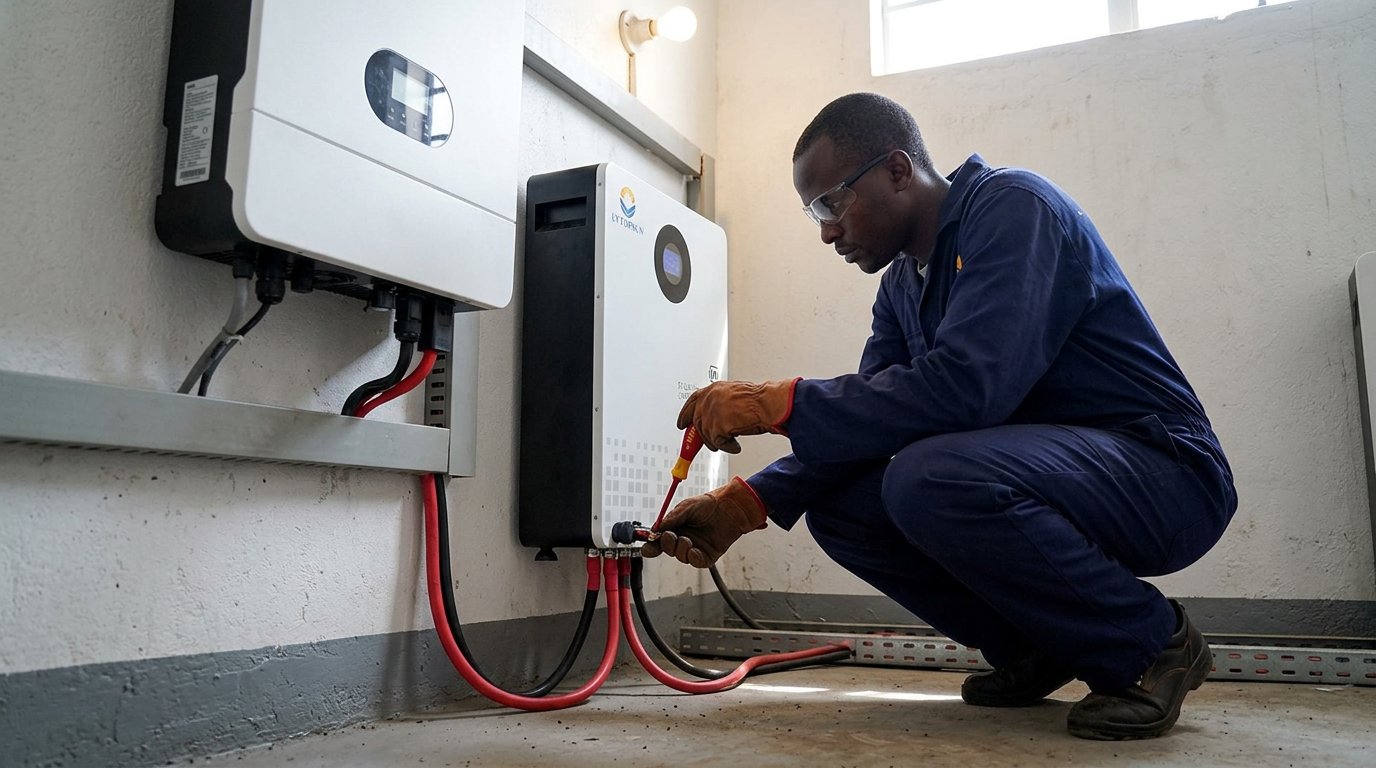
Solar battery troubleshooting starts by tracing the fault through the battery, wiring, charge controls and inverter, rather than assuming the battery has failed. A qualified solar technician assesses system behaviour and component compatibility to find whether a degraded battery, faulty wiring, loose terminals, reverse polarity or an inverter mismatch is interrupting charging, storage or power delivery.
You’ll learn what a technician checks, how battery and inverter compatibility affects operation, and why poor charging or unexpected shutdowns can have several causes. These steps explain when professional testing is needed and what to expect from diagnosis before repairs or system adjustments.
Key Takeaways
- A technician can trace charging faults through the charge controller and battery management system before concluding that the battery has failed.
- Loose terminals, damaged wiring and reverse polarity can disrupt operation and create safety risks that require professional inspection.
- Battery protection mode may explain unexpected charging or shutdown behaviour, so diagnosis should include battery condition and system settings.
- Matching the battery and solar inverter’s voltage and communication requirements is essential to resolving integration faults.
How Solar Technicians Troubleshoot Your Solar System: 5 Common Issues
A qualified technician traces charging failures through the battery, charge controller and inverter. The checks below help distinguish normal charging from faults that need system testing.
Start with Safe Battery Troubleshooting by a Qualified Technician
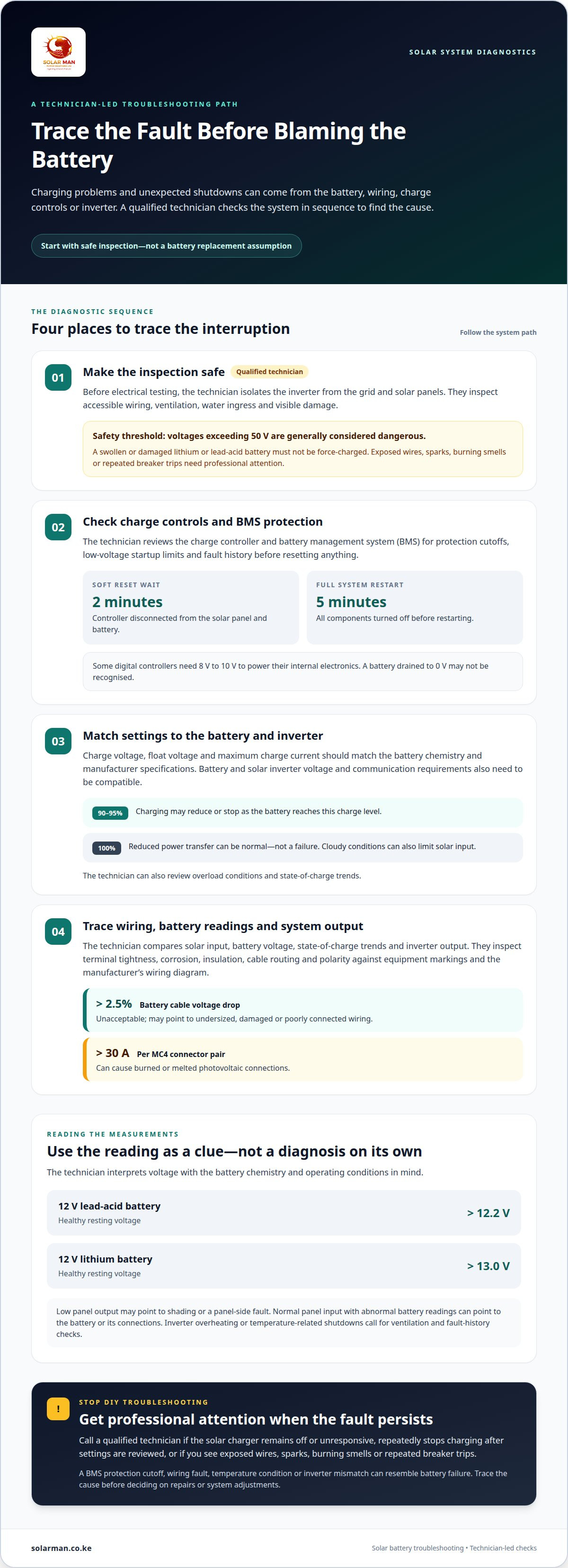
Arrange a qualified technician’s inspection if charging stops or the battery behaves unexpectedly. Before electrical testing, the technician isolates the inverter from the grid and solar panels, then checks accessible wiring, ventilation, water ingress and visible damage. Voltages exceeding 50 V are generally considered dangerous. A swollen or damaged battery must not be force-charged, whether lithium or lead-acid.
How a Technician Resets the Controller and Checks BMS Cutoffs
Have the technician assess the charge controller and battery management system (BMS) before resetting either device. For a soft reset, the technician disconnects the solar panel and battery, leaves the controller disconnected for 2 minutes, then reconnects them. A full system restart begins with all components turned off and a 5-minute wait. The technician checks for BMS protection cutoffs and confirms whether low battery voltage prevents the controller from starting.
How a Technician Reviews Charging Settings and Battery Behaviour
Ask for the inverter and controller settings to be checked against the battery’s chemistry and manufacturer specifications. Charge voltage, float voltage and maximum charge current must match those specifications. The technician also checks overload conditions and monitors state-of-charge trends. Charging may reduce or stop when a battery reaches 90%-95% charge; at 100%, reduced power transfer can be normal, not a failure. Cloudy conditions can also limit solar input.
Know When to Call a Solar Technician
Stop troubleshooting and call a qualified technician if the solar charger remains off, unresponsive or repeatedly stops charging after settings are reviewed. A controller may not start if battery voltage falls below its recovery threshold; some digital controllers need 8V to 10V to power their internal electronics. A battery drained to 0 V may not be recognised. Exposed wires, sparks, burning smells or repeated breaker trips also require professional attention—for instance, property owners in Sydney can consult clean energy professionals like Brighter Sparks Electrical Pty Ltd for onsite testing and fault resolution.
Faulty wiring, loose terminals, and reverse polarity
Have a qualified technician compare battery, panel and inverter measurements to trace connection faults safely, without handling live wiring.
Identify Common Fault Symptoms
Tell the technician about the symptoms and share any inverter or charge-controller error codes. Codes vary by model, so the manufacturer’s manual should be read alongside operating data. Comparing solar input, battery voltage, state-of-charge trends and inverter output helps identify which component is disrupting operation.
For safe battery checks, the technician measures voltage with suitable test equipment and reviews monitor data rather than relying on one reading. A healthy 12V lead-acid battery has a resting voltage above 12.2V; a healthy 12V lithium battery reads above 13.0V. These readings support diagnosis but must be interpreted with battery chemistry and operating conditions.
Ask the technician to compare panel output with battery charging and inverter behaviour. Low panel output may indicate shading or a panel-side fault. If panel input is normal but battery readings are abnormal, the battery or its connections may need attention. Inverter overheating or temperature-related shutdowns also call for checks of ventilation and recorded fault history.
Have a Technician Inspect Wiring and Connections
Arrange an inspection of cable routing, terminal tightness, corrosion, insulation damage and polarity. The technician should verify positive and negative connections against equipment markings and the manufacturer’s wiring diagram. Reverse polarity or a loose terminal can interrupt charging, generate heat or damage connected equipment.
During testing, the technician measures voltage at the battery and inverter terminals under operating conditions. A battery cable voltage drop greater than 2.5% is unacceptable and can indicate undersized, damaged or poorly connected wiring. The technician also checks photovoltaic connectors: exceeding 30A per MC4 connector pair can cause burned or melted connections.
If a BMS cutoff appears in the fault history, the technician investigates its trigger before resetting it. This distinguishes battery protection from a wiring fault or inverter failure. Solar system maintenance can include terminal cleaning, corrosion checks and connection testing. Solar system maintenance supports these checks.
Can a bad battery cause my solar system to fail?
Yes. A degraded battery or a battery management system (BMS) protection shutdown can interrupt storage and power delivery. By tracing system behaviour, a technician can distinguish battery faults from temperature conditions, grid events and connection problems.
Have a Technician Check for BMS Protection Mode
Ask the technician to review BMS status records alongside battery voltage, charging behaviour and inverter output. A BMS may stop charging or discharging when it detects a fault or an operating condition outside its configured limits. The technician can determine whether protection mode reflects a battery issue, a configuration problem or a fault elsewhere in the system.
The technician can also assess battery capacity and compare expected operation with recorded charge and discharge patterns. A cutoff affecting one battery in a series bank can change the bank’s available output. Before deciding whether a reset is appropriate, the technician should inspect battery cables and connections for damage or corrosion.
Have a Technician Assess Lithium Battery Temperature Protection
Request temperature checks alongside BMS status review. Lithium battery charging may be suspended below approximately 5°C as a protection measure, while a LiFePO4 BMS may stop charging below 0°C. The technician uses the battery’s reported temperature and operating history to determine whether a cutoff matches the battery’s protection behaviour.
Performance can decline when battery temperature exceeds 40°C. The technician inspects the battery location, ventilation and temperature records, then checks whether heat coincides with reduced capacity or interrupted output. Prolonged heat exposure can reduce performance and lifespan and create hazards such as thermal runaway, so a protective shutdown should not be bypassed.
- If battery shutdowns coincide with grid events, have the technician review the inverter records. They may show whether the inverter changed operating mode or logged a protection fault as grid supply changed. Comparing event timing with battery status helps distinguish a battery cutoff from an inverter response, without assuming either component has failed.
- Request system testing before replacing a battery. The technician should compare measured battery behaviour with monitoring data, inspect cables and corrosion, and check for BMS faults. If the battery still cannot sustain normal operation after connection and temperature issues are addressed, its condition and capacity become central to the diagnosis.
Battery and inverter compatibility
Compatibility faults can look like battery failure, even when the battery still holds charge. During solar battery troubleshooting, a technician checks voltage class, communication links and operating settings before recommending a replacement.
- Have the technician compare the battery-bank voltage with the solar inverter’s DC input specification. Systems may use 12V, 24V or 48V classes, and a mismatch can prevent correct operation. Equipment labels and configuration records help identify the system voltage. Matching voltage is necessary, but does not by itself confirm that the battery and inverter can communicate or charge correctly.
- Ask the technician to check the communication requirements of both devices, especially in closed-loop lithium systems. The battery management system and inverter need compatible communication protocols. Where closed-loop control is used, the technician should inspect the communication cable and confirm its connection. Firmware or protocol mismatches can disrupt integration, so replacing a battery before checking these links may not solve the problem.
- Have the technician compare inverter and charge-controller settings with the battery chemistry and manufacturer specifications. Charge voltage, float voltage and maximum charge current must meet the battery requirements. Incorrect settings can disrupt charging even when connections are sound. The technician should also check the solar panel input configuration, which affects available charging power.
- Ask for inverter load ratings and operating records to be compared with connected equipment. A 1000W inverter cannot handle a 1200W load; overload may appear as a shutdown rather than a battery fault. Reviewing demand alongside charging behaviour helps distinguish capacity limitations from compatibility faults. This system-level approach makes solar battery troubleshooting more precise and can prevent unnecessary component replacement.
For an assessment of system compatibility, request solar system testing across the battery, inverter and connected equipment.
Solar Man Power Solutions Ltd
Solar Man Power Solutions Ltd can help when battery faults point to wider system design or integration issues. The company provides Solar PV System Design & Installation, Energy Storage Systems (ESS), and Hybrid, Grid-Tied & Off-Grid Solar Solutions. These services are relevant when testing shows that the battery, inverter and wider system need to be assessed together.
If your system has repeated charging interruptions, unexpected shutdowns or compatibility concerns, share the symptoms and any recorded fault information with Solar Man Power Solutions Ltd. This helps focus the assessment on the system issue rather than assuming the battery needs replacing. The company also provides Power Backup & Critical Systems for projects where continuity needs to be considered alongside solar and storage.
Contact Solar Man Power Solutions Ltd to discuss your solar battery or system concerns.
Plan the Next Step for Your Solar System
After identifying a fault, decide whether the existing system can be corrected or needs a broader technical review. Effective solar battery troubleshooting leads to a clear diagnosis and repair path that accounts for how the equipment works together, rather than treating each component in isolation.
Solar Man Power Solutions Ltd provides Solar PV System Design & Installation, Energy Storage Systems (ESS), and Hybrid, Grid-Tied & Off-Grid Solar Solutions. This system-level expertise is relevant when battery performance concerns involve multiple components or the wider power arrangement. The next step depends on the fault findings and your system’s operational requirements.
Discuss your system’s symptoms and diagnostic needs with Solar Man Power Solutions Ltd. A clear technical starting point can help you move toward a considered solution for your home, facility or business.
Frequently Asked Questions
Why might a solar panel not charge your battery, and how can a technician diagnose the cause?
A panel may not provide the voltage or output expected by the system. A technician compares measured PV readings with the panel’s nameplate and system design. For example, a 400W panel rated at 40V open-circuit voltage should measure 36-44V in good sunlight. A reading outside that range directs further testing toward the panel or its operating conditions.
How does a solar technician troubleshoot a solar battery that is not charging?
A technician can review performance records across operating cycles to establish when charging starts, slows or stops. Comparing solar output with weather conditions and expected production can reveal abnormal drops that a single reading might miss. Controller event records provide further context, helping identify whether the pattern follows changing sunlight, a recurring interruption or another system event.
Why might a solar battery drain quickly or fail to hold charge, and how can a technician diagnose it?
Lead-acid batteries can lose charging performance when sulfation develops. Lead sulfate crystals build up on the plates during discharge and may not dissolve during charging. A technician can review charging history and test individual batteries in a series bank for uneven behaviour, revealing whether one unit is limiting the bank rather than the whole bank sharing the same fault.
How does a solar technician troubleshoot solar battery wiring, fuses, and connections?
A technician checks fuse continuity and compares electrical readings on both sides of the fuse to locate an interruption. They trace the circuit through its protective devices and connections, then test the affected path during operation. This helps distinguish an open fuse from a fault elsewhere in the circuit. If fuses fail repeatedly, the underlying cause needs to be found before normal operation resumes.
What do solar inverter and charge controller error codes mean?
Error codes vary by model. A technician interprets them using the manufacturer’s manual and system operating data, including solar input, battery voltage, state-of-charge trends and inverter output.