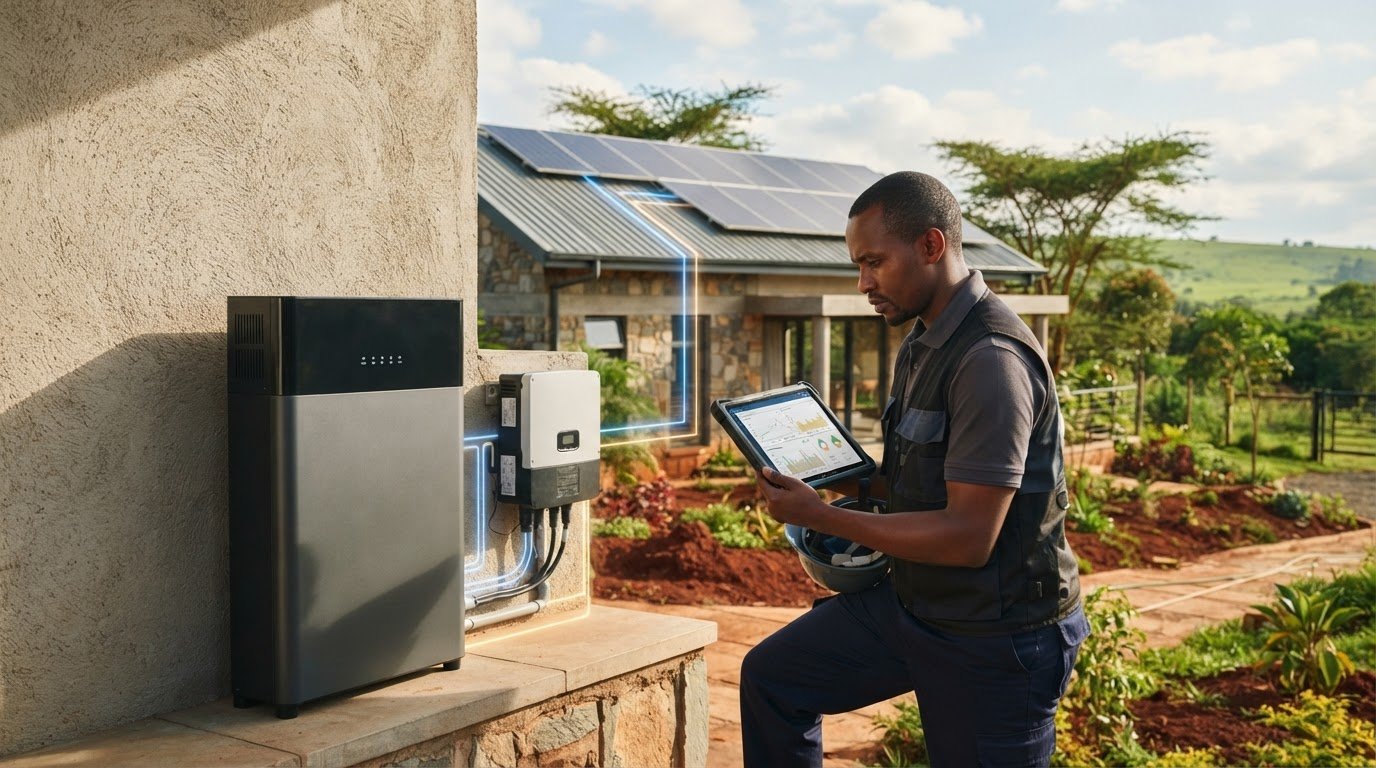
The battery with the highest capacity rating may not keep your essential equipment running for the hours you need. Knowing how to choose a solar battery starts with identifying which loads need backup, when they operate and how much energy they use. Rated capacity and usable energy are not the same, and the battery must also work with the inverter and the rest of the system.
Backup duration and total capacity are useful starting points, but comparing batteries on those figures alone can lead to a system that does not match your actual load profile or operating requirements.
This 2026 guide explains how to define critical loads and backup periods, compare battery technologies using consistent specifications, and check usable energy, inverter compatibility and operating priorities. It also outlines the information needed to size a system, including load data and site requirements. Solar Man Power Solutions Ltd designs and installs energy storage systems for homes, businesses, farms and institutions across Kenya, integrating battery selection with system design and installation. Use the steps below to define your requirements before comparing options.
Key Takeaways
- Identify whether your system is intended for backup, solar self-consumption, load shifting or off-grid operation. Each objective affects battery selection differently.
- Learn how to choose a solar battery by comparing technologies and specifications against your project’s operating requirements, not a single capacity figure.
- Use daily consumption and critical-load information to build a practical selection checklist instead of relying on a generic household estimate.
- Assess battery and inverter compatibility as part of the complete system design, including each component’s operating requirements.
- Use energy audits, site conditions and budget to inform an engineered battery and system design for your project.
How a solar battery supports power needs in Kenya
A solar battery stores electrical energy for later use, such as after sunset or when solar panels are not producing enough to meet demand. It does not generate electricity. Instead, it stores energy from a supply source and delivers it later, according to the system design and the loads connected to it. The overview of Home Energy Storage Systems describes this storage role across self-consumption, backup and off-grid applications.
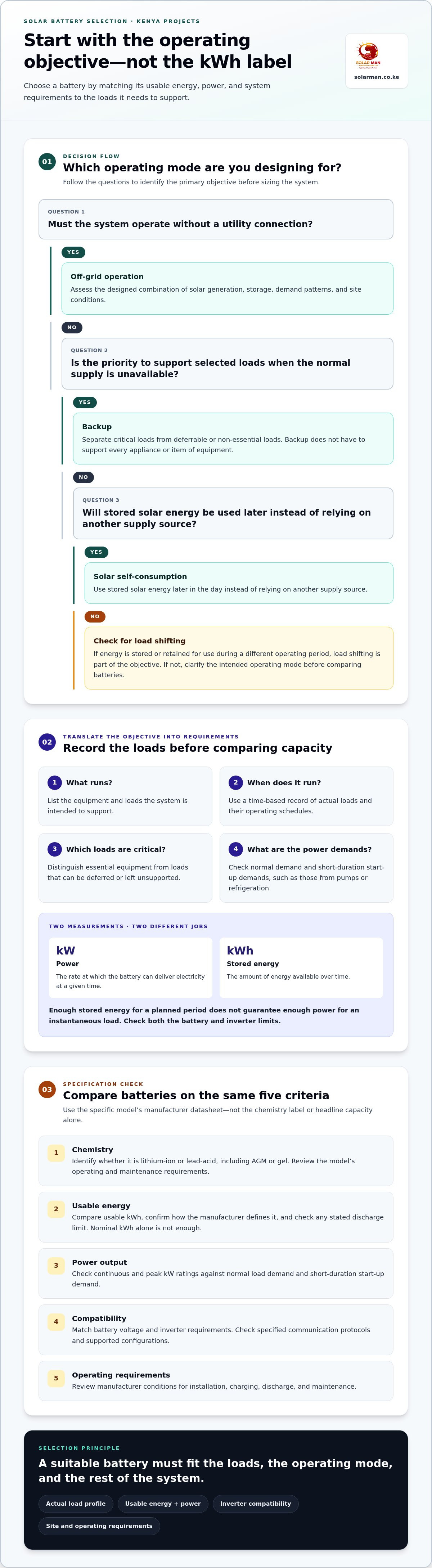
These operating objectives are related, but they are not interchangeable. Self-consumption uses stored solar energy later in the day instead of relying on another supply source. Backup prioritises selected loads when the normal supply is unavailable. Load shifting stores or retains energy for use during a different operating period. Off-grid operation relies on a designed combination of solar generation, storage and other system components without a utility connection. The intended operating mode affects both battery sizing and system configuration.
What does a solar battery do in a solar system?
When the solar panels are producing electricity, available power can serve connected loads and charge the battery. When production falls or demand exceeds generation, the battery discharges to supply the loads it is configured to support. A hybrid inverter coordinates power from the solar array, battery and other sources, such as the grid or a generator when included in the system design. Battery selection must therefore account for both the energy stored and the power the system needs to deliver.
Battery power, measured in kilowatts (kW), is the rate at which it can deliver electricity at a given time. Stored energy, measured in kilowatt-hours (kWh), is the amount available over time. A battery may store enough energy for the planned operating period but still be unable to supply a load whose instantaneous demand exceeds the battery or inverter limits.
Which applications may need battery storage?
Households may use stored solar energy for evening lighting, refrigeration, communications and other selected loads. Commercial sites, farms and institutions have different operating schedules and priorities. A business may need to maintain communications or security systems, while a farm may use equipment at specific times. These are examples, not a default list of loads. Record what runs, when it runs and which equipment must remain operational.
Backup does not necessarily mean supporting every appliance or piece of equipment. Separating critical loads from deferrable or non-essential ones helps define what the battery must supply during an outage. Pumps, refrigeration and other equipment may also have start-up demands that affect the required system power. An off-grid project needs a broader assessment of generation, storage, demand patterns and site conditions because it cannot rely on the grid as its routine supply.
Projects in Kenya vary in site conditions, grid connection and load profile, so a household assumption cannot reliably size a system for a farm, business or institution. To understand how to choose a solar battery, start with the operating objective and a time-based record of actual loads. That information links the battery’s energy and power requirements to the inverter and the wider system design.
Solar battery specifications and technologies that affect selection
Compare batteries against the same operating criteria rather than relying on headline capacity or a chemistry label. Manufacturer datasheets define usable energy, output limits, compatibility and installation conditions for each model. The U.S. Department of Energy’s Solar Energy Technologies and Storage resource provides broader context on solar technologies, while the battery’s own datasheet is the reference for its specifications.
Nominal kWh alone cannot determine whether a battery is suitable. It does not show how much energy is usable, how quickly the battery can deliver it or whether it is compatible with the system.
| Comparison criterion | What to assess |
|---|---|
| Chemistry | Identify whether the battery is lithium-ion or lead-acid, including AGM and gel variants. Review the model’s operating and maintenance requirements. |
| Usable energy | Compare usable kWh, not just nominal capacity. Confirm how the manufacturer defines usable energy and any stated discharge limit. |
| Power output | Check continuous and peak kW ratings against normal load demand and any short-duration start-up demand. |
| Compatibility | Match battery voltage and inverter requirements. Review any specified communication protocol or supported configuration. |
| Operating requirements | Review manufacturer limits and conditions for installation, charging, discharge and maintenance. |
How to compare lithium and lead-acid battery options
Lithium-ion, lead-acid, AGM and gel describe technology categories, not complete performance specifications. AGM and gel are lead-acid battery types, and exact requirements vary by model. Compare stated usable capacity, maintenance instructions, cycle-life data and installation conditions for the specific battery. Cycle-life figures need context, including the test conditions and discharge depth used. Do not assume one category always lasts longer, needs less attention or offers better value.
For a fair comparison, record each model’s nominal and usable energy, rated power, depth-of-discharge limit and specified operating conditions. Check whether a quoted cycle life applies to the discharge pattern you expect. These details help show whether the battery’s documented performance matches its intended use.
Which battery specifications matter most?
Capacity in kWh describes energy, while continuous and peak power ratings in kW describe the delivery rate. Depth of discharge indicates the portion of capacity the manufacturer permits the system to use. Do not treat nominal capacity as fully available energy or apply the same usable percentage to every model. Interpret each rating using the manufacturer’s definitions and limits.
A battery management system (BMS), where included, monitors and controls battery operation within the manufacturer’s specified limits. Inverter communication allows compatible equipment to exchange operating information and coordinate charging or discharge. Check that the battery and inverter support the required electrical configuration and communications. Matching voltage alone does not establish full compatibility.
These specifications make how to choose a solar battery a system-design decision, not just a chemistry comparison. Solar Man’s battery and inverter system design can account for energy needs, site conditions and equipment integration.
How to compare solar batteries for backup, self-consumption, or off-grid use
Choose a battery configuration to suit the system’s operating objective, not a general assumption about what a household or organisation needs. A household prioritising evening use may need a different charge and discharge pattern from a site protecting critical equipment during outages. Define the battery’s intended duty before comparing system options.
| Use case | Primary priority | Design consideration |
|---|---|---|
| Backup | Maintain selected loads when the usual supply is unavailable. | Identify essential circuits, their operating duration and power demand. |
| Solar self-consumption | Use solar energy when generation does not meet site demand. | Compare the timing of solar production with the site’s demand profile. |
| Load shifting | Move energy use between operating periods. | Assess when energy can be stored and when loads need to run. |
| Off-grid operation | Supply site loads without routine reliance on a grid connection. | Assess generation, demand schedules, seasonal conditions and contingency needs together. |
Choosing a battery for backup or critical operations
Start by listing the circuits that must remain operational, then separate them from loads that can be switched off or deferred. Estimate each critical load’s continuous demand and operating hours. For equipment with motors or compressors, account for start-up surges, which can exceed normal running demand. Backup duration depends on the supported loads and the battery’s available usable energy. The inverter’s output capability and system configuration also determine which loads can operate.
For example, a site may prioritise communications, security and selected refrigeration rather than trying to support every appliance or process. This prioritisation can substantially change the required energy and power profile. A battery’s stated capacity alone does not show how long it will supply those circuits, particularly if the inverter cannot meet their combined demand or surge requirements.
Choosing a battery for solar use or off-grid operation
For self-consumption, compare the hours of solar production with the hours when the site uses electricity. Storage may serve a different purpose at a site with high evening demand than at one with substantial daytime use. Load shifting also depends on the timing and flexibility of particular processes, not just total daily consumption.
Off-grid projects need a broader assessment. Include seasonal variation in solar generation, operating schedules, periods of higher demand and contingency requirements. More storage may support longer operating periods, but battery capacity cannot compensate indefinitely for insufficient generation or unmanaged demand. System design must balance generation, storage and load priorities without treating energy independence as guaranteed.
Do not assume grid services, export arrangements or tariff benefits as part of a battery’s value. In Kenya, any grid-connected operating arrangement depends on the applicable framework and project configuration. Base the battery comparison on verified, project-specific assumptions. A clear objective makes how to choose a solar battery a comparison of intended service, required power and usable energy, rather than a search for one configuration that fits every site.
A practical solar battery selection checklist for Kenyan projects
A sound selection starts with operating data, followed by equipment checks and a system-level design review. This sequence helps homeowners, businesses, farms and institutions turn actual site requirements into battery criteria without relying on a generic household estimate. Use the checklist to prepare project information. Detailed capacity calculations require a separate engineering assessment.
What project information should buyers gather?
Build a clear record of how the site uses electricity before comparing battery models. Daily consumption provides useful context, but it should be backed by load-level information: which equipment runs, when it operates and what must remain available during an outage. For an existing solar system, gather the installed equipment specifications too.
- Record consumption and operating periods. Collect available electricity-use records and list major loads with their operating hours. Note whether demand changes between weekdays, weekends or seasons.
- Identify critical loads. Separate equipment that must continue operating from loads that can be paused or switched off. Record each critical load’s normal demand and any relevant start-up surge.
- Define the required backup period. State how long selected loads need support and under what conditions. This defines the intended service instead of assuming every circuit needs backup.
- Document existing solar equipment. For a retrofit, record the array and inverter models, electrical ratings and current system configuration. These details inform integration and compatibility checks.
- Assess the site and future demand. Note available installation space, environmental conditions, access and other practical constraints. Include planned equipment additions or changes in operating schedules.
- Set the operating priority. Decide whether the project prioritises backup, solar self-consumption, load shifting or off-grid operation. This guides the criteria for comparing battery options.
- Review the complete design. Check that the selected battery, inverter and expected loads form a coherent system, with operating limits and installation conditions addressed.
For broader project context, the solar installation planning guide covers wider system-planning considerations relevant to Kenyan installations.
How to check battery and inverter compatibility
Compare battery voltage and configuration with the inverter’s supported battery range. Review communication requirements, including the specified protocol, and match continuous and peak power limits to the intended loads. Check charging, discharge and environmental operating limits against current manufacturer documentation for each component. Compatible nominal voltage alone does not establish that the equipment can operate together as designed.
Keep this checklist separate from final capacity calculations. A designer uses the load profile, required operating period, available solar generation and equipment limits to establish the system specification. Daily consumption alone is not a complete sizing method. Understanding how to choose a solar battery means assembling the right inputs before those calculations.
Solar Man Power Solutions Ltd provides energy audits, system design and installation for energy storage projects, with equipment selection shaped by energy needs, site conditions and budget. Plan a battery and inverter system around your project data and operating priorities.
How Solar Man approaches solar battery selection and system design
Solar Man Power Solutions Ltd treats battery selection as part of an engineered energy system, not an isolated product choice. The design considers energy needs, site conditions and budget alongside the project’s operating objective. This approach helps align storage with the solar PV array, inverter, electrical infrastructure and loads the system is intended to support.
From load assessment to an integrated storage design
An energy audit and load profile provide a basis for establishing system requirements. The assessment considers which equipment operates, when demand occurs and which loads take priority. For a home, the operating profile may centre on evening consumption or selected backup circuits. A commercial site, farm or institution may have scheduled processes, equipment start-up demands or critical systems that need a different operating plan.
Solar Man’s design and installation work coordinates energy storage with solar PV generation, inverter operation and site electrical infrastructure. This whole-system view helps determine how the components work together, rather than selecting a battery by headline capacity alone. Hybrid, grid-tied and off-grid projects have different supply arrangements, so the system configuration follows the intended mode of operation.
Solar Man’s listed battery options include the Vestwoods 5.12kWh 48V 100Ah Lithium Battery and the uHome 5.1kW Solid-State Lithium-ion Battery – (LFP 5120M). These are examples of available battery products, not universal recommendations. Assess usable energy, power limits, cycle-life conditions and inverter compatibility against current manufacturer documentation and the specific system design.
What to expect from a Solar Man project discussion
Useful project information makes the design discussion more precise. Prepare available records and details on:
- Energy use: daily consumption, major equipment and typical operating hours.
- Backup objectives: critical loads, required operating periods and equipment that can be deferred.
- Site conditions: installation space, relevant environmental factors and practical constraints.
- Existing equipment: solar array, inverter and electrical system details for a retrofit project.
- Future plans: anticipated changes in loads, site use or operating schedules.
Solar Man’s qualified technicians use energy needs, site conditions and budget to shape project-specific system design. The design is tailored to the site and its requirements rather than based on a standard battery choice. Solar Man also provides installation, energy audits, monitoring, maintenance and system upgrades, supporting projects from initial assessment through system integration.
For an engineered assessment of your project’s storage requirements, discuss a solar storage system with Solar Man.
Move from battery options to a project-ready design
The next step is to turn your operating priorities into a clear project brief. Use actual load information, backup objectives and existing equipment details to guide the design discussion, then assess the proposed system against your site constraints and budget. This keeps how to choose a solar battery focused on a practical outcome: storage that fits how your home, business, farm or institution operates.
Solar Man can turn that brief into a project-specific solar and storage design, supported by energy audits, system design, installation, monitoring and maintenance. The right configuration depends on your requirements, not a standard battery recommendation.
Discuss a project-specific solar storage system with Solar Man and take the next step toward a design aligned with your operating needs.
Frequently Asked Questions
How do I choose the right solar battery for my needs?
To understand how to choose a solar battery, define which loads it must support, when they operate and the backup period required. Compare usable capacity, power output, chemistry, operating limits and inverter compatibility against those needs. For a Kenyan home, business, farm or institution, account for site conditions and the wider solar design. Review current product documentation instead of selecting by nominal capacity or brand name alone.
What size solar battery do I need for my home or business?
Battery size depends on the energy used by selected loads during the period they need support, as well as system losses and equipment limits. Separate essential equipment from discretionary loads before estimating capacity. For example, a business that needs only its network equipment and security system during an outage has a different requirement from one that also needs refrigeration. Use actual consumption and operating schedules, not a generic household estimate, and check the result against inverter specifications.
Is a lithium battery better than a lead-acid solar battery?
Neither chemistry is automatically the best choice for every project. Compare usable capacity, discharge limits, maintenance instructions, cycle-life test conditions, power ratings, operating environment and inverter compatibility. Products can differ substantially within lithium-ion and lead-acid categories, including AGM and gel types. For a fair comparison, review current manufacturer datasheets and check that the stated performance applies to the intended use. Assess the complete system requirements instead of relying on the chemistry label alone.
Can any solar battery work with any hybrid inverter?
No. Compatibility depends on electrical parameters and, in some systems, communication between the battery management system and inverter. Check the voltage range, charging and discharge limits, communication protocol, firmware requirements and manufacturer compatibility documentation. A battery that appears suitable by capacity alone may not meet the inverter’s operating requirements. Before purchasing or connecting equipment, review the complete configuration against current documentation for each component, including any specified battery settings.
How long can a solar battery provide backup power?
Backup duration depends on usable battery energy, the power drawn by connected loads, inverter limits and system configuration. A battery supplying lights and communications will have a different runtime from one supplying refrigeration or other high-demand equipment. List the circuits to be backed up and their expected operating schedules to make a useful estimate. Nominal capacity alone cannot determine runtime. A reliable estimate needs project-specific load and performance data.
Do I need solar panels to use a solar battery?
Not necessarily, but the battery needs compatible equipment and a defined charging source. In a solar PV system, panels can charge storage during generation. Some hybrid configurations can also use another supply source, subject to system design and equipment settings. An off-grid installation needs coordinated generation and storage planning around the site’s loads. Treat the battery as one part of the electrical system, and establish its charging method and operating role before selecting it.
How do I know whether a solar battery is suitable for a Kenyan project?
Assess the project’s load profile, backup objective, site conditions, existing equipment and available solar generation. Use current manufacturer documentation for the battery and inverter, and account for applicable installation requirements for the project. Do not apply foreign rebates, tariffs or regulatory claims to Kenya without confirming their relevance. A household and an institution with similar nominal battery capacity may still need different system designs because their loads, schedules and site conditions differ.