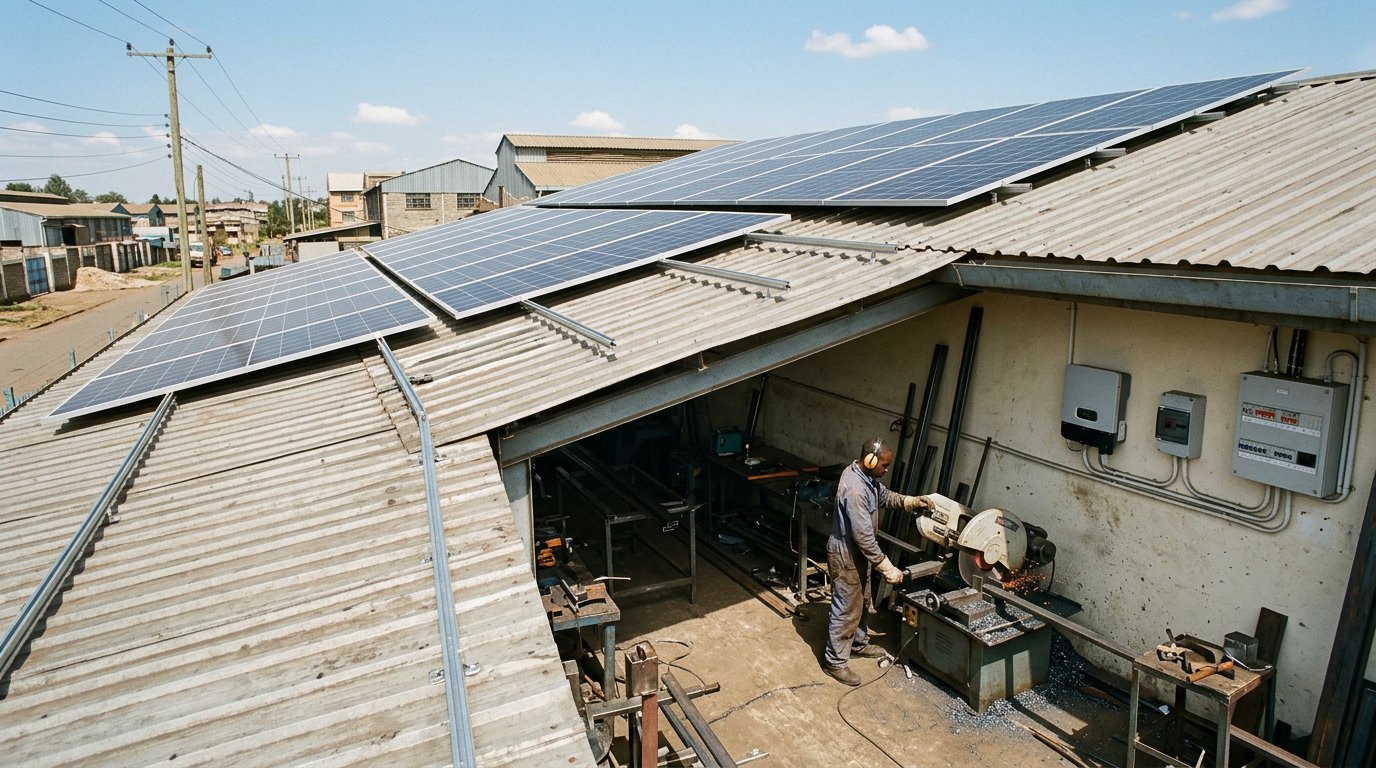
A grid-tied solar system in Kenya connects your property’s solar generation to the utility supply, without battery storage. A hybrid system adds batteries. The right configuration depends on when you use electricity and whether selected loads must stay powered during grid outages.
To assess potential savings, consider not only how much solar power the system generates, but also how much you can use on site. This guide compares grid-tied and hybrid systems, explains how capacity relates to energy use, and outlines the grid-connection considerations for Kenyan homes and businesses.
Key Takeaways
- Estimate payback using the electricity your system can offset during daylight hours, then account for any reduction in generator use.
- Compare a grid-tied design with a hybrid system by weighing lower equipment needs against your requirement for power backup.
- Use your energy consumption and site conditions to understand why system capacity affects the final installation scope.
- Factor Kenya Power interconnection and approval requirements into project planning for a grid-connected installation.
Electricity bill and diesel-generator savings
Grid-tied solar can reduce the electricity you draw from Kenya Power while panels supply your property during daylight. Residential solar payback in Kenya is estimated at 3-5 years against the 2026 KPLC tariff. Excess electricity compensation should not be assumed: count export credits or payments only where your applicable arrangement provides them.
Kenya Power Bill Savings
Savings on a Kenya Power bill come from using electricity generated on site instead of drawing it from the grid. The benefit depends on whether your electricity demand coincides with solar production. For example, a home that runs a water pump or laundry equipment during daylight can use solar power directly. A business can assess its regular daytime loads in the same way.
Compare electricity use by time of day, not just by monthly consumption. When solar production exceeds demand, surplus power may be exported rather than used on site. When demand exceeds production, the property continues drawing electricity from Kenya Power. This helps explain why similar systems can produce different bill savings at different properties.
Excess Solar Compensation and Payback
Excess solar compensation means receiving a credit or payment for electricity exported to the grid. In 2026, do not include export income in your payback estimate unless your applicable arrangement provides for it. This keeps projected returns focused on the electricity your property uses directly, rather than assuming surplus generation will be compensated.
Payback compares the period needed for savings to match the installation’s expected benefits. The residential estimate is 3-5 years against the 2026 KPLC tariff, but your own period depends on system output and direct solar use. Generator use adds another factor: when solar serves daytime loads that would otherwise run on a diesel generator, reduced generator operating hours can add to the benefit. The effect depends on your operating schedule and which loads solar can supply.
For a practical energy review, distinguish three outcomes: electricity from Kenya Power avoided, generator use reduced, and surplus electricity exported. Assess each against how your property operates. A household using appliances during the day and a business running equipment through daylight hours may see different savings, even with comparable solar generation.
Grid-tied and hybrid system equipment and backup
Grid-tied and hybrid systems differ in their equipment and how they respond to interruptions in Kenya Power supply. Compare what each configuration does, especially whether your property needs stored electricity to power selected loads.
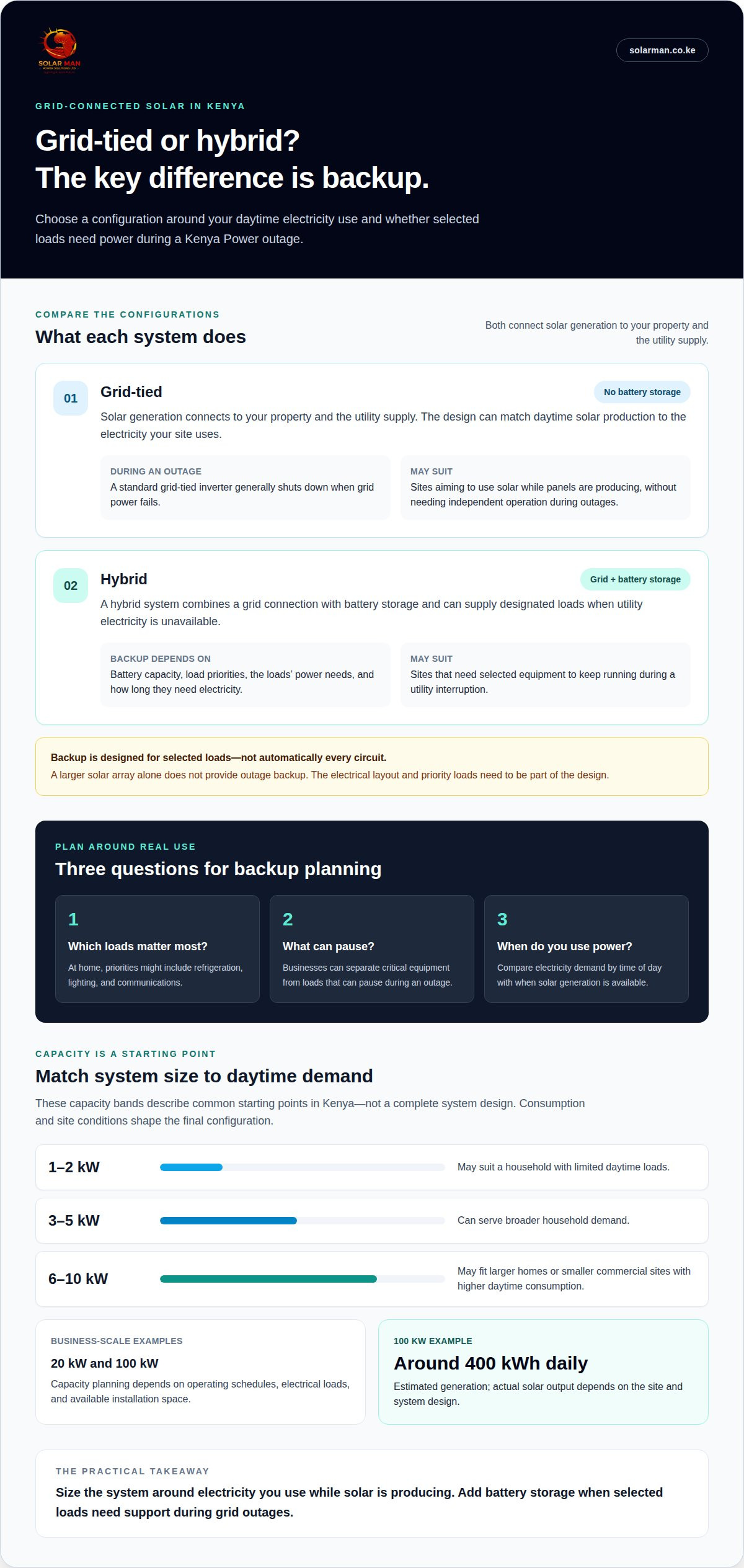
A grid-tied system connects solar generation to your property and the utility supply, without battery storage. Its design can match daytime generation to the electricity your site uses. It can suit properties aiming to use solar power while panels are producing, where solar does not need to operate independently during grid outages.
A hybrid system combines a grid connection with battery storage. It can support selected loads when utility electricity is unavailable, depending on battery capacity and load priorities. At home, priority circuits might include refrigeration, lighting, and communications. A business can separate critical equipment from loads that can pause during an outage.
The configuration also determines how the system operates during outages. A standard grid-tied inverter generally shuts down when grid power fails. A hybrid system can supply designated loads through its storage. Neither setup automatically backs up every circuit: the design must account for the loads, how long they need power, and the property’s electrical layout.
Consider how your site uses electricity across a normal day, which equipment must remain available, and how it is supplied during outages. Those requirements clarify whether a grid-connected arrangement or storage-backed hybrid design is more suitable. A solar system design can translate those operating needs into a defined system configuration.
Grid-tied system prices by capacity
Capacity gives you a useful starting point for understanding a grid-tied system’s scope. In Kenya, installations are commonly grouped into 1-2 kW, 3-5 kW, and 6-10 kW bands. These labels describe system size, not a complete design: your daytime electricity use and site conditions determine the final configuration. A 2026 grid-tied solar system cost estimate in Kenya therefore needs to reflect the planned installation, not capacity alone.
A 1-2 kW system may suit a household with limited daytime loads, while a 3-5 kW installation can serve broader household demand. A 6-10 kW system may fit larger homes or smaller commercial sites with higher daytime consumption. For businesses, a 20 kW or 100 kW project requires capacity planning around operating schedules, electrical loads, and available installation space.
The 100 kW example also shows why capacity alone does not determine value: such a system is estimated to generate around 400 kWh daily. Actual solar output depends on the site and system design, while savings depend on how much electricity the property uses as generation occurs. A suitable capacity should reflect consumption rather than an assumed panel count.
Outages affect the value of a grid-tied design because a standard grid-tied inverter may shut down when utility power fails. A larger array does not, by itself, provide backup during outages. If continuity matters, the design must address backup loads separately. For a well-designed solar system in Kenya, the estimated payback is 4-6 years, depending on use and project configuration.
The grid-tied solar system cost in Kenya for 2026 depends on capacity, solar panel selection, mounting arrangement, electrical protection, site conditions, and installation scope. Roof structure and access can also affect the work involved. The exact figure is provided in a quote tailored to your case, rather than inferred from capacity alone.
For a useful comparison, match the proposed system capacity to your daytime consumption and the equipment you need to run. This clarifies whether you need a grid-tied system to reduce electricity purchases or a design that also supports essential loads during outages.
What Kenya Power rules and approvals apply to grid-tied solar systems in 2026?
Grid connection planning in Kenya involves distinguishing a system that serves on-site loads from one that may export electricity. Under the EPRA Electricity Market, Bulk Supply and Open Access Regulations 2026, large Kenyan electricity users can contract with a third-party solar developer. This provision concerns eligible users and supply arrangements, not an automatic export credit for every rooftop installation.
A standard grid-tied project’s technical design should identify the property’s connection point, existing supply arrangement, proposed solar capacity, and expected operating pattern. These details help determine how the inverter will connect to the site’s electrical infrastructure. Homes and commercial facilities can have different distribution layouts, load profiles, and operating requirements.
Plan for what happens during a Kenya Power outage. A grid-tied inverter is generally configured to stop supplying electricity when the grid is unavailable, so do not assume the system provides backup. If critical circuits must stay powered, that requirement changes the design and needs to be addressed separately from the grid connection.
For a project that may export surplus electricity, treat export arrangements as a separate matter from equipment installation. The 2026 open-access provision specifically refers to large electricity users contracting with third-party solar developers. It does not establish that every residential customer receives payment or bill credits for excess generation.
Before installation, the engineering scope should specify the proposed connection, protection equipment, isolation points, and system testing. These design and commissioning details support safe integration with the property’s electrical supply. The coordination required depends on the site’s connection arrangement and project scope, so a general capacity range cannot determine the applicable process.
For commercial users considering an open-access supply arrangement, the relevant 2026 regulations provide a framework for contracting with a third-party solar developer. A conventional rooftop grid-tied installation and a contracted supply arrangement are distinct project models. Define which model applies before assessing interconnection, export, and operational requirements.
Solar Man Power Solutions: Hybrid, Grid-Tied & Off-Grid Solar Solutions
Solar Man Power Solutions Ltd designs and installs grid-tied, hybrid, and off-grid solar systems for homes and businesses. The team can match a system to your electricity use, site conditions, and backup requirements. Solar PV System Design & Installation covers planning and implementation, while Energy Storage Systems (ESS) can be included when the design requires stored electricity.
If your priority is reducing daytime grid consumption, a grid-tied design may suit your needs. If selected loads must stay powered during outages, a hybrid configuration with storage and Power Backup & Critical Systems may be more appropriate. Choose based on how you use electricity and which equipment needs to remain operational.
Contact Solar Man Power Solutions Ltd to discuss the solar configuration that fits your property and operating requirements.
Plan the right solar configuration for your property
The decision is not simply how much solar capacity to install. Consider how the system should fit your operating pattern, electrical infrastructure, and continuity requirements. A clear project brief identifies which loads run during daylight, what must remain available during outages, and whether battery storage belongs in the design.
Use that information to assess whether a grid-tied solar system suits your requirements for 2026, based on its intended role rather than capacity alone. Solar Man Power Solutions Ltd’s engineering team can develop Solar PV System Design & Installation around those project requirements, incorporating Energy Storage Systems where storage is part of the solution. This gives you a defined basis for moving from general estimates to a site-specific design.
When you are ready to develop the requirements for your property, contact Solar Man Power Solutions Ltd to discuss the next step. A well-defined design brief is a practical starting point for a solar project that fits your needs.
Frequently Asked Questions
How long does it take for solar panels to pay for themselves in Kenya?
Residential solar payback is estimated at 3-5 years against Kenya’s 2026 KPLC tariff. Your result depends on the share of solar electricity used on site and the project’s installation scope. For a household, daytime use of appliances such as a water pump or washing machine can affect how much grid electricity solar offsets. Generator use may also affect savings where solar reduces operating hours.
How much does a 5kW solar system cost in Kenya in 2026?
A single figure for a 5kW system would not reflect the different equipment and work required at each property. The total depends on whether the design is grid-tied or hybrid, whether it includes battery storage, and the site’s mounting and electrical requirements. For your specific installation, the exact figure is provided in a quote based on the system design and site conditions.
What else should you budget for?
Plan for the full installation scope, not just the panels and inverter. Depending on the property, the design may also require mounting, electrical protection, cabling, and work to integrate the system with existing infrastructure. Include battery storage if you need stored electricity or backup for selected loads. A site assessment helps identify what your installation requires.
What affects the price?
System capacity, equipment selection, roof or ground mounting conditions, and the complexity of connecting to existing electrical infrastructure all affect the estimate. Battery storage and backup needs change the configuration compared with a grid-tied system without batteries. Daytime consumption also informs system sizing. A site-specific quote reflects the chosen design and work required at your property.
What is the installed cost of a grid-tied solar system in Kenya in 2026?
The installed cost depends on system capacity, panel and inverter selection, mounting conditions, electrical protection, and installation requirements. A grid-tied system without storage has a different equipment scope from one that includes batteries. Roof access and existing electrical infrastructure also affect the work, so assess the complete installation scope using a quote prepared for your property.
What are typical 1 kW, 3 kW, 5 kW, and 10 kW grid-tied solar prices in Kenya?
These capacities represent different project sizes, but prices depend on the specified equipment and installation scope. A 1 kW design may serve a smaller set of daytime loads than a 10 kW system. For each capacity, the estimate also depends on site conditions, mounting requirements, and electrical integration. The exact figure for your selected capacity is provided in a case-specific quote.
Disclaimer
**Disclaimer**
The information published on this website is provided by Solar Man Power Solutions Ltd for general informational and educational purposes relating to solar energy, renewable energy systems, power backup, energy storage and related technologies.
While we make every effort to ensure that the information is accurate, reliable and up to date, product specifications, technical details, prices, availability and system configurations may change without prior notice. Information provided in our articles, guides and product descriptions should not be considered a substitute for a professional site assessment, technical evaluation or customized quotation.
**Solar System Performance:** Actual solar system performance, energy generation, battery backup duration and savings depend on several factors, including geographical location, weather conditions, equipment specifications, installation quality, energy consumption patterns and system maintenance. Any performance figures or estimated savings are indicative and are not guaranteed results.
**Product Information:** Product images, descriptions, specifications and technical information are provided for reference. Manufacturers may update product designs, specifications and features from time to time.
**Pricing and Quotations:** Prices, promotions and product availability displayed on this website are subject to change. Final project costs and system recommendations are determined following an assessment of the customer's requirements and site conditions.
**Professional Installation:** Solar installations and electrical systems should be designed, installed and commissioned by appropriately qualified professionals in accordance with applicable Kenyan laws, regulations and technical standards.
**External Links:** This website may contain links to third-party websites for additional information. Solar Man Power Solutions Ltd is not responsible for the content, accuracy or privacy practices of external websites.
By using this website, you acknowledge that the information provided is for general guidance and that any purchasing, installation or investment decision should be based on appropriate professional advice and an assessment of your specific requirements.
For technical assistance, product enquiries, quotations or professional solar energy solutions, please contact Solar Man Power Solutions Ltd through our official communication channels.
**Solar Man Power Solutions Ltd**
Reliable Solar & Energy Storage Solutions for East Africa.
Website: https://solarman.co.ke