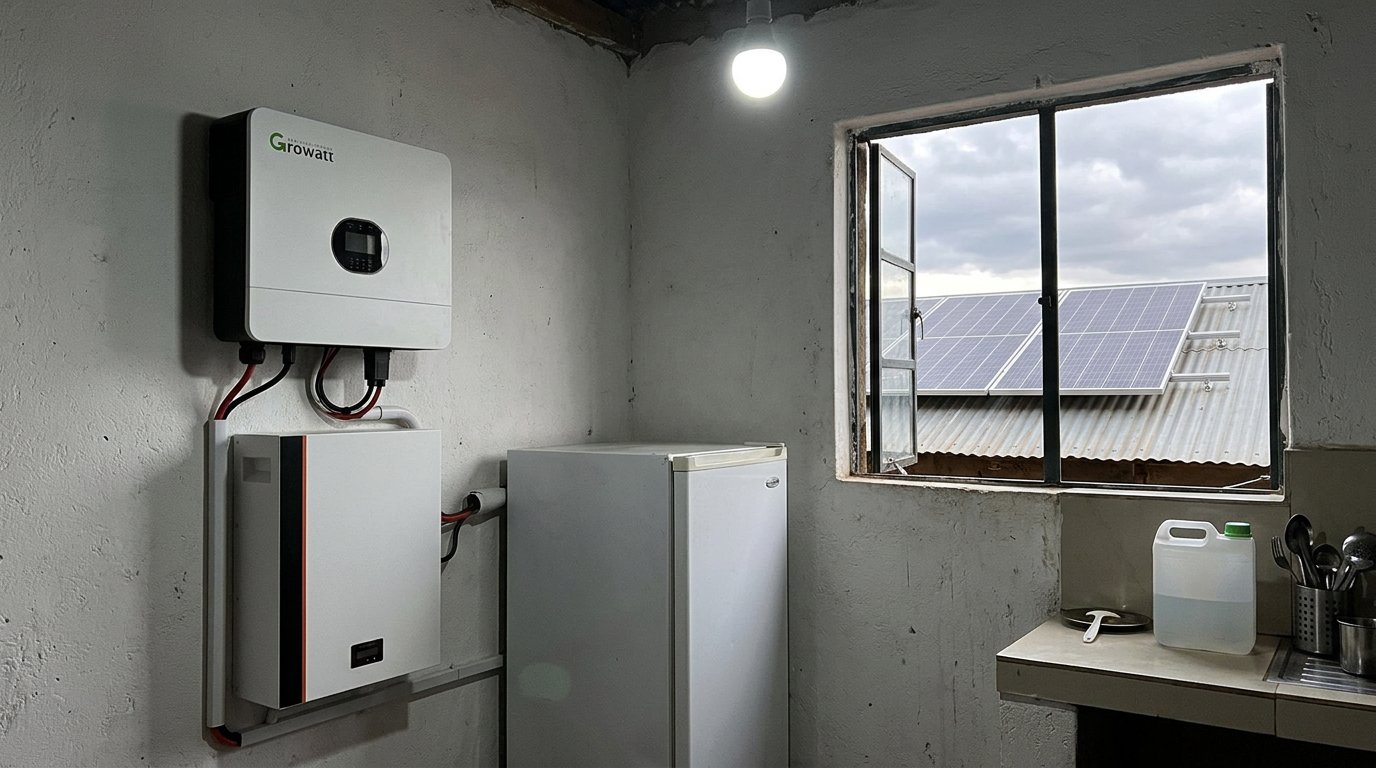
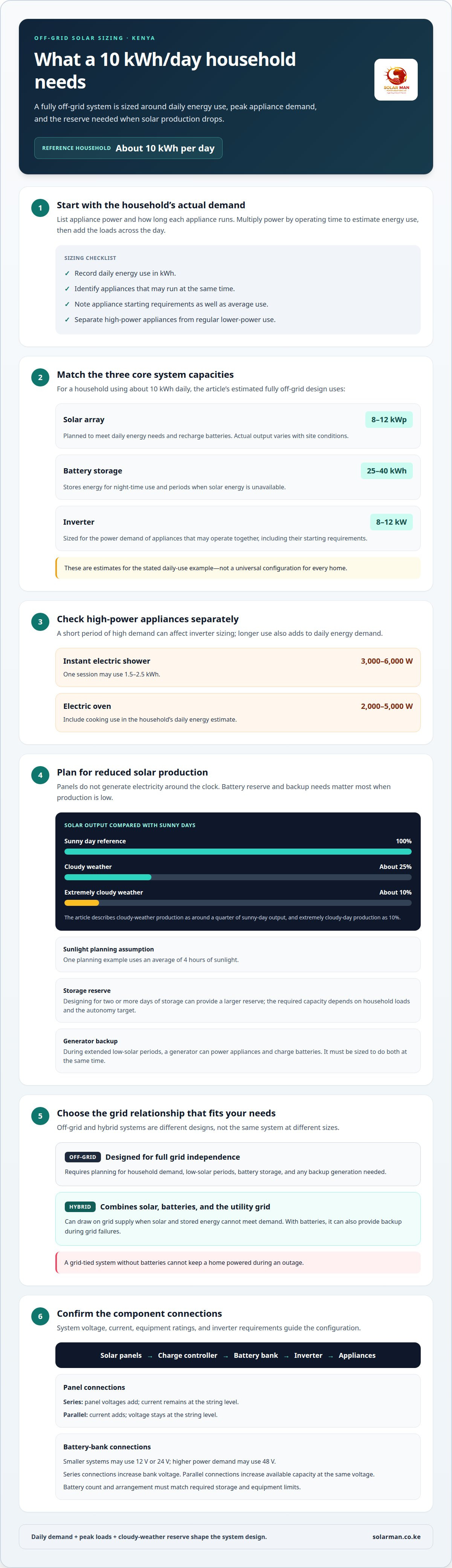
For a Kenyan household using about 10 kWh per day, a fully off-grid system is estimated to require an 8 to 12 kWp solar array, 25 to 40 kWh of battery storage, and an 8 to 12 kW inverter; an 80–90% hybrid system is a different design, not simply a smaller version.
Because solar panels do not generate electricity around the clock, battery capacity must cover demand at night and during cloudy weather, while the array must meet daily energy needs. Sizing off-grid solar systems involves more than counting panels.
This guide explains how to calculate daily demand, account for high-power appliances, and understand how panels, batteries, the charge controller, and inverter work together. It also compares off-grid and hybrid setups to help you choose the arrangement that fits your energy needs and desired level of grid independence.
Key Takeaways
- Assess cloudy-weather production and backup needs when deciding how much battery storage an independent system requires.
- Use daily appliance energy demand and peak loads to guide solar array, battery, and inverter sizing.
- Series and parallel connections affect system voltage and current, so component configuration must match the system design.
- Compare grid independence with the backup flexibility of a hybrid setup, then consider professional design and installation for your needs.
Off-Grid Solar in Kenya: Is 100% Independence Necessary?
Complete grid independence can be useful when utility supply is unavailable, but it requires planning for periods with little or no solar production. In Kenya, cloudy-weather output, household demand, battery storage, and backup generation all influence the design.
Cloudy Weather and Backup Needs
Cloudy-weather planning means sizing solar panels and batteries for reduced production as well as normal daily demand. Solar panels may produce around a quarter as much electricity in cloudy weather as on sunny days, and 10% on extremely cloudy days. Batteries supply appliances when solar energy is unavailable, including at night. A design for two or more days of storage can provide a larger reserve, but the required capacity depends on the household’s loads and autonomy target.
A backup generator can power appliances and charge batteries during extended periods of low solar production. Its capacity must be sufficient to do both at the same time.
Hybrid Solar and Backup Systems
A hybrid solar system combines solar panels and batteries with the utility grid, drawing on grid supply when solar and stored energy cannot meet demand. With battery storage, it can also provide backup during grid failures. A grid-tied system without batteries cannot keep a home powered during an outage. For households seeking partial independence, a hybrid system can reduce reliance on grid supply without requiring the same reserve as a fully off-grid design.
Applicable permits and standards depend on the system design, installation site, and grid connection. Identify relevant Kenyan electrical and site requirements in the project plan before installation.
System Requirements and Configuration
No single configuration suits every Kenyan household. Daily energy demand, desired backup duration, solar array capacity, battery storage, and site conditions determine the equipment and installation scope. A remote home without grid access may need a larger energy reserve and generator than a hybrid system. These requirements shape the project design, rather than fitting a universal system size.
Solar Man Power Solutions does not offer solar financing or loans. Government incentives or grants should not be assumed as part of a project plan; technical requirements remain based on household demand, cloudy-period backup, and available grid supply.
How professionals size an off-grid solar system for your daily energy demand
Professional sizing starts with actual electricity use, then matches the solar panels, battery storage, and inverter capacity to your needs. Daily energy consumption and peak power demand guide the design.
Inverter sizing and power demand: what a professional assesses
Inverter sizing matches the equipment’s output to the loads you may operate simultaneously. A professional reviews appliance ratings and starting requirements, not only average daily consumption. For a household using about 10 kWh daily, an estimated fully off-grid design uses an 8 to 12 kW inverter. This capacity must align with the system’s other components and the expected operating pattern.
What a professional assesses when sizing solar panels
Solar panel sizing estimates how much electricity the array must produce to serve demand and recharge batteries. A professional considers daily consumption, available sunlight, site conditions, and the energy reserve required. One planning assumption uses an average of 4 hours of sunlight. For a household using about 10 kWh daily, an estimated fully off-grid array is 8 to 12 kWp. Actual output varies with conditions at the installation site.
How a professional estimates the panels and batteries needed for household appliances
A professional estimates appliance energy by multiplying each appliance’s power rating by its operating time. The resulting watt-hours help show how loads add up across a day. For a 10 kWh daily household, the estimated fully off-grid battery storage is 25 to 40 kWh. The required panel count depends on each panel’s rating; the array is therefore specified in kWp, rather than by count alone.
Appliance choices change the calculation. An instant electric shower draws 3,000 to 6,000 watts, and one session may use 1.5 to 2.5 kWh. An electric oven draws 2,000 to 5,000 watts while cooking. These loads can influence inverter capacity and daily energy demand, so the assessment distinguishes high-power appliances from regular lower-power use.
To align panel, battery, and inverter specifications with your usage, consider professional solar system design.
How professionals connect off-grid solar system components in series and parallel
An off-grid solar system uses solar panels, a charge controller, a battery bank, and an inverter to power appliances. The panels generate electricity, the controller manages battery charging, and stored energy supplies loads when solar production falls.
A professional selects series or parallel connections according to component ratings, system voltage and current, and inverter requirements. In a series connection, panel voltages add while current remains at the string level. In parallel, current adds while voltage stays at the string level. The array layout must match the charge controller’s operating range and the inverter design.
Battery banks also need a planned configuration. Smaller systems may use 12 V or 24 V, while structures with higher power demand may use 48 V. Series connections increase bank voltage; parallel connections increase available capacity at the same voltage. The number and arrangement of batteries must match the required storage and equipment limits.
Professional installation coordinates the electrical path from the array to appliances, including protective equipment, correctly sized cables, and secure connections. The charge controller should be connected to the battery before the solar panels, allowing it to calibrate. System testing then checks that all components work together safely and correctly.
Lithium and lead-acid batteries are not interchangeable without checking system compatibility. The right type depends on usable capacity, charging profile, maintenance needs, operating conditions, and compatibility with the inverter and controller. Lithium is not automatically the best choice for every installation; the design must meet the household’s operating requirements.
For either battery chemistry, professionals assess efficiency, charge limits, and how appliances draw power throughout the day. The resulting configuration determines how much renewable energy can be stored and delivered. Series and parallel wiring are design choices, not universal rules; the system structure and component specifications determine the right arrangement.
Off-grid and hybrid solar system differences
The main difference is the available energy source. A fully off-grid installation operates independently of the national grid, so its solar array and battery bank must meet demand without utility supply. A hybrid system connects solar panels and battery storage to the grid, providing another supply option when solar production or stored energy falls short.
In an off-grid system, solar energy powers appliances first, and surplus production charges the battery bank. Once the batteries are full, charging stops. At night or during cloudy periods, appliances draw on stored energy. If prolonged low production uses up the battery reserve, a backup generator can power loads and charge the batteries. This arrangement suits locations without grid access, but requires careful planning for reserve capacity and generator use.
A hybrid system can draw from the grid when solar and batteries cannot meet demand. Battery capacity still matters: a hybrid setup may be designed to supply energy for 5 to 10 hours overnight, depending on the application. During a grid failure, a hybrid system with batteries can provide backup power. Solar panels without battery storage cannot keep a home powered during an outage.
Grid-tied solar serves a different purpose. It connects panels to the utility grid, and surplus electricity can be sent to the grid. Without batteries, a grid-tied system cannot power household lights during an outage. It may suit a property focused on using solar while remaining grid-connected, but it does not provide the independent supply of an off-grid or battery-backed hybrid system.
Choose a system based on grid access and the continuity your household needs. A remote property may require fully off-grid operation and generator backup. A grid-connected home that needs outage support may suit a hybrid design. If maintaining a grid connection matters more than independence, grid-tied solar may be more appropriate. These differences shape installation requirements and the role of each energy source; expected savings depend on the system and how it is used.
For a system matched to your grid access and backup requirements, request solar system design and installation.
Solar Man Power Solutions: Hybrid, Grid-Tied & Off-Grid Solar Solutions
Solar Man Power Solutions designs and installs hybrid, grid-tied, and off-grid solar solutions for households and organizations. Its Solar PV System Design & Installation service accounts for the site, daily energy demand, and intended level of grid independence.
Turn to the team for a professionally designed system, energy storage, or backup power for critical loads. Energy Storage Systems (ESS) and Power Backup & Critical Systems can help manage stored solar energy and backup needs. The right configuration depends on whether your site requires independent operation, a grid connection, or a hybrid arrangement.
Contact Solar Man Power Solutions to discuss your solar system requirements.
Plan a system around the way you use power
Consider how your energy needs may change over time. New appliances, expanded operations, or different backup requirements can affect the system you need. Include expected changes in the design brief alongside your current load profile, site conditions, and preferred level of grid connection. This keeps the system aligned with actual use rather than a single snapshot of demand.
Planning off-grid solar systems means balancing independence, stored energy, and available backup. Solar Man Power Solutions Ltd provides Solar PV System Design & Installation, Energy Storage Systems (ESS), and hybrid, grid-tied, and off-grid solar solutions. Its engineering team can shape a system design around your property or facility’s operating requirements.
Bring your priorities and energy-use information into the next planning discussion. Contact Solar Man Power Solutions Ltd to discuss a suitable direction for your project.
Frequently Asked Questions
Can I completely eliminate my KPLC bill with solar?
Whether you can avoid buying grid electricity depends on your system design and whether it can meet your needs when solar production is low. If you keep a grid connection, electricity drawn from it may still appear on your bill. When estimating likely grid use, review the connection arrangement and how the system handles periods of low solar production.
What is the biggest planning mistake for an independent solar setup?
A common design mistake is sizing a system around average household consumption while overlooking brief periods of high, simultaneous use. For example, an electric shower and cooking appliance running together can create a higher peak load than either appliance alone. A load profile should capture both daily energy use and the appliances likely to run at the same time.
What size solar setup do I need for my home in Kenya?
Your appliance schedule, daily consumption, peak loads, and preferred backup duration determine the capacity you need. A household that uses electric cooking or water heating has a different load profile from one using gas for those tasks. Provide an accurate appliance list and typical usage patterns so the design reflects your home, not a generic assumption.
Which solar brands and installers are suitable for homes in Kenya?
Suitability depends on whether the equipment works together and meets your household’s needs. Solar Man Power Solutions offers TBB Riiosun II and Sunsynk LYNKS hybrid inverters, alongside Vestwoods lithium batteries. When planning an installation, assess whether the design accounts for your loads, site conditions, and backup priorities, and includes testing of the installed equipment.
How does independent solar compare with grid-tied and hybrid solar?
An off-grid setup suits properties without grid supply or where grid reliance must be reduced. Grid-tied solar remains connected to the utility, while a hybrid arrangement combines grid connection with solar and battery storage. The practical difference is how the property receives electricity when solar production is low or utility supply is unavailable.
How do professionals choose, install, and maintain a solar setup, and what should you expect?
Professionals use your energy-use information and site conditions to develop the design, then install and configure the selected equipment. Commissioning includes testing the equipment and connections. Ongoing care may involve inspections, troubleshooting, performance monitoring, or upgrades as your usage changes. Support accurate planning by sharing appliance details and identifying essential loads that need backup.