A 400 W solar panel can charge a 200 Ah battery, but those ratings alone cannot show whether the system will meet your needs; a sound solar battery capacity calculation also accounts for battery voltage, energy use, charging conditions and system losses.
A professional sizes storage by multiplying the energy your selected loads use each day by the required backup days, then dividing by the battery’s usable depth of discharge and system efficiency. For example, a household using 5 kWh daily and seeking 2 days of autonomy with an 80% depth of discharge needs a 12.5 kWh battery bank before any additional design adjustments.
Learn what information goes into a solar battery capacity calculation, how essential loads and backup duration affect the result, and why nominal capacity differs from usable capacity. This guide also explains how storage goals and site conditions in Kenya shape the design, helping you assess whether a proposed battery size suits your backup needs.
Key Takeaways
- Identify the circuits and appliances that must stay powered, then base the estimate on their energy use and operating schedule.
- Account for depth of discharge and battery efficiency to distinguish usable energy from the battery’s rated capacity.
- Set backup duration according to your power needs and whether the system is grid-tied or off-grid.
- Match storage to your goal, such as essential-load backup, whole-home coverage or using surplus solar energy later.
How does a professional calculate the required capacity of a home battery?
A professional begins with your appliances’ energy use, required backup duration and battery limits. The estimate also accounts for demand, conversion losses and seasonal solar conditions.
How a Professional Estimates Daily Appliance Energy Use
1. Provide the appliance list and typical operating schedule for each load. The professional estimates daily energy by multiplying each appliance’s wattage by its hours of use, then totals the results. For example, a 60 W device used for 7 hours consumes 420 Wh daily. Avoid using appliance wattage alone, because operating duration changes actual consumption.
How a Professional Calculates Backup Energy Needs
2. Identify which circuits need backup and for how long. The professional multiplies their daily energy use by the required backup days to determine usable energy, then adjusts for battery efficiency and system losses. A 1,000 W critical load running for five hours requires 5 kWh of usable energy. Peak power also matters: refrigerator, pump and air-conditioner motors can draw start-up surges 3-7 times their running wattage.
How a Professional Converts Energy From Wh to Ah
3. Match the required energy to the battery-bank voltage. Convert watt-hours to amp-hours by dividing Wh by volts: a 24 kWh bank at 48 volts equals 500 Ah. For compatibility, the professional checks the inverter’s battery voltage range, current limits and supported battery configuration against the battery specifications. Capacity in Ah alone does not establish compatibility.
Account for Efficiency and Future Needs
4. Include conversion losses and expected changes in household demand. A 10% allowance for charge and inverter losses can inform lithium-bank sizing, while efficiency and usable capacity vary by system design. For Kenya, local peak sun hours are typically estimated at 3-6 hours daily, with fewer in winter and more in summer. Seasonal output affects recharge planning, not just stored capacity. The professional also considers future appliances and checks safe installation conditions and applicable battery warranty terms. Reduce demand through efficient lighting and controlled standby loads, but retain essential circuits in the calculation.
Adjusting nominal battery capacity for depth of discharge
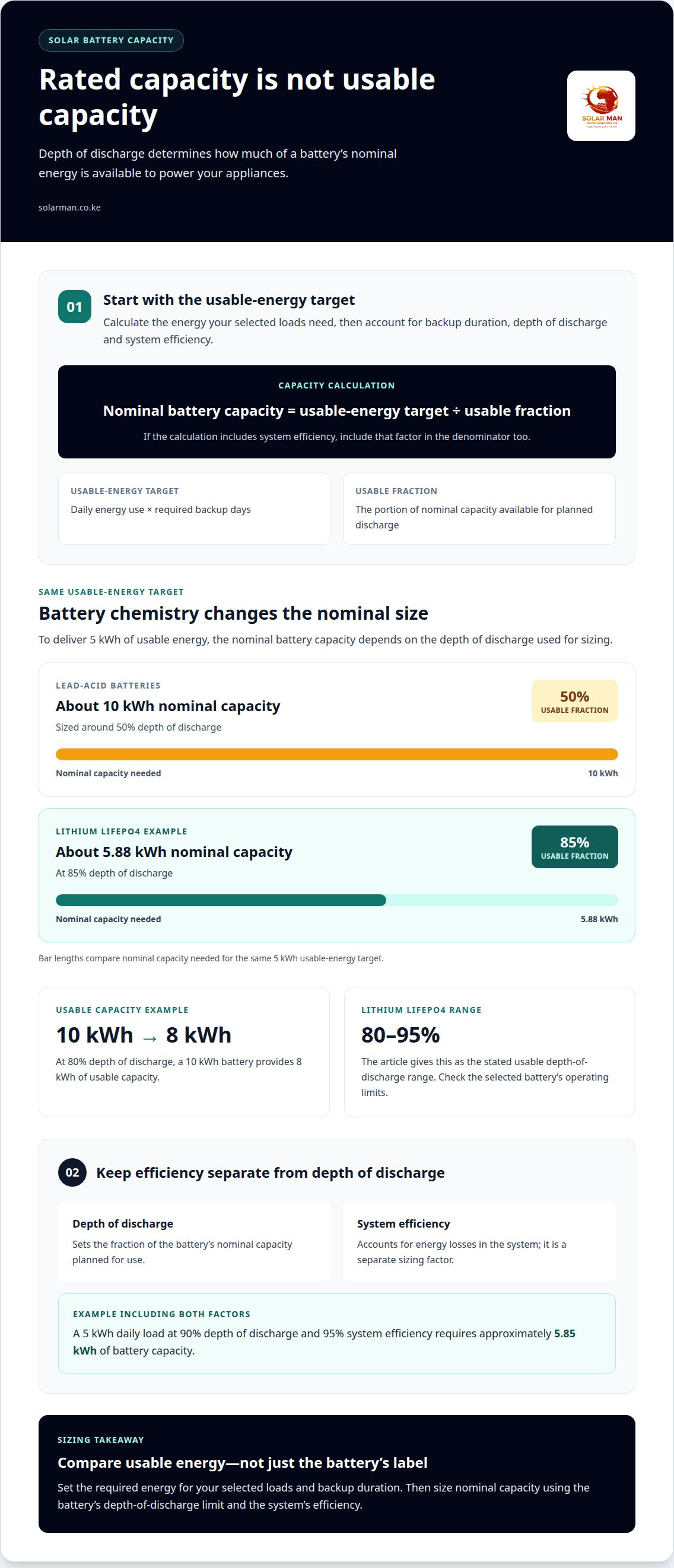
Rated capacity is not the same as usable energy. Depth of discharge determines how much stored electricity the system can draw to power appliances.
How a Professional Calculates Storage From Depth of Discharge
- Set the usable-energy target, then divide it by the depth of discharge expressed as a decimal. For example, a 10 kWh daily requirement needs 12.5 kWh of lithium storage at 80% usable depth of discharge. If the calculation also accounts for system efficiency, include that factor in the denominator. A 5 kWh daily load at 90% depth of discharge and 95% system efficiency requires approximately 5.85 kWh of battery capacity.
How a Professional Determines Usable Battery Capacity
- Compare the battery’s nominal rating with the fraction available for discharge. At 80% depth of discharge, a 10 kWh battery stores 8 kWh of usable capacity, leaving the remaining capacity outside the planned discharge. This distinction matters when your critical appliances need a defined amount of electricity. The professional checks the usable-energy target against the battery rating, rather than treating the full nominal figure as available.
Compare Depth of Discharge by Battery Type
- Specify the battery chemistry before applying a depth-of-discharge assumption. Lithium LiFePO4 batteries have a stated usable depth of discharge of 80-95%, while flooded and sealed lead-acid batteries are commonly sized around 50%. Therefore, a 5 kWh usable-energy requirement at 50% depth of discharge corresponds to about 10 kWh nominal capacity. A 5 kWh usable requirement at 85% corresponds to about 5.88 kWh nominal capacity. Check the selected battery’s operating limits.
Keep battery efficiency separate from depth of discharge: one accounts for energy losses, the other sets the usable fraction. For project-specific battery capacity planning, consider both figures alongside the load profile.
Backup loads and days of autonomy
Battery autonomy is how long your solar system can power selected loads without charging input. Size storage around essential circuits and the interruption duration you need to cover.
- Define which loads must keep running during an outage. Separate critical circuits, such as refrigeration, communications and essential lighting, from appliances that can remain off. A common recommendation is 1-3 days of critical-load use. This approach limits the battery design to required backup functions instead of assuming every appliance operates throughout an outage.
- Set autonomy according to the system’s operating role. For grid-tied systems with battery backup, 8-24 hours of autonomy for essential circuits is described as typical. Off-grid systems may be designed for 3-5 days during rainy or cloudy weather. These are distinct planning contexts, not interchangeable targets; longer autonomy requires more stored energy for the same daily load.
- Account for periods when solar production cannot replenish the battery. Off-grid planning commonly uses 3-5 days of autonomy based on average daily consumption. Northern or cloudy regions may call for 1.5 to 2 times more storage to buffer days with little sun. The design therefore considers both stored energy and expected charging conditions, rather than panel output alone.
- Check that the battery and inverter can support the selected backup circuits. Battery voltage must match the system design, and its discharge capability must support loads running at the same time. Even with enough stored energy, a system can fall short if the inverter cannot supply the combined demand. Professionals assess load priorities, backup duration, charging, solar production and voltage together.
Choosing a battery size based on storage goals
Choose storage based on the outcome you need, not the battery’s nominal rating alone. Daily energy use, solar production and inverter requirements all affect the estimate.
- Define the storage goal before selecting a capacity. Essential-load backup has a different profile from whole-home backup or shifting solar energy for later use. A 5-10 kWh battery is recommended for essential loads, while whole-home backup is described as requiring 20 kWh or more. These are planning ranges, not substitutes for load analysis.
- For a grid-tied home, determine whether storage will shift usage or cover outages. Households seeking time-of-use peak shifting are commonly paired with 10-13.5 kWh of battery capacity. The professional compares this target with daily energy consumption and the amount of electricity available for storage, rather than sizing only from total appliance use.
- For a solar system, compare battery capacity with array output and usable surplus. A suggested starting range is 1 to 1.5 kWh of storage per kWp of solar panels. A 5 kW array producing about 20 kWh daily is described as pairing well with 10-20 kWh of storage. Actual sizing still depends on when loads run and how much production remains after daytime use.
- For time-of-use optimization, size the battery around daily excess solar production. A suggested target is 50%-80% of that surplus. This aligns storage with energy available to charge it, rather than assuming the battery can store all daily generation. The inverter and battery configuration must also support the intended operating pattern. For a tailored storage assessment, request solar system design support.
Solar Man Power Solutions
Solar Man Power Solutions Ltd translates your load profile and backup goals into a coordinated solar and storage design. Its Solar PV System Design & Installation and Energy Storage Systems (ESS) services address battery sizing as part of the complete system, rather than treating capacity as an isolated figure.
This approach helps align essential circuits, autonomy, battery depth of discharge, inverter compatibility and expected solar production. Whether you need a grid-tied, hybrid or off-grid system, the design considers how it will operate and which loads it must support. Share your appliance schedule, preferred backup duration and details of existing equipment to inform the assessment.
For a residential, commercial or institutional project, contact Solar Man Power Solutions Ltd to discuss your battery sizing requirements.
Plan your storage around future operation
Use the solar battery capacity calculation as a design baseline, then record the system’s performance in operation. After commissioning, note which circuits take priority during an outage and whether routines change. This record can inform future system reviews as your needs evolve.
For a home or facility, document significant changes in equipment use and backup priorities before planning an upgrade. Keeping these decisions in one operating record gives future design work a clear reference and helps maintain continuity as requirements change.
Solar Man Power Solutions Ltd’s team supports solar system design and installation. Discuss your project’s next design step.
Frequently Asked Questions
Can a 400W solar panel charge a 200Ah battery?
Yes, a 400 W panel can charge a 200 Ah battery if the charging equipment and voltage are compatible, but those ratings alone cannot predict recharge time. At 48 V, 200 Ah represents 9.6 kWh of nominal storage. A professional also accounts for battery state of charge, panel output under site conditions, controller limits and energy used simultaneously.
How does a professional determine how many solar batteries your house needs?
Battery quantity is a configuration decision, not simply a matter of total storage. An installer checks the inverter’s battery voltage, each battery’s usable energy and the supported series or parallel arrangement. These checks show whether the system can be assembled to meet its electrical requirements. Usable kilowatt-hours alone do not determine how many batteries can be connected in a compatible bank.
How long will a 10kWh solar battery last?
A 10 kWh battery’s runtime depends on usable capacity and the total load drawing power. The rating describes stored energy, not a fixed duration. Several appliances running together draw energy faster than a small, intermittent load. Runtime also depends on conversion losses and the battery’s operating limits. An estimate in hours needs the actual connected load profile.
What information should you provide to start designing your solar battery system?
Provide recent electricity bills, site operating priorities and details of planned equipment additions. Include model numbers for existing panels, inverter, charge controller and battery. Wiring diagrams or installation photographs can help clarify how the components connect. This information lets the designer assess integration and expansion constraints instead of treating a new battery as an isolated component.
Why Correct Solar Battery Calculation is Critical?
Accurate sizing helps align the battery, inverter and charging equipment with the system’s operating requirements. A design that treats all rated storage as available can overstate the energy supplied to loads. Overlooking a component’s limits can also prevent the system from operating as intended. A sound calculation supports coordinated equipment selection and realistic operating expectations.
How does a professional calculate solar battery capacity from your daily energy use in kWh?
A professional converts daily consumption into a reserve target by multiplying it by the required backup days, then adjusts for battery limits and system efficiency. For example, 420 Wh daily consumption over 3 backup days equals 1260 Wh of reserve energy. The final nominal capacity must account for the selected battery’s usable fraction and conversion losses.